

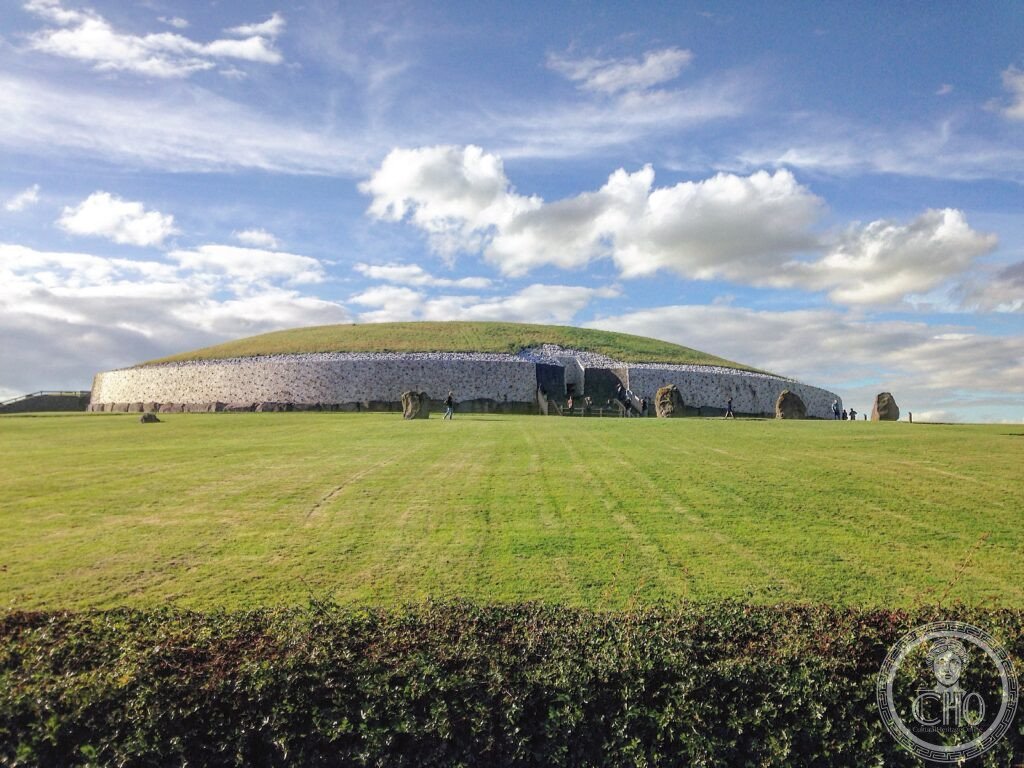
Newgrange is a Neolithic passage tomb built centuries before the Egyptian pyramids and Stonehenge, famous for a roof-box that channels the winter solstice sunrise the length of its passage to illuminate the central chamber. The alignment, rediscovered in 1967, remains one of the most precise astronomical features known from prehistory.
At a glance
Newgrange stands in County Meath beside the River Boyne, part of the Brú na Bóinne complex that also includes the passage tombs of Knowth and Dowth. The mound is roughly 85 metres across and 13.5 metres high, faced with white quartz that was recovered during excavation and partially restored to the front facade. A single entrance leads into a 19-metre passage ending in a cross-shaped chamber roofed by a corbelled vault.
The monument is best known for the alignment of its roof-box, a purpose-built aperture above the entrance lintel that admits sunlight only around the winter solstice, when it travels the length of the passage to strike the back of the chamber.
Key facts
- Type: Neolithic passage tomb, part of the Brú na Bóinne UNESCO World Heritage Site
- Built: around 3200–3100 BCE
- Dimensions: approximately 85 metres in diameter and 13.5 metres high
- Passage and chamber: a 19-metre passage leading to a cruciform chamber with a 6.1-metre corbelled vault
- Famous feature: the triple spiral carved on the back stone of the chamber, among the earliest known uses of the motif
- Coordinates: 53.6947° N, 6.4759° W (approximate)
History
Newgrange was built and used for around five centuries, from roughly 3200 to 2700 BCE, for purposes that combined burial, ritual and astronomical observance. It was then deliberately sealed, its entrance blocked, and left undisturbed for millennia. In 1142 Cistercian monks from Mellifont Abbey were granted the surrounding lands for farming, and the site passed through Anglo-Norman and later landholdings under the name New Grange.
In 1699 the landowner Charles Campbell had workers digging for building stone break through the blocked entrance, leading to the first documented modern discovery of the chamber. Antiquarian visits followed over the following century, including a description by Sir William Wilde, father of Oscar Wilde, in 1849. The first full scientific excavation was carried out between 1962 and 1975 by Michael J. O’Kelly, Professor of Archaeology at University College Cork.
In 1967, during that excavation, O’Kelly became the first person in roughly 4,500 years to witness the winter solstice sunrise entering the roof-box and travelling the passage to the chamber, a discovery later verified by survey to occur within a narrow window of days around the solstice. Newgrange and the wider Brú na Bóinne complex were inscribed as a UNESCO World Heritage Site in 1993.
What you see
Visitors approach the mound past its restored white quartz facade before entering the passage, which narrows toward the chamber and requires stooping in places. The passage is about 19 metres long, roughly 90 centimetres wide at points and 1.8 metres high near the entrance. It opens into a corbelled central chamber standing 6.1 metres high, built without mortar by setting each ring of stones slightly inward from the one below until they close at the top. The vault has remained watertight for around five thousand years without repair.
Above the entrance, the roof-box, a small aperture roughly 25 by 25 centimetres, is positioned to admit sunlight only around the winter solstice. Inside the chamber, three recesses radiate from the centre, each containing a large stone basin thought to have held cremated remains. The back stone of the chamber, known as C10, bears the carved triple spiral, one of the most reproduced prehistoric images in the world. Around the main mound lie the remains of smaller satellite tombs.
Practical information
- Access: Newgrange can only be visited as part of a guided tour departing from the Brú na Bóinne Visitor Centre; there is no direct public access to the mound.
- Booking: advance booking is recommended, particularly in summer, through the visitor centre’s official channels.
- Winter solstice viewing: places to witness the solstice light event from inside the chamber are allocated through an annual lottery run by the Office of Public Works; details are available from the OPW.
Getting there
All visits to Newgrange are organised through the Brú na Bóinne Visitor Centre near Donore, County Meath, which also manages access to the neighbouring tomb of Knowth. There is no independent entry to the monument itself.
Nearby
- Knowth — a major passage tomb within the same Brú na Bóinne complex, reached from the same visitor centre.
- Dowth — the third of the principal Brú na Bóinne passage tombs.
- Satellite tombs (Sites A, B and C) — smaller passage tombs standing near the main Newgrange mound.
Sources
- UNESCO
- Office of Public Works (OPW) Ireland
- University College Cork
Find it on the map
See this place and what’s around it →📷 Become a Cultural Heritage Online photographer
Share your photos of places: they stay published under your name as the author. The more they're seen, the more you get noticed — and soon a contest will reward the most appreciated photos.
Log in or sign up free to add a photoIs this page about you?
This page is read by travellers and heritage enthusiasts who find it on Google. Tell us how you are connected to this place and we will take it from there.