

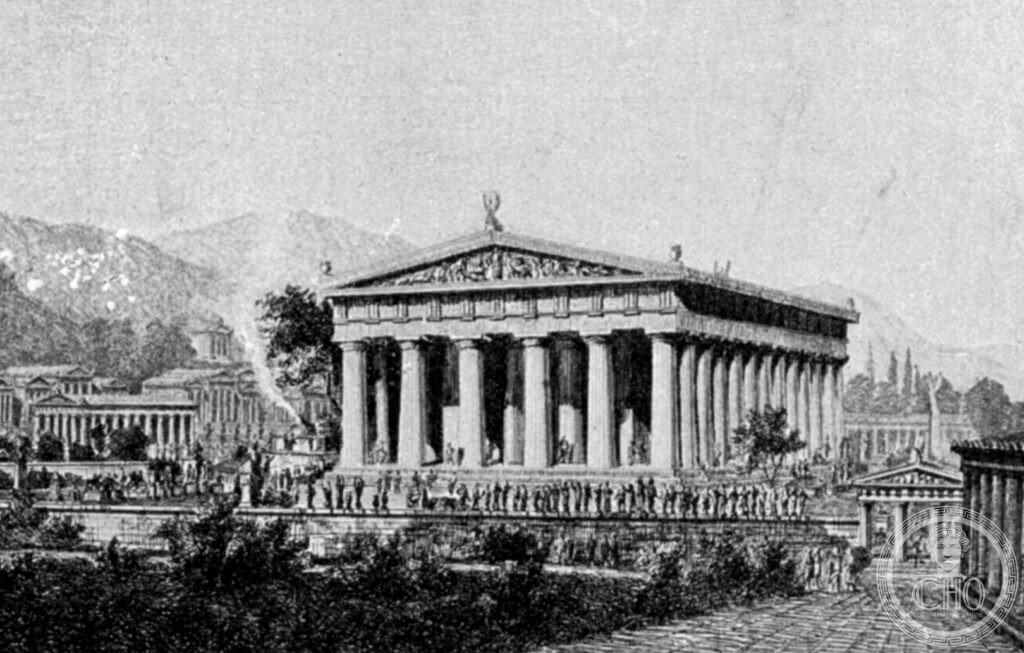
Ancient Olympia was the sanctuary where the Panhellenic Games were held every four years for over a thousand years, and the home of Phidias’s chryselephantine Statue of Zeus, one of the Seven Wonders of the Ancient World. Buried under river silt for centuries, its ruins and the workshop where the statue was made were only recovered through German excavation.
At a glance
Ancient Olympia lies in Elis, in the Peloponnese, and was one of the most sacred sanctuaries of the Greek world. It hosted the Panhellenic Games from 776 BCE until 393 CE, a run of nearly 1,170 years and 293 Olympiads, and held the Statue of Zeus by Phidias, one of the Seven Wonders of the Ancient World. The site is inscribed as a UNESCO World Heritage Site.
At its heart stands the Altis, the sacred grove enclosed within a roughly 200 by 200 metre precinct, containing the Temple of Zeus, the Temple of Hera, the treasuries, the Pelopion, the Prytaneion and the Philippeion, along with numerous bronze tripods and statues.
Key facts
- Founding date of the Games: 776 BCE, with Koroibos of Elis recorded as the first champion, winner of the stadion race over roughly 192 metres.
- Temple of Zeus: built 470–456 BCE in the Doric order, with 6 by 13 columns originally 10.5 metres high; it housed the Statue of Zeus by Phidias.
- Temple of Hera: built around 600 BCE, one of the oldest surviving Doric temples in the world.
- End of the Games: banned by Emperor Theodosius I in 393 CE, after the 293rd Olympiad; pagan sanctuaries were ordered closed around 426 CE by Theodosius II.
- Destruction and rediscovery: the site was largely destroyed by an earthquake around 551 CE, then buried under several metres of river silt; it was identified in 1766 CE by the British antiquarian Richard Chandler and systematically excavated from 1875 by the German Archaeological Institute.
- Recognition: designated a UNESCO World Heritage Site in 1989.
History
Olympia grew from an early cult site into the great sanctuary of the Panhellenic Games, with a major building programme in the seventh and sixth centuries BCE. The Temple of Hera, raised around 600 BCE, is among the oldest Doric temples known. Individual Greek city-states built their own treasuries within the Altis as national showcases of wealth and piety. After the Persian Wars, the Temple of Zeus was built between 470 and 456 BCE under the architect Libon of Elis, and around 435 BCE Phidias created the great chryselephantine Statue of Zeus in a purpose-built workshop south of the Altis.
The Games themselves ran on a four-year cycle that became a basis for Greek timekeeping, continuing until Emperor Theodosius I banned them in 393 CE after the 168th Olympiad. Around 426 CE, Theodosius II ordered the closure of pagan temples, and a Byzantine church was later built over the site of Phidias’s workshop. Earthquakes around 550–551 CE destroyed most of the standing structures, and subsequent flooding from the rivers Alpheus and Kladeos buried the sanctuary under several metres of silt, hiding it entirely through the medieval period.
The site was identified again in 1766 by the British antiquarian Richard Chandler, and first excavated in 1829 by the French Expédition de Morée, whose team removed the metopes of the Temple of Zeus to the Louvre. Systematic excavation began in 1875 under the German Archaeological Institute, funded by Kaiser Wilhelm I, and has continued intermittently ever since. The modern Olympic Games were revived in Athens in 1896, inspired by the French historian Pierre de Coubertin. The Olympic flame ceremony, using a parabolic mirror on the steps of the Temple of Hera, was introduced for the 1936 Berlin Games and has been held at Olympia before every Summer Olympics since.
What you see
Visitors walk through the Altis, the sacred enclosure holding the ruins of the Temple of Zeus, where fallen column drums remain stacked as the earthquake of 551 CE left them, alongside one re-erected column from the 1875 German excavation. The temple’s metopes are now divided between the Acropolis Museum in Athens and the Louvre in Paris. The Temple of Hera, built around 600 BCE, is the best preserved building on the site, with sixteen columns still standing or their bases visible.
The Philippeion, a round tholos raised by Philip II of Macedon after the Battle of Chaeronea in 338 BCE, once held chryselephantine statues of Philip, Alexander and the Macedonian royal family, said to be the first instance of mortals depicted alongside the divine within the same building. The Prytaneion held the eternal sacred flame, and the Bouleuterion was where athletes swore the Olympic oath before a statue of Zeus Horkios. The Stadium, entered through a tunnel, took its present form in the fifth century BCE and held around 45,000 spectators, who sat on grass embankments rather than stone seating, with only judges given stone seats.
The Archaeological Museum of Olympia holds finds from the site, including the marble Hermes attributed to Praxiteles, found in 1877 and considered one of the finest surviving original Greek statues, the Nike of Paionios, a terracotta model of the Statue of Zeus, and tools and clay moulds recovered from Phidias’s workshop.
Practical information
- What to see together: the Altis, the Stadium and the Archaeological Museum of Olympia are usually visited as a single circuit.
- Opening arrangements: visiting hours and admission are set by the Greek Ministry of Culture and the local ephorate of antiquities; check official channels before travelling.
- On-site facilities: the museum sits close to the excavated sanctuary and displays the principal finds, including material from Phidias’s workshop.
Getting there
Ancient Olympia lies in the Elis regional unit of the Peloponnese, near the confluence of the rivers Alpheus and Kladeos. It is best reached by road from other Peloponnesian towns; travellers should consult current transport schedules and routes through official or local tourism channels.
Nearby
- Archaeological Museum of Olympia — on the edge of the ancient site, holding the Hermes attributed to Praxiteles and finds from Phidias’s workshop.
- Rivers Alpheus and Kladeos — the watercourses whose flooding buried the ancient sanctuary under silt for centuries.
Sources
- UNESCO
- German Archaeological Institute
- Strabo
- Pausanias
- Dio Chrysostom
- Richard Chandler, Ionian Antiquities
Find it on the map
See this place and what’s around it →
📷 Become a Cultural Heritage Online photographer
Share your photos of places: they stay published under your name as the author. The more they're seen, the more you get noticed — and soon a contest will reward the most appreciated photos.
Log in or sign up free to add a photo