
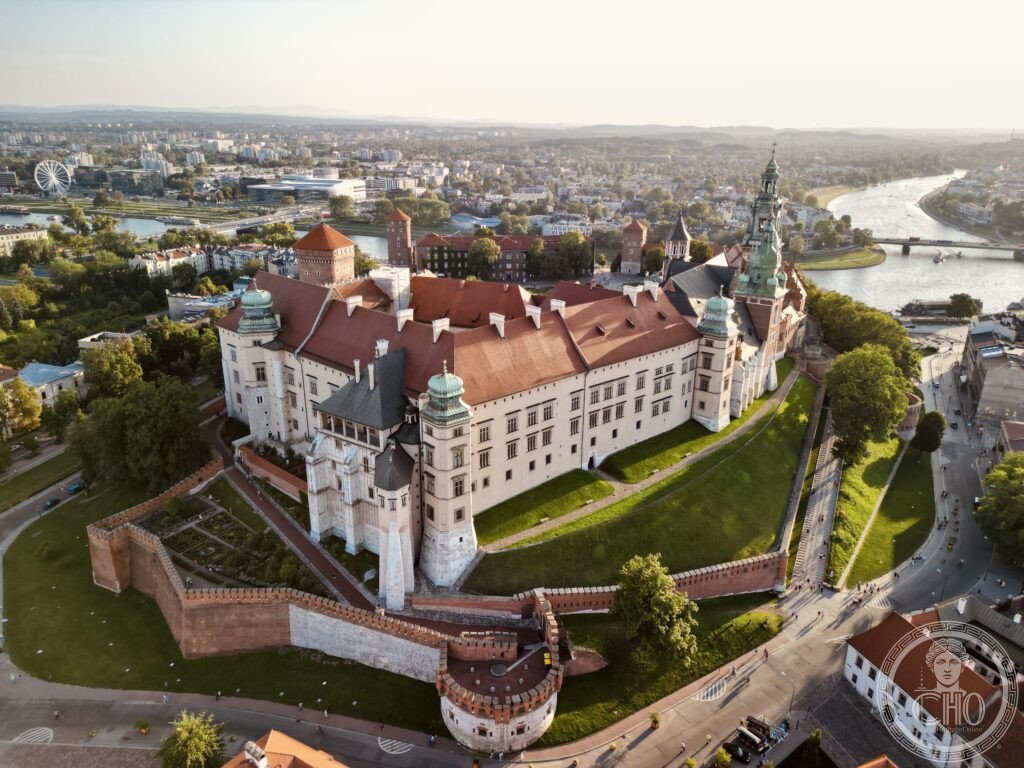
Kraków was Poland’s royal capital for over five centuries and is the only major Central European city whose Gothic and Renaissance core survived the Second World War intact. Its Wawel Hill complex, market square and Jewish quarter of Kazimierz together form one continuous historic fabric, rare on this scale anywhere in Europe.
At a glance
Kraków served as the seat of Polish kings from 1038 until 1596, when Sigismund III Vasa moved the court to Warsaw, though the city kept its role as coronation site and royal necropolis. Forty-five Polish kings and queens are buried in Wawel Cathedral. The old town, the Wawel hill and the former Jewish district of Kazimierz remain largely as they were built, making Kraków the best-preserved medieval city centre in Central Europe.
The city sits on the Vistula River, with Wawel Hill, a limestone outcrop rising above the water, forming its historic natural fortification. Legend places a dragon’s den in a cave beneath the hill, tied to the founding myth of the city by Krak.
Key facts
- Status: UNESCO World Heritage Site, inscribed in 1978.
- Royal capital: Seat of the Polish crown from 1038 to 1596.
- Wawel Cathedral: Coronation and burial church of Polish kings, built 1320–1364.
- Jagiellonian University: Founded in 1364 by Casimir the Great, re-endowed in 1400 by Queen Jadwiga; Nicolaus Copernicus studied there from 1491 to 1495.
- Rynek Główny: The largest medieval market square surviving in Europe.
- Lady with an Ermine: Leonardo da Vinci’s portrait of Cecilia Gallerani, held in the Czartoryski Museum.
History
Kraków rose to prominence under the Piast dynasty and became the political heart of the kingdom that Casimir the Great rebuilt in stone during the fourteenth century. Under the Jagiellonian dynasty, established through Jadwiga’s marriage in 1386, the city stood at the centre of a union stretching from the Baltic to the Black Sea, and by the mid-sixteenth century Poland-Lithuania was the largest state in Europe. The Union of Lublin in 1569 created a joint Commonwealth with its own parliament, the Sejm, though Kraków’s political primacy ended in 1596 when Sigismund III Vasa relocated the capital to Warsaw.
The city was sacked during the Swedish invasion known as the Deluge in 1655, and its fortunes declined further with the Partitions of Poland between 1772 and 1795, when Russia, Prussia and Austria erased the country from the map; Kraków fell within Austrian Galicia. Poland was restored as an independent state in 1918, only for Nazi Germany to occupy it in September 1939. The Germans made Kraków the capital of the General Government, with Hans Frank governing from Wawel Castle itself.
Unlike Warsaw, which was almost entirely levelled, Kraków survived the war with its historic fabric intact. Because the Nazis had made the city their own administrative seat, they had reason not to destroy it, and the rapid Soviet liberation in January 1945 left German forces no time to carry out demolition orders before withdrawing. This unusual survival is the main reason the historic centre was inscribed as a UNESCO World Heritage Site in 1978.
What you see
The Rynek Główny is dominated by St Mary’s Basilica, a fourteenth-century Gothic church with two asymmetric towers; from the taller one a bugle call, the hejnał, is sounded on the hour and broken off mid-note, recalling a medieval trumpeter said to have been struck by a Mongol arrow while sounding the alarm. Nearby stands the Town Hall Tower, the only surviving fragment of a town hall demolished in the nineteenth century.
On Wawel Hill, the Royal Castle groups a Gothic core with a Renaissance courtyard built for Sigismund I by the Italian architect Bartolommeo Berrecci, considered the finest of its kind in Poland. The gilded Sigismund Chapel, built in the early sixteenth century, was described by the historian Jacob Burckhardt as the finest Renaissance funerary chapel outside Italy. The adjoining cathedral houses the Sigismund Bell, rung on major national occasions, alongside the state rooms, a set of sixteenth-century Brussels tapestries known as the Jagiellonian Arras, the Crown Treasury and the legendary Dragon’s Cave beneath the hill.
South of the old town, Kazimierz was founded as a separate royal city by Casimir the Great and became home to Kraków’s Jewish population after their expulsion from the city centre in 1495. It remained the centre of Jewish life until the Holocaust. The former Oskar Schindler enamel factory in nearby Podgórze, where Schindler employed Jewish workers under Nazi occupation, is now a museum dedicated to the wartime history of the city.
Practical information
- Tickets and access: Wawel Castle’s state rooms, the treasury and the cathedral are ticketed separately; check the Wawel Royal Castle’s official channels for current arrangements.
- Leonardo’s Lady with an Ermine: On permanent display at the recently renovated Czartoryski Museum; consult the museum directly for visiting details.
- Schindler’s Factory Museum: Located at Lipowa 4 in the Podgórze district; check the museum’s own site for opening arrangements.
- Walking the old town: The Rynek Główny, St Mary’s Basilica, Wawel Hill and Kazimierz are all within walking distance of one another.
Getting there
Kraków’s historic centre lies on the Vistula River, with Wawel Hill visible from across the water to the northwest of the old town. The Rynek Główny, Wawel Castle and Kazimierz are close enough together to be visited on foot, and the city’s compact layout makes walking the most practical way to move between them.
Nearby
- Rynek Główny — a short walk north of Wawel Hill, the medieval market square at the heart of the old town.
- Kazimierz — adjoining the old town to the south, the former Jewish quarter with its historic synagogues and streets.
- Schindler’s Factory Museum — across the river in Podgórze, housed in Oskar Schindler’s wartime enamel factory.
- Czartoryski Museum — in the old town, home to Leonardo da Vinci’s Lady with an Ermine.
Sources
- UNESCO
- Jacob Burckhardt
- Wawel Royal Castle State Collections
- Czartoryski Museum
- Schindler’s Factory Museum
Find it on the map
See this place and what’s around it →📷 Become a Cultural Heritage Online photographer
Share your photos of places: they stay published under your name as the author. The more they're seen, the more you get noticed — and soon a contest will reward the most appreciated photos.
Log in or sign up free to add a photo