
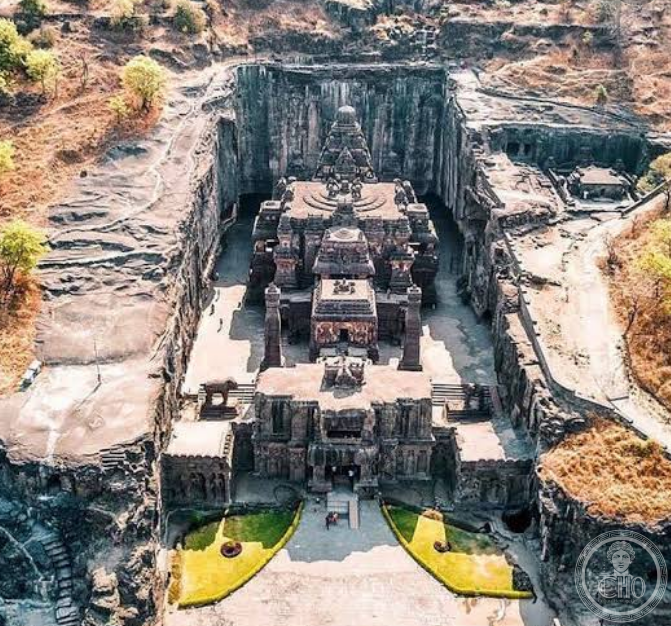
Ellora is the only place where Buddhist, Hindu and Jain rock-cut architecture stand side by side on a single cliff. Its centrepiece, the Kailasa Temple, was carved downward out of one basalt hill, a free-standing shrine cut from living rock rather than built from blocks.
At a glance
The Ellora Caves lie on a basalt escarpment in Aurangabad district, Maharashtra, and comprise 34 excavated monasteries and temples cut into the rock between the 5th and 12th centuries CE. Buddhist, Hindu and Jain communities worked at the same cliff in succession, leaving monastic halls, shrines and temples that trace the religious history of the region.
The site’s defining monument is Cave 16, the Kailasa Temple, dedicated to Shiva and commissioned under the Rashtrakuta dynasty. Unlike the other caves, it was not tunnelled into the hillside but carved from the top of a single rock mass downward, leaving a free-standing temple isolated from the surrounding cliff.
Key facts
- Location: Ellora, Aurangabad district, Maharashtra, India
- Caves: 34 rock-cut monasteries and temples, Buddhist, Hindu and Jain
- Period: excavated from the 5th to the 12th century CE
- Kailasa Temple: Cave 16, monolithic, built under the Rashtrakuta king Dantidurga, roughly 750–775 CE
- Recognition: UNESCO World Heritage Site, inscribed 1983
History
The earliest excavations at Ellora, Caves 1 to 12, are Buddhist and date from the 5th and 6th centuries CE, carved under the patronage of the Vakataka dynasty at the same period as the Buddhist caves of Ajanta nearby. When Vakataka power collapsed around 500 CE and the Chalukya dynasty rose in the region, the new rulers were devotees of Shiva, and Buddhist patronage at the site gave way to Hindu excavation. The Hindu caves, numbered 13 to 29, followed.
The Rashtrakuta dynasty, which defeated the Chalukyas in 752 CE, was even more strongly Shaivite, and it was under Rashtrakuta patronage, associated with king Dantidurga and continued under Govinda III, that the Kailasa Temple was carved, roughly between 750 and 775 CE. Jain patrons later added Caves 30 to 34 between the 9th and 12th centuries, including the elaborately carved Indra Sabha, Cave 32.
Activity at Ellora appears to have ceased after about 1100 CE amid local political decline, and the site was overtaken by jungle. It resurfaced in later records under the Bahmani sultan Ahmad Shah in the 1430s and was known again during the Mughal period around 1600. British East India Company surveyors documented the caves in the 1820s, with W. Erskine publishing an account in 1824 and James Bird a further description in 1847.
What you see
The Kailasa Temple, Cave 16, is the natural starting point of a visit. A carved gateway leads into a court roughly 82 metres long, within which stand a free-standing hall dedicated to Nandi, Shiva’s bull, and two tall victory pillars flanking the approach to the main pillared hall. The temple’s tower, or shikhara, rises to about 32.6 metres above the inner sanctum, and traces of the original paint survive on some of the carved ceilings. The courtyard walls carry a gallery of large relief carvings, including scenes from the Ramayana and the Mahabharata, a panel of Shiva as Nataraja dancing with eight arms, and, on the south wall, the celebrated composition of Ravana lifting Mount Kailash while Shiva presses it down with a single toe.
South along the cliff lie the Buddhist caves. Cave 10 holds the finest chaitya hall at the site, with a three-tiered facade and a seated Buddha carved in the apse before a stupa. Cave 12, known as Tin Tal, is a three-storey monastery complex, the largest Buddhist excavation at Ellora.
North of the Kailasa Temple are the Jain caves. Cave 32, the Indra Sabha, is a two-storey hall with an elaborately carved lotus ceiling regarded as among the finest of its kind in India, and a full sculptural programme reflecting both Digambara and Shvetambara traditions. Cave 33, the Jagannath Sabha, contains a seated figure of Mahavira, and Cave 34 preserves the best-kept Jain facade at the site.
Practical information
- Time needed: a serious visit to the main caves, Buddhist, Hindu and Jain, takes several hours; allow a full morning or afternoon
- Route: the Kailasa Temple, Cave 16, is generally seen first, followed by the Buddhist caves to the south and the Jain caves to the north
- Current visiting arrangements: hours, fees and access details change and are best checked through the official channels for the site before travelling
Getting there
Ellora lies within Aurangabad district in Maharashtra. The nearest major town is Aurangabad itself, and current transport options and timings are best confirmed through official travel information rather than fixed in advance.
Nearby
- Ajanta Caves — around 100 km northeast; Buddhist rock-cut caves excavated in the same Vakataka period as Ellora’s earliest caves
Sources
- UNESCO World Heritage Centre
- W. Erskine (1824)
- James Bird (1847)
Find it on the map
See this place and what’s around it →📷 Become a Cultural Heritage Online photographer
Share your photos of places: they stay published under your name as the author. The more they're seen, the more you get noticed — and soon a contest will reward the most appreciated photos.
Log in or sign up free to add a photo