
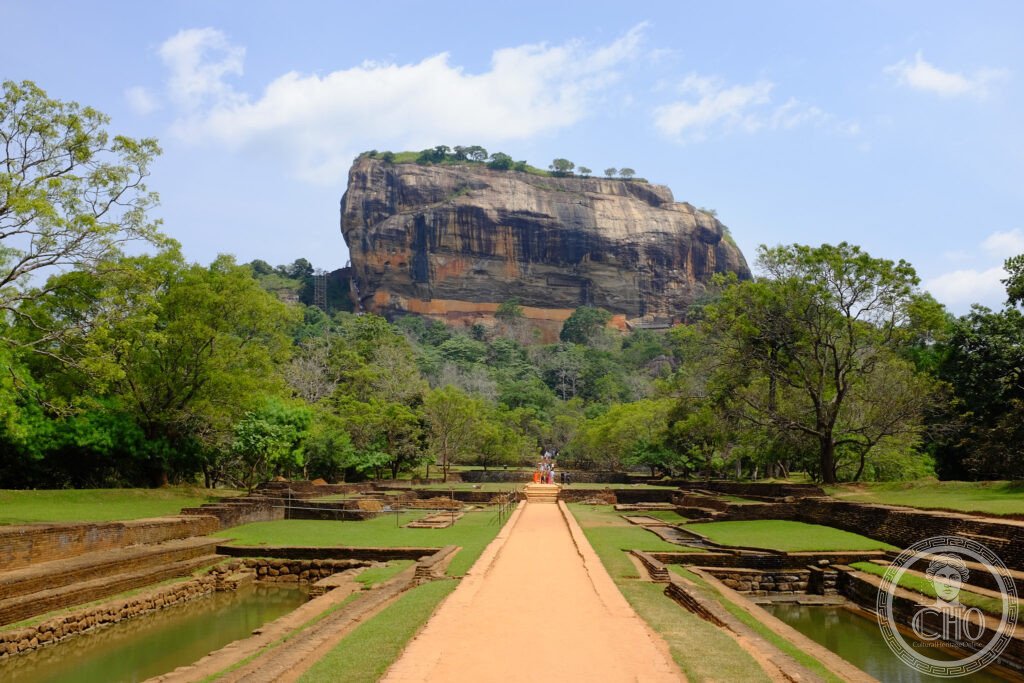
A king who had murdered his father moved the capital onto the top of a rock, and in eighteen years built gardens, a gallery of painted women, a wall polished to a mirror and a palace in the sky. He lost the throne and the site was abandoned to monks — which is why the gardens at its foot are the oldest surviving landscaped gardens in Asia.
At a glance
Sigiriya is a granite intrusion standing roughly 180 metres above the plain of central Sri Lanka — 349 metres above sea level — with the remains of a royal citadel on its summit and an elaborate designed landscape around its base. It was built between 477 and 495 by Kashyapa I, and abandoned as a capital immediately after his death, which is the reason so much survives: nothing was rebuilt over it. The site divides into four parts, and the sequence matters, because it was meant to be experienced in order: the symmetrical water gardens on the level ground, the boulder garden where the natural rocks were absorbed into the architecture, the terraced gardens climbing the slope, and finally the summit. UNESCO inscribed it in 1982.
Key facts
- The water gardens: the oldest surviving landscaped gardens in Asia, laid out on a symmetrical plan with pools, channels and fountains. The fountains still work in the rainy season, driven by gravity and pressure alone, with no pump — fifteen centuries after they were cut.
- The frescoes: a little over twenty survive, in a sheltered pocket of the rock face about a hundred metres up. They are all that remains of a painted surface that once covered a wide band of the western face — perhaps five hundred figures — visible from the gardens below. The overhang saved these; the weather took the rest.
- The Mirror Wall: a parapet finished in lime plaster polished until it reflected. Visitors began scratching verses into it after the site was abandoned, and kept doing so between roughly the sixth and the fourteenth centuries; more than 1,800 of these inscriptions have been recorded. Most are responses to the paintings, and they are among the earliest surviving specimens of written Sinhala.
- The lion: the final staircase to the summit once passed through a gateway built as a lion’s head and forequarters. Only the paws survive, giving the rock its name and an idea of the scale of what stood above them.
- Heritage: UNESCO World Heritage Site, Ancient City of Sigiriya, inscribed 1982 (reference 202).
- GPS: 7.9570° N, 80.7603° E
History
The story comes from the Culavamsa, the Sri Lankan chronicle, and it is unusually lurid. King Dhatusena was overthrown and killed by Kashyapa, his son by a non-royal consort, who feared the throne would pass to his half-brother Moggallana; the chronicle has him walled up alive. Moggallana escaped to India, and Kashyapa — expecting his return — left the old capital of Anuradhapura and built himself a citadel on a rock that could be defended and, just as importantly, seen. Moggallana came back in 495. Kashyapa’s army left him on the battlefield and he took his own life.
After that the site reverted to what it had been before the palace: a Buddhist monastic settlement, occupied in some form until the fourteenth century, then left to the forest. Its rediscovery in the nineteenth century by British administrators and archaeologists began the long conservation history that continues under the Central Cultural Fund today. Whether Sigiriya was primarily a fortress, a palace or a monument built to be looked at is still argued over; the design, which stages the approach like a procession, suggests it was never only defensive.
What you see
From the western gate the axis runs straight at the rock through the water gardens, so the climb is framed from the first step. Past the pools, the path enters the boulder garden, where enormous natural blocks carry cut steps, cisterns and the sockets of vanished timber buildings, and then rises through brick terraces onto the rock itself.
Halfway up, a spiral stair leads into the sheltered gallery of the frescoes, and immediately below it runs the Mirror Wall with its scratched verses. Above, the path crosses the terrace where the lion gateway stood — the paws still flank the stair — and the last flights climb the exposed face to the summit, where the foundations of the palace, its cisterns and a rock-cut pool sit on about 1.6 hectares of level rock, with the plain in every direction below.
Practical information
- The climb: roughly 1,200 steps to the summit, an hour or two up and down, much of it on metal stairways bolted to the rock face. It is exposed, and it is not for anyone uneasy with heights. Start at opening time: by mid-morning the heat and the queues on the narrow stairs both bite.
- Tickets: issued by the Central Cultural Fund, which manages the site along with Sri Lanka’s other World Heritage sites; foreign-visitor prices are set in dollars and change with the exchange rate, so check the CCF’s own site. The on-site museum is included, and a combined Cultural Triangle ticket is worth it if you are also visiting Polonnaruwa, Anuradhapura or Dambulla.
- Hornets: the rock has resident wasp colonies and the marked quiet zones on the stairs are not decorative — noise has provoked swarms in the past.
Getting there
Sigiriya is about 165 km from Colombo, four hours by road through Dambulla. By rail, the nearest useful station is Habarana, about 20 km away, from where it is a short tuk-tuk ride. Most visitors come as part of a circuit of the Cultural Triangle rather than as a day trip from the coast. GPS: 7.9570, 80.7603.
Nearby
- Dambulla Cave Temple — 17 km south; five caves under an overhang, filled with Buddha images and painted from ceiling to floor. UNESCO World Heritage 1991.
- Polonnaruwa — 65 km east; the medieval capital, with the colossal rock-cut Buddhas of the Gal Vihara. UNESCO World Heritage 1982.
- Pidurangala — the neighbouring rock, a shorter and rougher climb, and the place people go for the view of Sigiriya itself at sunrise.
Sources
- UNESCO World Heritage Centre, Ancient City of Sigiriya, reference 202, inscribed 1982
- Central Cultural Fund, Sri Lanka — Sigiriya Rock Fortress, site management and ticketing
- Department of Archaeology, Sri Lanka — Sigiriya
- Encyclopaedia Britannica, Sigiriya
Find it on the map
See this place and what’s around it →📷 Become a Cultural Heritage Online photographer
Share your photos of places: they stay published under your name as the author. The more they're seen, the more you get noticed — and soon a contest will reward the most appreciated photos.
Log in or sign up free to add a photoDo you manage this place?
This page is read by travellers and heritage enthusiasts who find it on Google. Keep it accurate — and make it work for you. Free for non-profit heritage institutions.