
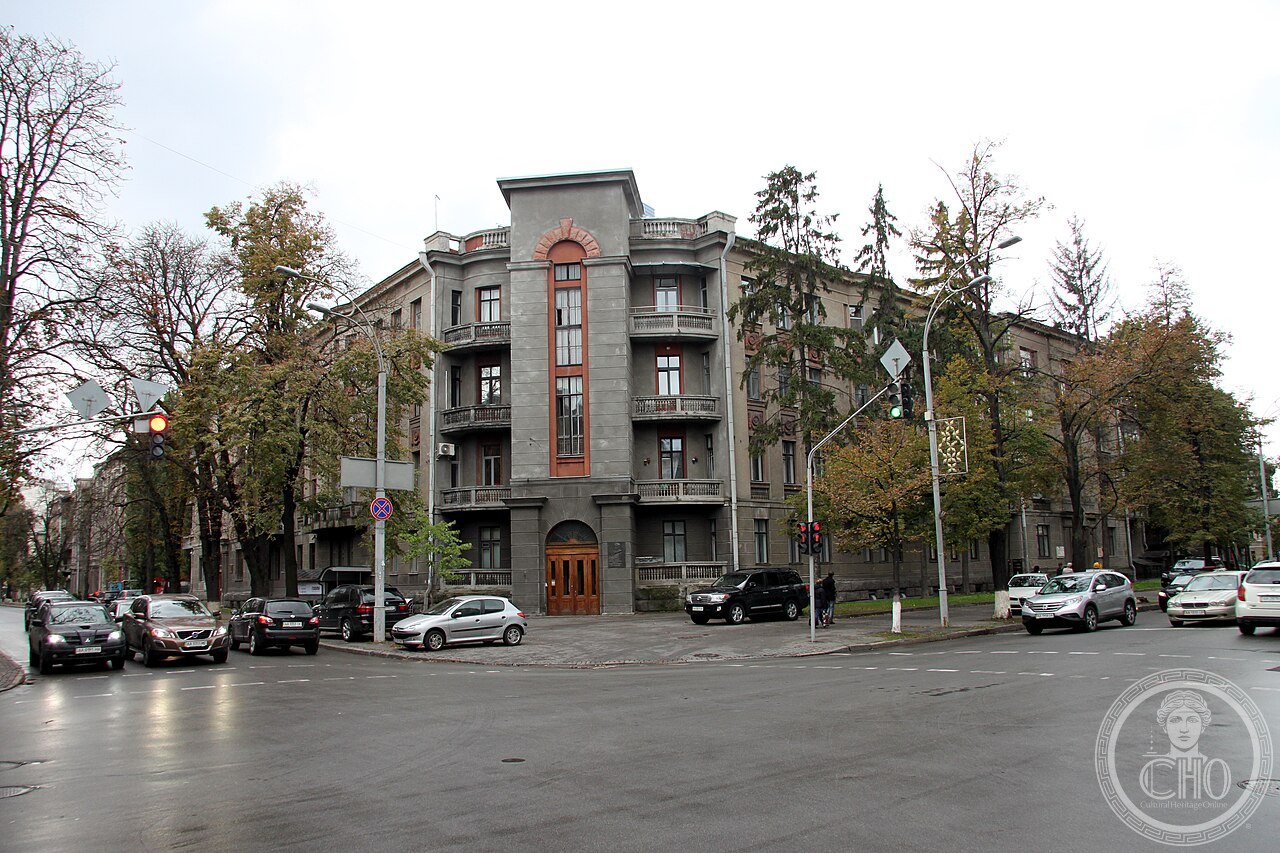
Ukraine’s official cultural diplomacy arm occupies a Postconstructivist building in the heart of Kyiv’s government quarter, projecting Ukrainian arts, literature, and identity to the world.
At a glance
The Ukrainian Institute, established by the Cabinet of Ministers of Ukraine in June 2017 and operational from summer 2018, operates from a Soviet-era Postconstructivist building at 20/8 Instytutska Street, a prestigious address in Kyiv’s Pecherskyi district. Designed by architect Serhii Hryhoriev, the structure originally served as a residential building for workers of the Council of People’s Commissars of the Ukrainian Soviet Socialist Republic. Today it houses an institution whose mandate — promoting Ukrainian culture internationally across cinema, music, literature, and the performing arts — has taken on heightened urgency since Russia’s full-scale invasion of 2022.
Key facts
- Built: 1930s, attributed to architect Serhii Hryhoriev
- Style: Postconstructivism (Soviet-era transition)
- Status: Active cultural institution; public programming and research centre
- Address: Instytutska Street 20/8, Kyiv 01021, Ukraine
- GPS: 50.4458, 30.5339 — Open in Google Maps
- UNESCO/Listed: No national listing
History
Instytutska Street takes its name from the Kyiv Institute for Noble Maidens, constructed between 1838 and 1842. The street became one of the city’s most politically charged addresses, housing government ministries and the residences of senior officials throughout the Soviet period. The building at number 20/8, designed in the Postconstructivist style that bridged Soviet constructivism and Stalinist classicism in the 1930s, was originally built to house state workers and has been associated at various points with Ukrainian political figures.
Ukraine’s Ministry of Foreign Affairs established the Ukrainian Institute by government decree on 21 June 2017, modelling it partly on institutions such as the British Council and the Goethe-Institut. Volodymyr Sheiko, who had spent eleven years at the British Council, was appointed General Director through open competitive selection. The Institute became operational in summer 2018, taking up residence at Instytutska 20/8.
Since 2022, the Institute’s work defending and projecting Ukrainian cultural identity has become a matter of national importance alongside its diplomacy function, with programmes running across dozens of countries worldwide despite wartime constraints.
What you see
The building exemplifies the Postconstructivist transition that characterised Soviet architecture in the late 1930s: the strict geometric volumes of constructivism softened by the introduction of classical ornamental motifs and more conventional window rhythms. The facade facing Instytutska Street presents a composed, institutional presence — solid, measured, and built to convey civic permanence. The street itself drops steeply from the government plateau toward the Maidan, making the building’s setting visually dramatic from multiple angles.
The interior has been adapted over decades to accommodate governmental and then cultural uses. Public-facing spaces host exhibitions, screenings, and residency presentations, while research and administrative functions occupy the upper floors.
Practical information
- Open for public cultural events and exhibitions; check ui.org.ua for current programme
- Access may be subject to wartime security arrangements; verify before visiting
- Guided tours available: no standard building tour; events open to the public
- Estimated visit time: 1–2 hours for an exhibition or screening
Getting there
The nearest metro station is Maidan Nezalezhnosti (Independence Square) on the Sviatoshynsko-Brovarska line, a 5-minute walk uphill along Instytutska Street. Kyiv Boryspil International Airport is approximately 30 km east; express trains and taxis connect to the city centre in 35–60 minutes. The building is a 3-minute walk from Independence Square.
Nearby
- Maidan Nezalezhnosti (Independence Square): The symbolic heart of modern Ukraine, 200 m downhill, site of the 2004 Orange Revolution and the 2013–14 Euromaidan.
- October Palace: A grand 19th-century neoclassical building immediately adjacent, originally the Merchants’ Assembly and now a major concert and event venue.
- National Museum of the History of Ukraine: The country’s principal history museum, a 10-minute walk through the Pecherskyi district.
- St. Sophia Cathedral: A UNESCO World Heritage Site and the finest example of Byzantine architecture in Eastern Europe, 15 minutes on foot.
Sources
Find it on the map
See this place and what’s around it →📷 Become a Cultural Heritage Online photographer
Share your photos of places: they stay published under your name as the author. The more they're seen, the more you get noticed — and soon a contest will reward the most appreciated photos.
Log in or sign up free to add a photoIs this page about you?
This page is read by travellers and heritage enthusiasts who find it on Google. Tell us how you are connected to this place and we will take it from there.