
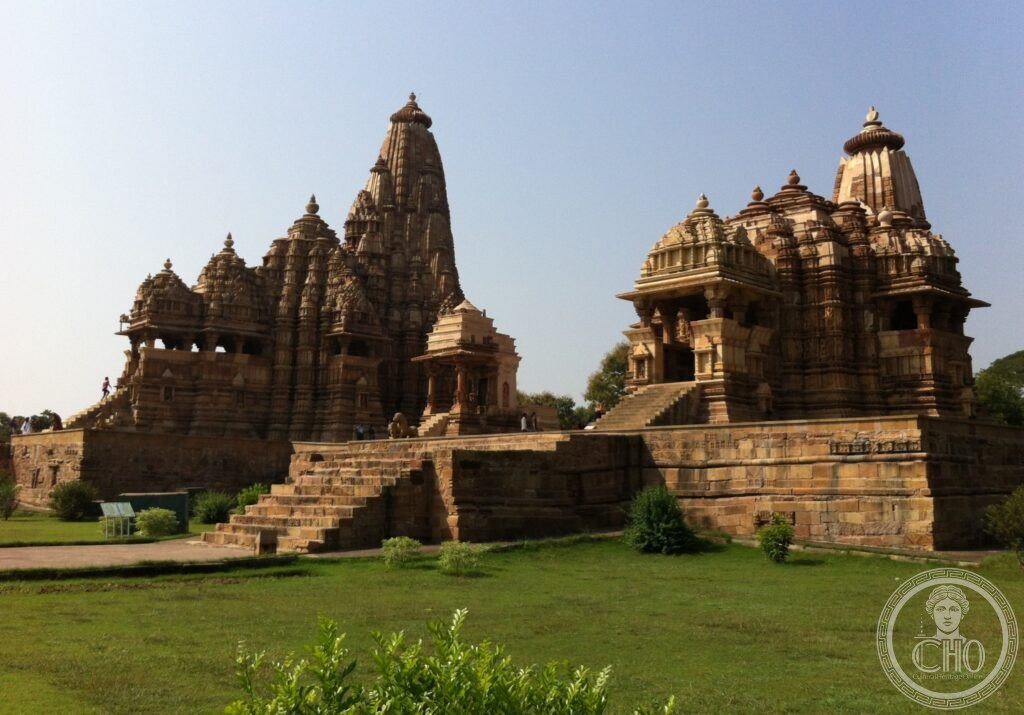
Of the original eighty-five temples raised by the Chandela dynasty at their ceremonial capital, twenty-five survive, their sandstone surfaces carried from base to spire by tier upon tier of sculpture. Gods, celestial nymphs, warriors and lovers crowd the friezes, including the erotic panels for which Khajuraho is best known worldwide.
At a glance
The temples at Khajuraho fall into three groups. The western group, enclosed within a protected park, is the largest and most elaborate, containing the Kandariya Mahadeva, Lakshmana, Vishvanatha and Matangesvara temples. The eastern group holds the principal Jain cluster, including the Parsvanatha temple with its sculpted apsaras, along with the Vaishnava Vamana and Javari temples. The southern group consists of two later, isolated temples, Chaturbhuja and Duladeo.
The erotic carvings that have made Khajuraho famous form only a small part of the overall sculpture, concentrated on external friezes at the base of the main temple bands rather than inside the shrines. Art historians have offered several explanations, from Tantric philosophy to apotropaic magic to depictions of celestial nymphs in states of bliss, but no single reading is agreed upon.
Key facts
- Location: Khajuraho, Chhatarpur District, Madhya Pradesh, India
- Built: 950–1050 CE, under the Chandela Rajput dynasty
- Surviving temples: 25, of an original 85
- Key monument: Kandariya Mahadeva Temple, dedicated to Shiva, the largest and most elaborate of the group
- Status: UNESCO World Heritage Site, inscribed 1986
History
The Chandela were a Rajput clan claiming descent from the moon, who ruled the Jejakabhukti region, now Bundelkhand, from around 831 CE. They reached their height between roughly 900 and 1050 CE, when Khajuraho served as their principal ceremonial capital, while Mahoba remained the administrative seat. All 85 original temples were built within this century of Chandela power, as the dynasty fought recurring wars against the Paramaras and Kalachuris and later faced incursions from the Ghaznavids and the Delhi Sultanate. By around 1200 CE the dynasty was in decline and the temples were abandoned, though not deliberately destroyed.
The sculptural programme is thought to have involved several hundred sculptors working over the course of a century, following a coordinated iconographic scheme repeated with variations across the temples. The carving typically moves from cosmic imagery of deities on the interior, through celestial nymphs in the middle registers, to human scenes of daily life, warfare and desire on the lower bands, forming a continuous cosmological statement across each building.
After the Chandela decline, the temples were left to the jungle rather than demolished. They remained largely forgotten until 1838, when Captain T. S. Burt of the Bengal Engineers, surveying a local revenue boundary, came upon the western group and recorded them in a report that mixed scientific curiosity with Victorian unease. The Archaeological Survey of India began systematic work at the site in the 1850s.
What you see
The western group, the main protected enclosure, holds the site’s most significant temples. The Lakshmana Temple, dating to 954 CE, is the oldest complete structure in the group; its base carries friezes of military scenes, hunting and erotic panels, and its shrine houses a three-headed, four-armed image of Vishnu.
The Kandariya Mahadeva Temple, built around 1025 CE and dedicated to Shiva, is the largest and most ambitious at Khajuraho. Its tower rises through a sequence of smaller spires climbing toward the central shikhara, a profile said to echo the Himalayan mountain mass, and its exterior carries hundreds of carved figures, including the well-known panel of three figures in union above the main entrance. The Vishvanatha Temple nearby is noted for its dancing-girl panels, among the finest sculptural work on the site.
Practical information
- Access to the groups: the western group lies within a protected, fenced park with an admission charge for the site; the eastern and southern groups stand in open ground and are freely accessible. Check the Archaeological Survey of India’s current arrangements before visiting.
- Time needed: allow the better part of a day to take in all three groups unhurried.
- Season: the cooler months from October to March are generally considered the most comfortable for visiting; summer temperatures rise sharply.
- Events: a classical Indian dance festival is held at the temples each November.
Getting there
Khajuraho has its own airport with direct flights from Delhi and Varanasi. It can also be reached by train to Jhansi or Mahoba, followed by road transport to the town. Khajuraho itself is a small town geared toward visitors, with hotels within walking distance of the western group.
Nearby
- Orchha — about 170 km south, the fortified former Bundela Rajput capital, with the Ram Raja Temple, where Ram is worshipped as a king, the Jehangir Mahal palace and a riverside group of Bundela cenotaphs.
- Bandhavgarh National Park — about 270 km east, one of India’s leading tiger reserves, noted for a high density of Bengal tigers, with an ancient hilltop fort and Vishnu carvings on its cliff face.
Sources
- Wikipedia, Khajuraho Group of Monuments
- Wikipedia, Kandariya Mahadeva Temple
- Wikipedia, Chandela dynasty
- UNESCO, Khajuraho Group of Monuments
Find it on the map
See this place and what’s around it →📷 Become a Cultural Heritage Online photographer
Share your photos of places: they stay published under your name as the author. The more they're seen, the more you get noticed — and soon a contest will reward the most appreciated photos.
Log in or sign up free to add a photoIs this page about you?
This page is read by travellers and heritage enthusiasts who find it on Google. Tell us how you are connected to this place and we will take it from there.