
Sri Lanka’s second medieval capital holds the finest concentration of Sinhalese Buddhist sculpture and architecture in the country, above all the Gal Vihara, four Buddha figures cut from a single granite outcrop under King Parakramabahu I.
At a glance
Polonnaruwa became the capital of Sri Lanka after Anuradhapura, the first capital, was sacked by the South Indian Chola Empire in 993 CE. It flourished until 1293 CE, when it was abandoned following Pandyan invasions. The medieval city, covering roughly 12 square kilometres, contains the finest concentration of Buddhist architecture in Sri Lanka, including the circular Vatadage shrine, the Rankoth Vehera stupa, the Lankatilaka brick temple and the Gal Vihara rock sculptures.
The city’s greatest ruler, Parakramabahu I, known as the Great, reigned from 1153 to 1186 CE. He unified Sri Lanka under a single ruler for the first time, repelled three Chola invasions from South India, sent an expedition to Burma, and built a vast network of dams and irrigation canals, declaring that no drop of water should reach the sea without first serving mankind.
Key facts
- Gal Vihara: a rock shrine of around 1180 CE, carved from a single granite outcrop on the orders of Parakramabahu I, containing a reclining Buddha about 15 metres long, a standing Buddha about 12 metres high regarded as one of the finest standing stone figures in Asia, a seated meditating Buddha about 7 metres high, and a smaller seated Buddha in a cave shrine.
- Parakrama Samudra: the Sea of Parakrama, a reservoir built in stages by Parakramabahu I, with a final earth dam some 14 kilometres long, a surface area of about 2,800 hectares and a depth of around 12 metres, the largest artificial irrigation tank of ancient Asia and still used for paddy irrigation.
- The Vatadage: a circular relic house of around 1187 CE, probably built by King Nissankamalla, with four seated Buddha figures facing the cardinal directions, an elaborately carved moonstone at its entrance and a stepped concentric platform, considered the finest and most complete Sinhalese vatadage surviving.
- Location: North Central Province, Sri Lanka, approximately 7.94° N, 81.00° E.
History
The Chola Empire of South India, then the dominant naval power in the Indian Ocean, conquered Anuradhapura in 993 CE. Rajendra I, son of the conqueror Rajaraja I, made Polonnaruwa the capital of the occupied territory. Chola rule over the city lasted around 77 years until the Sinhalese king Vijayabahu I expelled them in 1070 CE and restored Polonnaruwa as a Sinhalese capital.
The city was finally abandoned around 1293 CE after Pandyan and later Arya Chakravarti invasions from South India devastated its irrigation system. Without functioning irrigation the surrounding rice paddies could not be maintained, the population retreated south, and the jungle reclaimed the site. It was rediscovered by European explorers only in the 18th century.
What you see
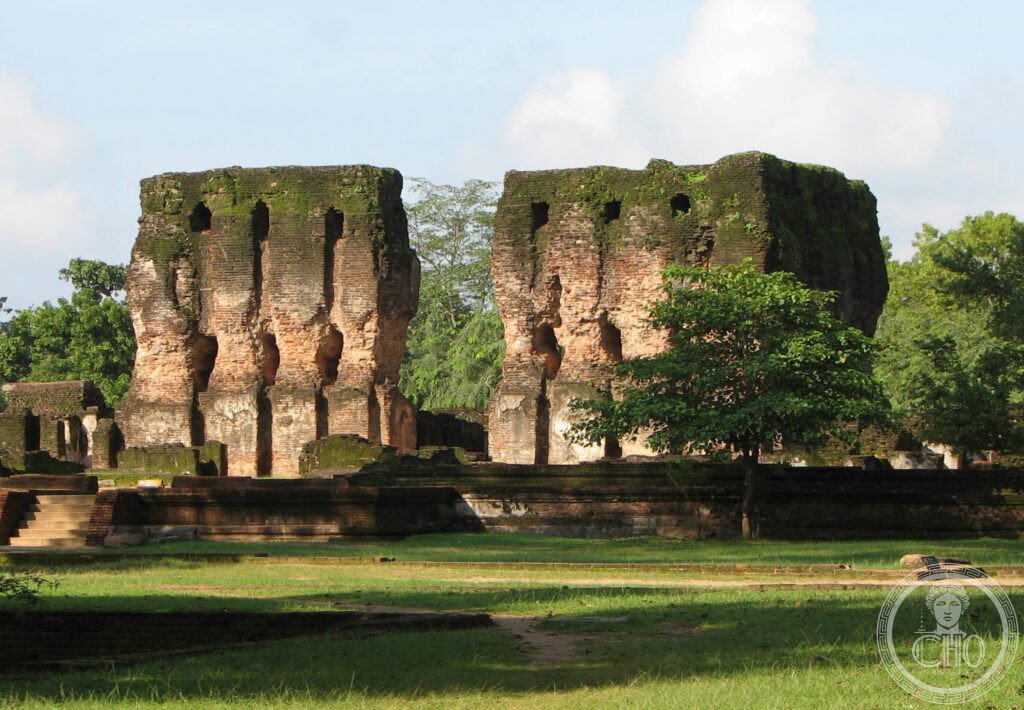
The Royal Palace of Parakramabahu I formed the administrative heart of the city. The original building is said to have had seven storeys and a thousand rooms; only the lower three storeys of the main block survive, standing around 9 metres high with brick walls some 2.4 metres thick. Beside it stands the Council Chamber, or Audience Hall, whose platform is ringed by a carved stone elephant frieze considered the finest of its kind in Sri Lanka.
The Rankoth Vehera, the Golden Pinnacle Stupa built around 1187 CE by King Nissankamalla, is the largest stupa in Polonnaruwa at about 55 metres high, a near-perfect hemispherical dome modelled on the Ruwanwelisaya at Anuradhapura. Four shrines around its base each hold a standing Buddha image.
Practical information
- Tickets: a combined Cultural Triangle ticket covers Polonnaruwa along with Anuradhapura, Sigiriya, Dambulla and Kandy, or a single-site ticket for Polonnaruwa alone can be bought; check current prices and validity with the site’s official channels.
- Getting around: bicycle hire from the bus stand is the most practical way to cover the site’s ruins, which are spread across some 12 square kilometres; the Gal Vihara lies about 4 kilometres from the main cluster of monuments.
- Best time to visit: early morning is recommended for cooler temperatures, softer light and fewer visitors.
Getting there
Polonnaruwa lies about 215 kilometres northeast of Colombo, reachable by bus or by train from Colombo Fort. It can also be reached from Dambulla, around 90 kilometres away, by bus.
Nearby
- Sigiriya — about 65 kilometres west; a rock fortress and palace of around 477-495 CE atop a 200-metre granite monolith, with a famous fresco gallery, the Mirror Wall and water gardens at its base; a UNESCO World Heritage Site.
- Minneriya National Park — about 25 kilometres north; known for the seasonal gathering of wild elephants around the Minneriya Tank between July and September, alongside leopards, sloth bears and painted storks.
Sources
- Wikipedia
- UNESCO
Find it on the map
See this place and what’s around it →📷 Become a Cultural Heritage Online photographer
Share your photos of places: they stay published under your name as the author. The more they're seen, the more you get noticed — and soon a contest will reward the most appreciated photos.
Log in or sign up free to add a photo