

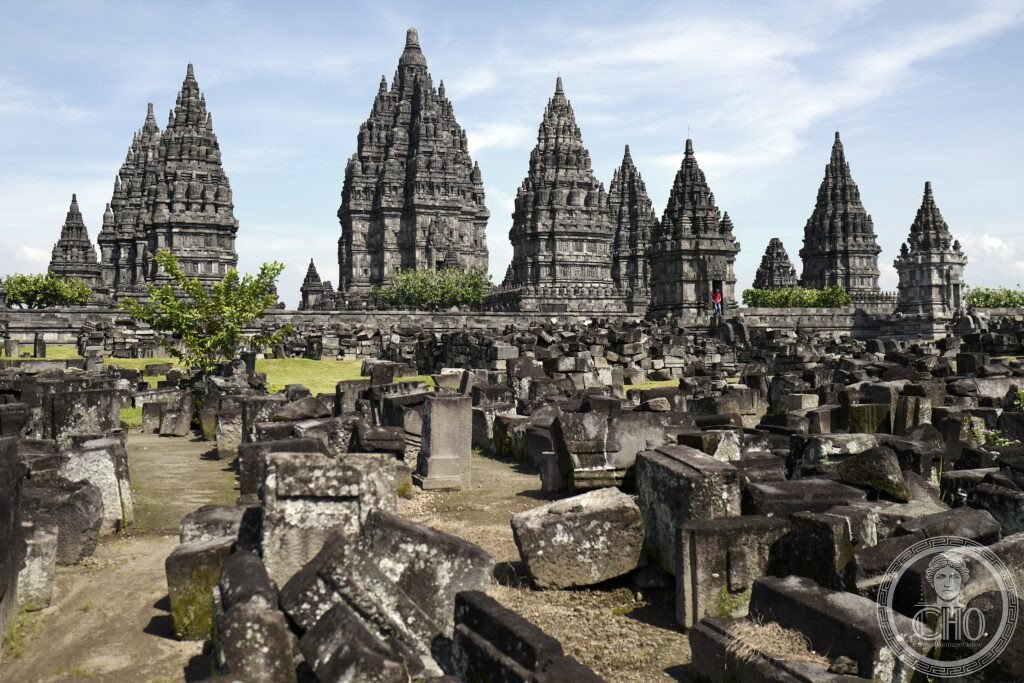
Three towers rise above the Javanese plain at Prambanan, dedicated to Shiva, Vishnu and Brahma. Built by the Sanjaya dynasty around 850 CE, the compound carries 1,300 bas-relief panels telling the Ramayana in full, and a legend of a princess turned to stone that still shapes how visitors read the central shrine.
At a glance
Prambanan is a compound of Hindu temples in the Sleman Regency of Yogyakarta Province, raised by the Sanjaya dynasty around 850 CE at roughly the same time that the Buddhist monument of Borobudur was being built nearby by the rival Sailendra dynasty. Its three central towers, the tallest of which is dedicated to Shiva and rises 47 metres, dominate a site that once held 240 temples, of which only a fraction survive intact.
The main Shiva shrine houses a three-metre statue of Durga known locally as Loro Jonggrang, Slender Virgin, after a Javanese legend in which a princess is turned to stone by a spurned suitor who had built a thousand temples in a single night to win her hand. On full-moon nights between May and October, the open-air Trimurti Theatre stages the Ramayana Ballet with the illuminated towers as its backdrop.
Key facts
- Built: around 850 CE by the Sanjaya dynasty, named Siwagrha, House of Shiva, in the Siwagrha Inscription of 856 CE.
- Central towers: dedicated to the Hindu Trimurti, Brahma, Vishnu and Shiva; the Shiva tower reaches 47 metres, the tallest Hindu temple tower in Indonesia.
- Reliefs: 1,300 bas-relief panels in the inner galleries of the Shiva and Brahma temples narrate the Ramayana in sequence.
- Damage and repair: the compound was toppled in part by an eruption of Gunung Merapi and earthquakes around 1006 CE, and damaged again by the 2006 Yogyakarta earthquake; restoration continues.
- Status: inscribed as a UNESCO World Heritage Site in 1991.
History
Prambanan was built by the Sanjaya Hindu dynasty around 850 CE, in what is read as a deliberate answer to the Buddhist temple of Borobudur then under construction by the rival Sailendra dynasty. Its original name, recorded in the Siwagrha Inscription of 856 CE, was Siwagrha, House of Shiva, and the inscription names the main temple and records its dedication.
A major eruption of Gunung Merapi with associated earthquakes around 1006 CE toppled much of the compound, and it lay in ruin for centuries. The Dutch colonial government began restoring the site in 1918, and the reconstruction of the Shiva temple alone took around forty years, finishing in 1953. The 2006 Yogyakarta earthquake caused further damage, and repair work is still under way. Prambanan was inscribed as a UNESCO World Heritage Site in 1991.
What you see
The compound is arranged in two zones. The inner zone holds the main Trimurti towers, each facing a smaller shrine for its associated vehicle: Nandi the bull for Shiva, Garuda the eagle for Vishnu, and Hamsa the swan for Brahma. The Garuda Temple contains a Garuda Pancasila statue regarded as an ancestor of Indonesia’s national emblem. The outer zone once held 224 small Perwara guardian temples in four concentric rows, most of which remain in ruins.
Doorways on the main temples are flanked by kala-makara motifs, sea-monster heads typical of Central Javanese Hindu carving, and the outer walls carry 432 celestial figures set in niches alongside the narrative reliefs. Inside the Shiva and Brahma temples, the 1,300 bas-relief panels carry visitors along the story of King Rama’s rescue of his wife Sita from the demon king Ravana, with the help of Hanuman’s monkey army, across a gallery circuit of some 2.4 kilometres.
Practical information
- Tickets and access: current admission arrangements, including combined tickets with Borobudur, are best checked on the official Prambanan channels before visiting.
- Ramayana Ballet: performed at the open-air Trimurti Theatre on full-moon nights from May to October, with the temple itself as backdrop; an indoor version runs year-round without the open-air setting. Advance booking is recommended through the Prambanan ticket office or the Yogyakarta tourism office.
- Restoration: work following the 2006 earthquake is ongoing, and some areas may be closed to visitors at any given time.
Getting there
Prambanan lies to the northeast of Yogyakarta city centre and is reachable by taxi, ride-hailing services or the TransJogja bus line running from Malioboro. It is commonly combined with a visit to Borobudur on the same day, though the two sites are some distance apart to the west.
Nearby
- Borobudur — a Buddhist monument to the west, built at roughly the same period by the rival Sailendra dynasty; the two sites are often described together as the twin pillars of ancient Javanese heritage.
- Plaosan Temple — close to Prambanan, a ninth-century Buddhist twin-temple complex built by the Sailendra dynasty, quieter than Prambanan and largely unrestored, with numerous stone Buddhas and Bodhisattva reliefs.
- Gunung Merapi — an active volcano to the north, among the most active in Indonesia, with a museum at Kaliurang documenting its eruptions through photographs and preserved objects.
Sources
- Wikipedia, Prambanan
- Wikipedia, Ramayana Ballet
- Wikipedia, Loro Jonggrang
- UNESCO, Prambanan Temple Compounds
Find it on the map
See this place and what’s around it →📷 Become a Cultural Heritage Online photographer
Share your photos of places: they stay published under your name as the author. The more they're seen, the more you get noticed — and soon a contest will reward the most appreciated photos.
Log in or sign up free to add a photoIs this page about you?
This page is read by travellers and heritage enthusiasts who find it on Google. Tell us how you are connected to this place and we will take it from there.