
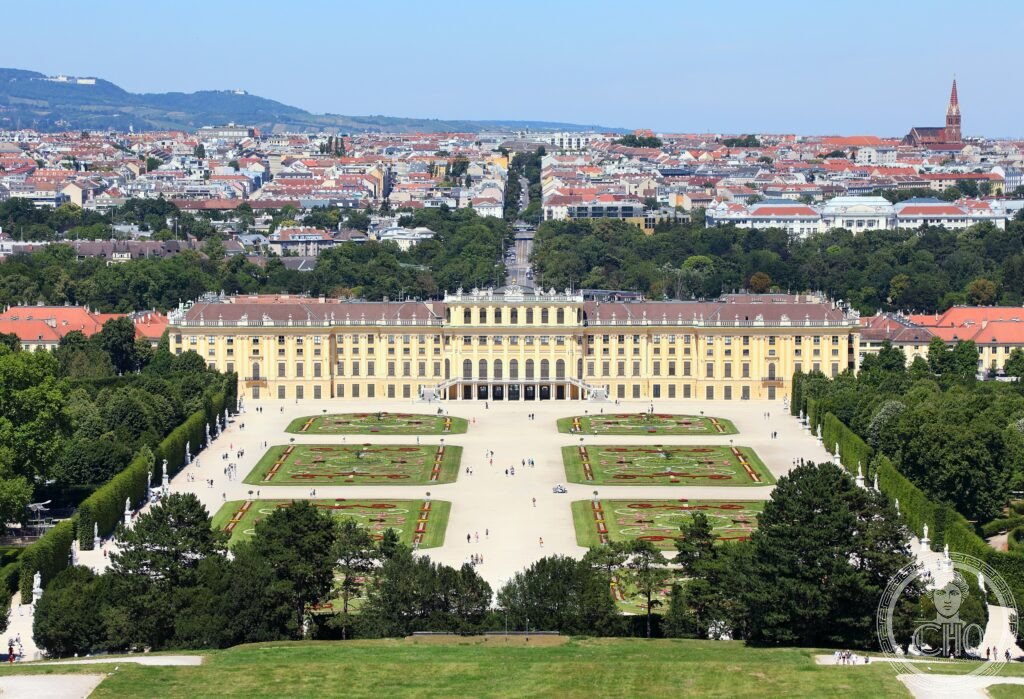
The Habsburgs’ summer palace is where the dynasty did its living rather than its governing: Maria Theresa raised sixteen children here, Mozart played here at six, Napoleon slept here twice as a conqueror, and in a small blue salon in 1918 the last emperor signed away his part in government, ending six centuries of Habsburg rule.
At a glance
Schönbrunn stands in Hietzing, on the western edge of Vienna, and is the most complete Baroque imperial ensemble in Central Europe: palace, formal gardens, hill-top colonnade, menagerie and outbuildings, all conceived together. The house has 1,441 rooms, of which 45 are shown to visitors. Its present form is Maria Theresa’s: a rebuilding begun in 1743 under the court architect Nikolaus Pacassi, on foundations laid by an earlier and far more grandiose scheme by Johann Bernhard Fischer von Erlach that was never affordable. The interiors that resulted are Rococo rather than Baroque, and the empress directed them closely. UNESCO inscribed the palace and its gardens in 1996.
Key facts
- The colour: the facades are painted in the ochre-yellow that has been called Schönbrunn yellow ever since Maria Theresa’s time, and has been reproduced faithfully at every restoration since. It is the single most imitated detail of Habsburg architecture across Central Europe.
- Mozart: in October 1762 the six-year-old Wolfgang Amadeus was brought here to play before Maria Theresa and her court — the beginning of the family’s career on the road.
- Napoleon: occupied the palace as his headquarters in 1805 and again in 1809, when the treaty that bears the palace’s name was signed here. His son, the Duke of Reichstadt, later died in the building.
- Franz Joseph: born in the east wing in 1830 and died in his apartments in the west wing on 21 November 1916, having occupied them for most of a 68-year reign. His rooms are on the visitor route, and their plainness beside the Rococo state rooms is the point.
- The end of the monarchy: in November 1918, in the Blue Chinese Salon, Emperor Charles I signed his renunciation of any part in the government of the state. He never formally abdicated; the monarchy ended anyway.
- Heritage: UNESCO World Heritage Site, Palace and Gardens of Schönbrunn, inscribed 1996.
History
The estate began as a hunting ground with a mill and a manor, and took its name from a spring — the schöner Brunnen, the beautiful well — found there in the early seventeenth century. The Ottoman siege of 1683 destroyed what stood on the site, and Leopold I commissioned Fischer von Erlach to design a replacement. The first design, a palace intended to outdo Versailles from the top of the hill, was a manifesto rather than a plan; the version actually built was more modest and sat at the foot of the slope.
Maria Theresa inherited the house in 1740 and made it the family’s principal summer residence. The rebuilding of the 1740s raised a storey, reorganised the interiors around court ceremony and family life together, and produced the Rococo rooms that give the palace its character. In the 1770s the gardens received their present shape and their monuments — the Neptune Fountain, the deliberately artificial Roman Ruin, and the Gloriette closing the vista on the hilltop. The zoo in the grounds, founded in 1752 as an imperial menagerie, is the oldest in the world still operating. After 1918 palace and gardens passed to the republic, and the site has been open to the public ever since.
What you see
Inside, the route runs from Franz Joseph’s spare working apartments into the state rooms: the Great Gallery, forty metres of white and gold under ceiling frescoes, used for balls and receptions and still used for state occasions; the Vieux-Laque Room, panelled with Chinese lacquer that Maria Theresa had cut up and reset after her husband’s death; the Millions Room, faced in rosewood and hung with Indo-Persian miniatures; and the Blue Chinese Salon where the monarchy ended.
Outside, the parterre runs straight up the slope to the Gloriette, an open colonnade of 1775 built as an eye-catcher and a viewing platform — the view back down over the palace to the city is the one to climb for. On either side lie the maze, the orangery, the Palm House of 1882, the Roman Ruin and the Neptune Fountain, and the zoo with its original Baroque pavilion at the centre.
Practical information
- Tickets and tours: the palace interior is visited on timed tickets, with a shorter route through the Imperial Apartments and a longer one taking in the Maria Theresa rooms; book ahead, since entry times sell out in season. The park is free to walk.
- Separate admissions: the Gloriette, the maze, the Palm House, the Privy Garden and the zoo each charge on their own; combined tickets exist and are worth it if you plan a full day.
- When to come: early morning or late afternoon for the gardens; the palace itself is busiest between eleven and three, and the parterre is best in the low light at either end of the day.
Getting there
Underground line U4 to Schönbrunn, about fifteen minutes from the centre of Vienna, then a short walk to the main gate; trams 10 and 60 and several bus routes stop at the Hietzing side. GPS: 48.1849° N, 16.3122° E.
Nearby
- Tiergarten Schönbrunn — inside the grounds; founded 1752 as the imperial menagerie and the oldest zoo in the world still in operation.
- Hofburg — 6 km east; the winter residence, and the other half of the Habsburg story.
- Wagenburg (Imperial Carriage Museum) — in the palace grounds; the court’s coaches, including the black funeral carriage that carried Franz Joseph.
Sources
- Schloss Schönbrunn Kultur- und Betriebsges.m.b.H. — official site: the palace, its architectural history and the visitor route
- UNESCO World Heritage Centre, Palace and Gardens of Schönbrunn, inscribed 1996
- Die Welt der Habsburger (Austrian public history project) — Maria Theresa and Schönbrunn
- Vienna Tourist Board (wien.info) — visitor information
Find it on the map
See this place and what’s around it →
📷 Become a Cultural Heritage Online photographer
Share your photos of places: they stay published under your name as the author. The more they're seen, the more you get noticed — and soon a contest will reward the most appreciated photos.
Log in or sign up free to add a photoIs this page about you?
This page is read by travellers and heritage enthusiasts who find it on Google. Tell us how you are connected to this place and we will take it from there.