
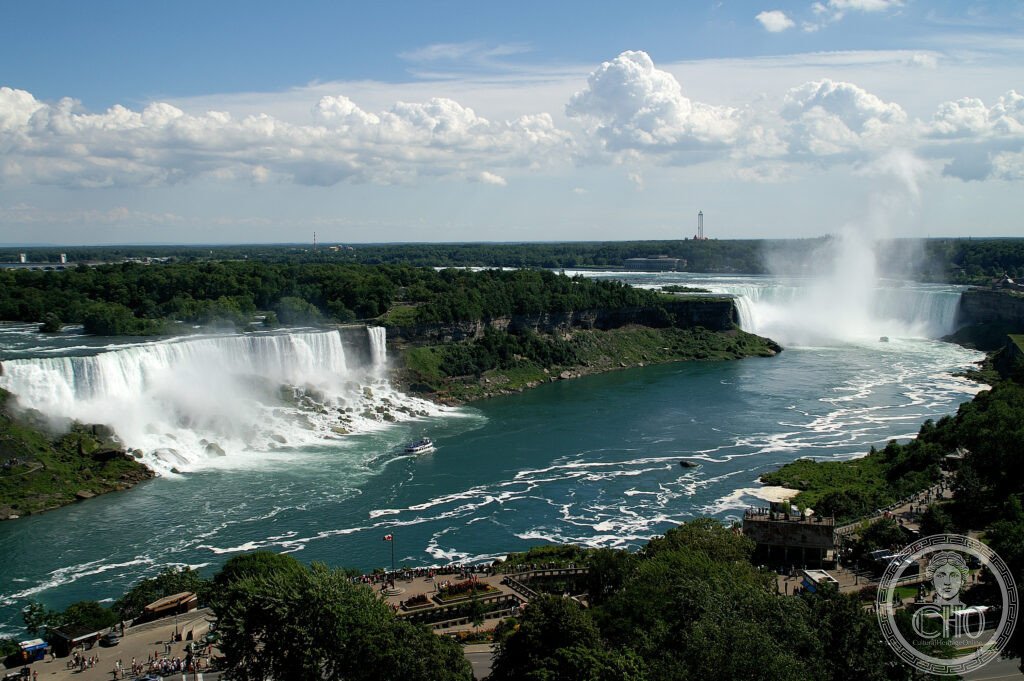
Niagara Falls is not one waterfall but three, carved by the Niagara River as it drops from Lake Erie towards Lake Ontario. The Canadian side faces the largest of them, Horseshoe Falls, whose curved crestline and driving spray make it the most powerful single flow of falling fresh water on the continent.
At a glance
Niagara Falls sits on the border between Ontario, Canada, and New York State, and is made up of three separate waterfalls on the Niagara River. Horseshoe Falls, on the Canadian side, is the largest by volume, with a curved crestline roughly 670 metres wide and a drop of about 57 metres. On the American side stand the American Falls, around 260 metres wide with a drop of 21 to 34 metres, and the smaller Bridal Veil Falls, separated from the American Falls by Luna Island.
The falls formed roughly 12,000 years ago, when meltwater from the retreating glaciers of the last Ice Age began flowing from Lake Erie to Lake Ontario. They originally lay some 11 kilometres south, near what are now the towns of Queenston and Lewiston, and have been retreating upstream ever since as the river erodes the hard dolomite cap rock and the softer shale beneath it, at a rate of roughly 30 centimetres a year.
Key facts
- Location: Niagara Falls, Ontario, Canada, facing Niagara Falls, New York, across the Niagara River.
- Three falls: Horseshoe Falls (Canada), American Falls and Bridal Veil Falls (both USA).
- Drainage: the falls carry water from the upper four Great Lakes — Superior, Michigan, Huron and Erie — into Lake Ontario and the St Lawrence River. The Great Lakes together hold around a fifth of the world’s fresh surface water.
- Hydroelectric sharing: a 1950 treaty between Canada and the USA governs how much of the river’s flow goes to power generation and how much is left to run over the falls for scenery, with more diverted at night and in winter.
- Coordinates: Horseshoe Falls lies at approximately 43.0896° N, 79.0849° W.
History
The first written European account of the falls is thought to be that of Étienne Brûlé, a companion of Samuel de Champlain, from the early seventeenth century. The first published description came from Father Louis Hennepin in 1678, who dramatically overstated their height at 183 metres against an actual drop of 51 to 57 metres.
Niagara Falls State Park, on the American side, was established in 1885 and is the oldest state park in the United States; its layout was designed by Frederick Law Olmsted. In 1901 Annie Edson Taylor, a retired schoolteacher, became the first person to go over the falls in a barrel and survive, doing so on her 63rd birthday with her cat sent over ahead of her in the same oak barrel. Stunts of this kind have since been banned. In 1950 Canada and the United States signed the treaty that still regulates how the river’s water is divided between hydroelectric plants and the falls themselves.
What you see
On the Canadian side, Table Rock offers the closest view of Horseshoe Falls, standing only about 30 metres from the water’s edge. From here the Journey Behind the Falls, a tunnel system cut into the rock by the Niagara Parks Commission, leads visitors down through passages that emerge at observation points looking straight out through the curtain of falling water.
Boat tours, run under the Maid of the Mist name since 1846 and now operated as Hornblower or Niagara Cruises on the Canadian side, take passengers in blue ponchos towards the base of Horseshoe Falls, where the spray soaks everyone aboard. At night the falls are lit with coloured floodlights, and viewing from Table Rock after dark is considered one of the more memorable ways to see them.
Practical information
- Attractions pass: a combined pass is available covering the boat tour, the Journey Behind the Falls and the White Water Walk; check current inclusions and cost through the Niagara Parks Commission.
- Winter conditions: in cold spells the falls partially freeze and an ice bridge can form at their base; this is not safe to walk on. A floating ice boom is placed at the mouth of the Niagara River each winter to stop large ice floes from reaching the falls and damaging hydroelectric intakes.
- Busiest months: July and August draw the largest crowds, especially on the Canadian side, so advance planning is worthwhile. May, June, September and October are quieter while the flow remains strong.
Getting there
Niagara Falls is reached from Toronto, around 130 kilometres to the north, by car or by bus to the Niagara Falls bus station. From Buffalo, New York, it is a much shorter drive, around 30 kilometres. The Canadian side is generally recommended for the best views of Horseshoe Falls and gives access to the boat tours, the Journey Behind the Falls and the Niagara Parkway; the American side has Niagara Falls State Park and the Cave of the Winds.
Nearby
- Niagara-on-the-Lake — about 20 kilometres north, a well-preserved nineteenth-century town with Georgian architecture, the Shaw Festival theatre, Fort George from the War of 1812, and the Niagara wine region known for its Icewine.
- Toronto — about 130 kilometres north, home to the CN Tower, the St Lawrence Market, the Royal Ontario Museum, Kensington Market and the Distillery District.
- Thousand Islands National Park — around 350 kilometres northeast, an archipelago of over a thousand islands in the St Lawrence River on the Canada-USA border, near the limestone city of Kingston, once the first capital of Canada.
Sources
- Wikipedia
- Niagara Parks Commission
- United States Geological Survey
Find it on the map
See this place and what’s around it →📷 Become a Cultural Heritage Online photographer
Share your photos of places: they stay published under your name as the author. The more they're seen, the more you get noticed — and soon a contest will reward the most appreciated photos.
Log in or sign up free to add a photo