
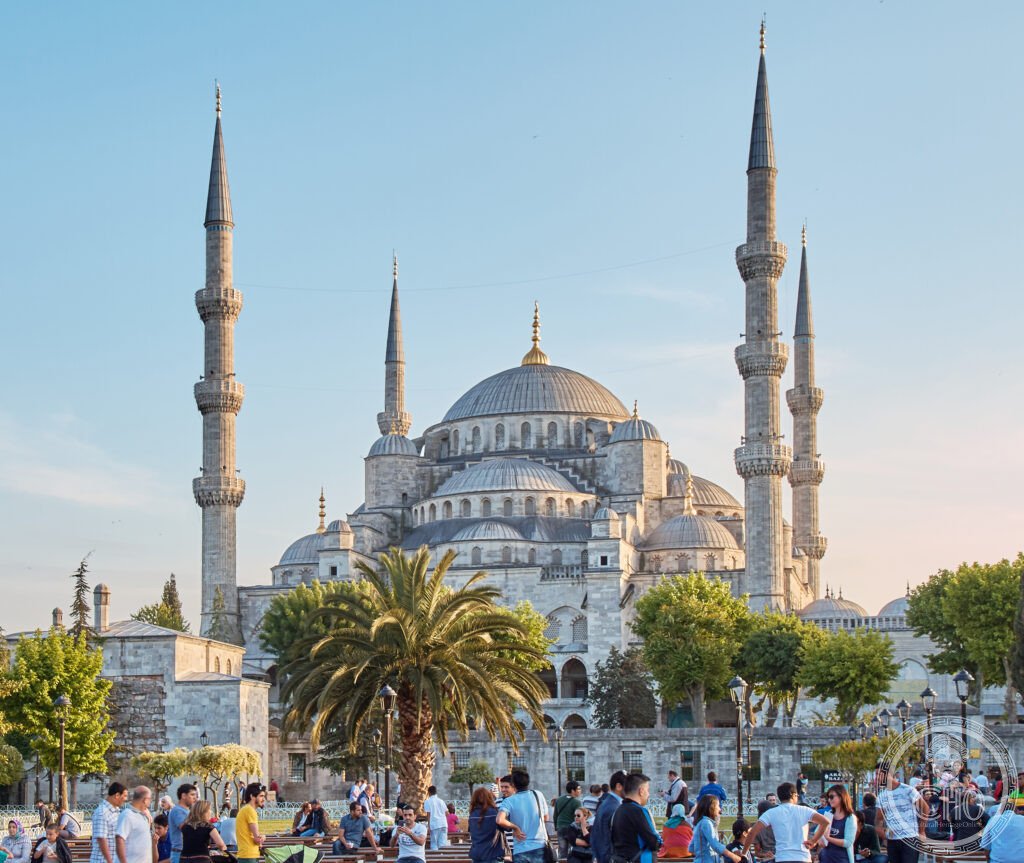
Six minarets, a sequence of cascading domes and more than twenty thousand hand-painted Iznik tiles set the Sultan Ahmed Mosque apart from every other mosque in Istanbul. Built to face Hagia Sophia across the old Hippodrome, it remains an active place of worship and the defining silhouette of the Sultanahmet skyline.
At a glance
The Sultan Ahmed Mosque, known popularly as the Blue Mosque for the blue and turquoise tones of its interior tilework, was raised on the orders of Sultan Ahmed I directly opposite Hagia Sophia. The two buildings face each other across the Hippodrome, and together they form one of the most discussed architectural pairings in the city. Its six minarets are unique among Istanbul’s mosques and caused a stir at the time, since the Grand Mosque of Mecca had the same number; a seventh minaret was added at Mecca to settle the matter.
The building is the work of Sedefkar Mehmed Aga, a pupil of the great Ottoman architect Sinan, and is generally read as his tribute to and reworking of his master’s style.
Key facts
- Built: 1609–1616
- Architect: Sedefkar Mehmed Aga, pupil of Sinan
- Patron: Sultan Ahmed I, who commissioned the mosque aged nineteen and died in 1617 before its decoration was complete
- Minarets: six, the only mosque in Istanbul with this number
- Tiles: more than 20,000 hand-painted Iznik ceramic tiles
- Structure: a central dome flanked by eight secondary domes and four semi-domes, with around 260 windows
History
The mosque belongs to the late flowering of Ottoman architecture that follows directly from Sinan, whose own masterpieces were the Süleymaniye Mosque in Istanbul and the Selimiye Mosque in Edirne. Sedefkar Mehmed Aga trained under Sinan and designed the Blue Mosque as a development of his teacher’s ideas, giving the outer courtyard exactly the same footprint as the prayer hall itself.
Commissioning the mosque was controversial in its own day. Tradition held that a sultan should only build on this scale after a great military victory, and Ahmed I had none to his name; the choice of six minarets, matching the Grand Mosque of Mecca, added to the unease until a seventh minaret was built there. Ahmed I died in 1617, aged twenty-seven, without seeing the mosque fully decorated.
The Blue Mosque has been in continuous use since it opened and, together with Hagia Sophia, forms part of the Historic Areas of Istanbul, inscribed as a UNESCO World Heritage Site in 1985. Since 2020, when Hagia Sophia was reconverted from a museum into a mosque, both buildings that face each other across the Hippodrome are again active places of worship.
What you see
Visitors generally find the interior more striking than the exterior. The domes cascade from the centre outward, and daylight filtering through the many windows gives the prayer hall an unusually luminous, almost weightless quality. The finest Iznik tilework, dating from a period when the potteries of Iznik were already past their peak, is concentrated in the upper galleries originally set aside for women.
Large calligraphic roundels on the piers carry the names of Allah, Muhammad and the first four Caliphs. The floor of the prayer hall is laid with a single red carpet, replaced periodically by the Turkish Directorate of Religious Affairs.
Practical information
- Dress code: shoulders, legs and head covered for women, shoes removed before entering
- Access: the mosque closes to visitors during the five daily prayer times; a separate entrance is used for tourists to keep worshippers undisturbed
- Current arrangements: for up-to-date entry conditions and any charges, check with the mosque’s own administration or official visitor information before travelling
Getting there
The mosque sits in the Sultanahmet district and is reached by the T1 tram line, alighting at the Sultanahmet stop. From Taksim, take the M2 metro to Vezneciler and continue on the T1 tram. It is within walking distance of the Grand Bazaar and the other Sultanahmet sights.
Nearby
- Hagia Sophia — a short walk away across the Hippodrome; built 532–537 under Justinian I, it was for centuries the largest building of its kind and was reconverted from museum to mosque in 2020.
- Topkapi Palace — nearby to the northeast; the administrative and residential seat of the Ottoman sultans from 1465 to 1856, with a treasury holding relics including the Topkapi Dagger and the Spoonmaker’s Diamond.
- Basilica Cistern — a short walk to the west; an underground Byzantine reservoir of 532 built under Justinian I, supported on 336 marble columns and including two inverted Medusa-head column bases.
Sources
- Wikipedia (Sultan Ahmed Mosque; Sedefkar Mehmed Aga; Hippodrome of Constantinople; Iznik pottery)
- UNESCO, Historic Areas of Istanbul, World Heritage reference 356
- Godfrey Goodwin, A History of Ottoman Architecture, Thames & Hudson, 1971
Find it on the map
See this place and what’s around it →📷 Become a Cultural Heritage Online photographer
Share your photos of places: they stay published under your name as the author. The more they're seen, the more you get noticed — and soon a contest will reward the most appreciated photos.
Log in or sign up free to add a photoIs this page about you?
This page is read by travellers and heritage enthusiasts who find it on Google. Tell us how you are connected to this place and we will take it from there.