
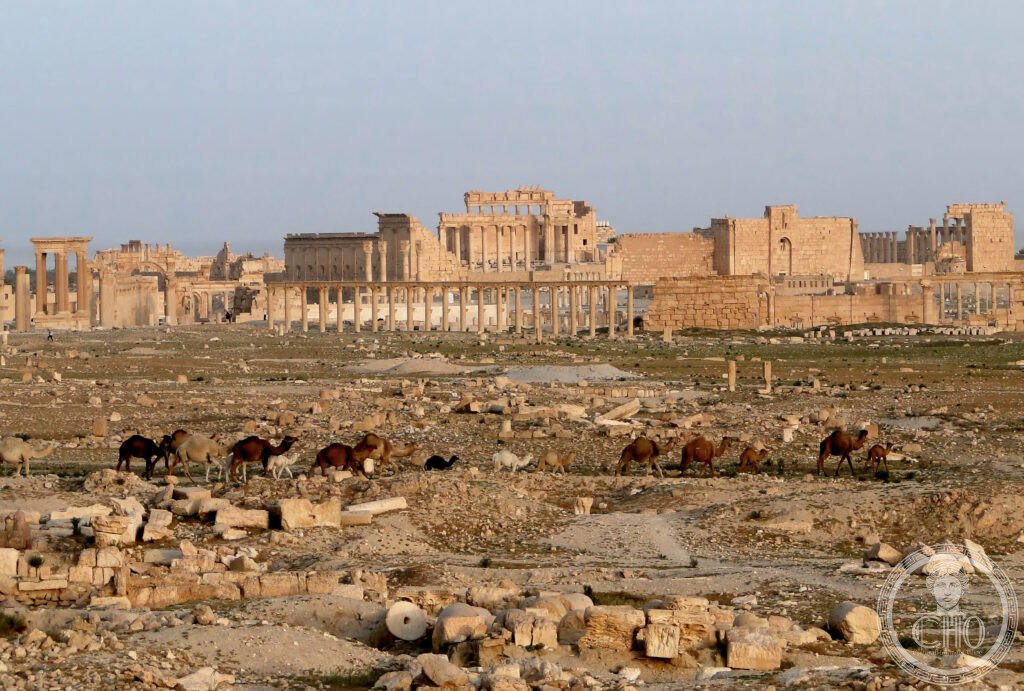
Palmyra was the great oasis city of the Silk Road, a meeting point of Roman and Persian culture and the seat, briefly, of Queen Zenobia’s breakaway empire. Much of its ancient fabric was deliberately destroyed by the Islamic State between 2015 and 2017, and the site now stands as both a monument and a wound.
At a glance
Palmyra grew rich as a caravan city in the Syrian Desert, taxing and servicing the trade that passed between the Mediterranean and Mesopotamia. Its merchants established colonies as far afield as Rome and Dura-Europos, and its architecture fused Roman, Persian and local Syrian traditions, a blend also visible in its use of Aramaic alongside Greek.
The city is inseparable from the story of Queen Zenobia, who briefly carved out an empire from Rome, and from the more recent history of its partial destruction by the Islamic State, an act that has made Palmyra a symbol of both ancient sophistication and modern loss.
Key facts
- Queen Zenobia: in 272-273 CE she expanded Palmyrene rule into Egypt, Asia Minor and Syria; the resulting empire lasted only two years before the Roman emperor Aurelian defeated her at the Battle of Immae and captured her; her ultimate fate is disputed.
- Temple of Bel: dedicated in 32 CE to the supreme Palmyrene deity Bel, combining Greek architectural form with Semitic religious content; its inner sanctuary was destroyed by the Islamic State in 2015, though the outer colonnade survived.
- 2015-2017 destruction: the Islamic State captured Palmyra in May 2015, destroyed the Baalshamin Temple entirely that August, demolished the Arch of Triumph and partially destroyed the Tetrapylon.
- Khaled al-Asaad: the site’s 83-year-old chief archaeologist, who had devoted his career to Palmyra and refused to disclose where artefacts had been hidden, was publicly executed there in August 2015.
- Heritage status: inscribed as the Site of Palmyra on the UNESCO World Heritage list in 1980, and placed on the List of World Heritage in Danger in 2013.
History
Palmyra, known in antiquity as Tadmor, is first attested in texts from the second millennium BCE and appears in Assyrian sources. It came under Roman rule in 19 CE under the emperor Tiberius and reached its height in the second and third centuries CE, when the Temple of Bel, the Great Colonnade and the Valley of the Tombs were built.
Arab-Muslim armies took the city in 634 CE, after which it went into gradual decline. It re-entered European awareness when English merchants trading out of Aleppo brought word of the ruins back in 1678.
The Syrian Civil War, which began in 2011, placed the site in danger, prompting its addition to the Endangered list in 2013. Islamic State forces then occupied and systematically damaged the city between 2015 and 2017.
What you see
Despite the damage, substantial ancient heritage survives. The outer colonnade of the Temple of Bel still stands even though its inner sanctuary was destroyed. Many columns of the Great Colonnade, once lined for over a kilometre with roughly 1,500 columns, remain in place, some rising nine metres and carrying the projecting bracket corbels characteristic of Palmyrene building.
The Valley of the Tombs preserves its tower tombs, some as tall as four storeys, a form found nowhere else in the ancient world; these largely escaped the worst of the destruction.
Practical information
- Access and security: the Syrian conflict remains unresolved; Palmyra changed hands more than once between government forces and the Islamic State before being permanently recaptured in March 2017. Most Western governments advise against all travel to Syria, so anyone considering a visit should check current official travel advisories rather than rely on published guides.
- Who visits: access at present is largely limited to journalists and archaeologists working under special arrangement.
- Digital access: several institutions have produced 3D models of Palmyra based on surveys carried out before 2015, and a 3D-printed replica of the Arch of Triumph was displayed in London’s Trafalgar Square in 2016. Palmyrene funerary portraits can be seen in the National Museum in Damascus, the Louvre, the British Museum and the Metropolitan Museum in New York.
- Documentation: the destruction was systematically recorded by the American Schools of Oriental Research Cultural Heritage Initiatives, and it contributed to wider international discussion, including at the International Criminal Court, of cultural destruction as a war crime.
Getting there
Palmyra lies about 240 kilometres northeast of Damascus. Reaching the site currently requires specialist arrangements because of the ongoing conflict, and most Western governments advise against travel to Syria altogether. In the meantime, digital models and virtual tours offer an alternative way to see the site.
Nearby
- Damascus — about 240 km southwest; a UNESCO World Heritage Site since 1979 and one of the world’s oldest continuously inhabited cities, home to the Umayyad Mosque, the Azm Palace and the old city souks.
- Crac des Chevaliers — about 120 km west, when accessible; a UNESCO World Heritage Site since 2006 and one of the best-preserved Crusader castles anywhere, held by the Knights Hospitaller from 1142 to 1271 and damaged during the civil war between 2012 and 2014.
- The Euphrates Valley — about 100 km northeast; includes the Roman-Parthian city of Dura-Europos, with a synagogue containing some of the oldest known narrative biblical paintings, and the Byzantine fortified sites of Halabiyeh and Zalabiyeh, though the area remains remote and requires specialist access.
Sources
- Wikipedia
- UNESCO
- Michael Sommer, Palmyra: A History, Routledge, 2018
Find it on the map
See this place and what’s around it →📷 Become a Cultural Heritage Online photographer
Share your photos of places: they stay published under your name as the author. The more they're seen, the more you get noticed — and soon a contest will reward the most appreciated photos.
Log in or sign up free to add a photoDo you manage this place?
This page is read by travellers and heritage enthusiasts who find it on Google. Keep it accurate — and make it work for you. Free for non-profit heritage institutions.