
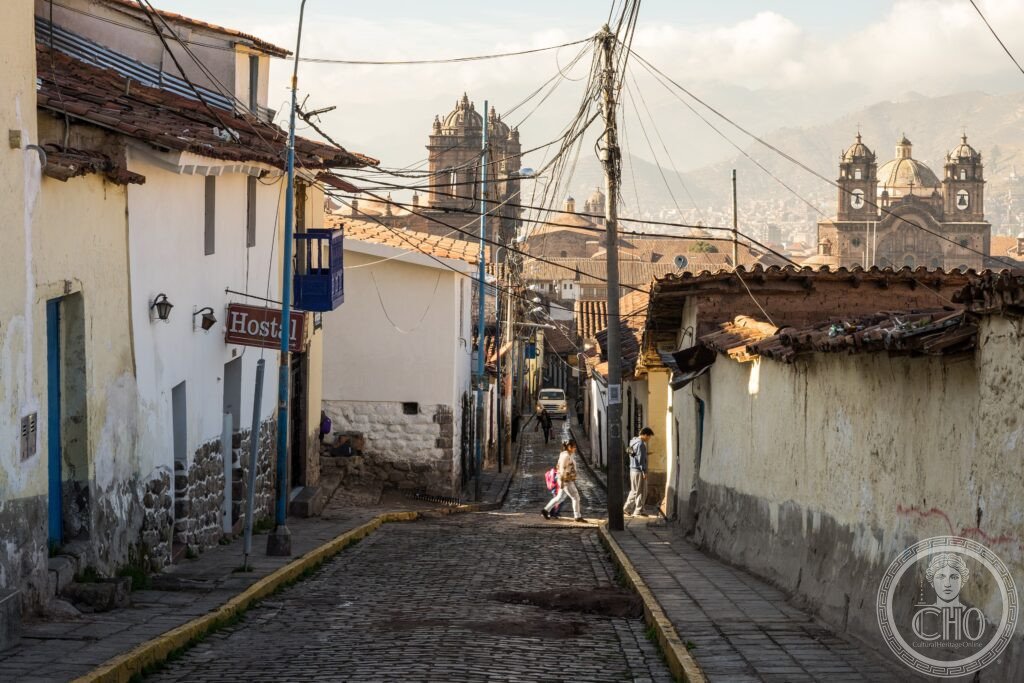
Cusco was the capital of the Inca Empire and remains a city where two civilisations sit visibly on top of one another: Inca stone foundations carry Spanish colonial buildings above them on almost every street, and the massive walls of Sacsayhuamán still stand on the hill above the old imperial centre.
At a glance
Cusco sits at 3,400 metres in a valley of the Peruvian Andes and was, in Quechua, called Qosq’o, “the navel of the world”. Its centre is built around the Plaza de Armas, known in Inca times as Huacaypata, where the Inti Raymi procession once ended and where important public and political events were staged. The square is now framed by the Cathedral of Cusco and by the Jesuit church of La Compañía de Jesús, both raised on the foundations of former Inca palaces. Around them run the polygonal Inca stone walls for which the city is best known, fitted without mortar and still standing after later colonial buildings on top of them were destroyed by earthquake.
Key facts
- Sacsayhuamán: a large Inca stone complex on a hill above Cusco, built from massive blocks and arranged in three parallel zig-zag terraces; it is the setting for the annual Inti Raymi, the Festival of the Sun.
- Qorikancha: the former Temple of the Sun, once lined with gold panels that the Spanish stripped away; the Church of Santo Domingo was later built directly onto its surviving Inca walls.
- Hatun Rumiyoc stone: a twelve-angled stone set into the wall of the former palace of Inca Roca, on Hatunrumiyoc Street, cited as an example of precise Inca stonework.
- Heritage status: the City of Cusco was inscribed as a UNESCO World Heritage Site in 1983.
- Coordinates: 13.5170° S, 71.9780° W.
History
Cusco’s foundation is traditionally attributed to Manco Cápac, said to have established the city around 1200 CE; the myth tells of him and Mama Ocllo emerging from Lake Titicaca. Under the emperor Pachacuti Inca Yupanqui, in the fifteenth century, Cusco grew from a regional kingdom into the capital of an empire stretching from present-day Colombia to Chile, and the city itself was reportedly redesigned in the shape of a puma.
Francisco Pizarro entered Cusco in November 1533, arriving as the Inca civil war was drawing to a close and shortly after the death of Atahualpa in Cajamarca. The Spanish subsequently built their colonial city over Inca foundations, including the Cathedral, constructed between 1560 and 1654 using stone taken from Sacsayhuamán, and the Church of Santo Domingo, raised on the walls of Qorikancha. The City of Cusco was inscribed on the UNESCO World Heritage List in 1983.
What you see
Walking through central Cusco means reading two cities stacked on one another: Inca stone foundations at street level, Spanish colonial architecture above. A common route runs from Hatunrumiyoc Street, past the twelve-angled stone, to Qorikancha, then on to the Plaza de Armas and the Cathedral, whose floodlit facade stands out against the Cathedral square in the evening.
Sacsayhuamán lies a short distance uphill from the Plaza de Armas and can be reached by taxi or on foot; its zig-zag terrace walls are at their most striking in the low light of early morning. Qorikancha, with its combination of Inca masonry and the colonial church built over it, and its adjoining museum, forms part of the same historic circuit. The Sacred Valley, with sites such as Pisac and Ollantaytambo, is generally treated as a separate day trip from the city.
Practical information
- Altitude: Cusco sits at roughly 3,400 metres and altitude sickness is a genuine risk for arriving visitors; allowing time to acclimatise before continuing to Machu Picchu is recommended, and coca tea, widely available and legal in Peru, is commonly used locally as a remedy. Anyone concerned about altitude should seek medical advice in advance.
- Boleto Turístico: a combined ticket, issued through the COSITUC office, covers a number of Cusco’s main heritage sites, including Sacsayhuamán and other Inca sites in and around the Sacred Valley; it does not include Machu Picchu. Current prices and validity should be checked with COSITUC directly.
- The Sacred Valley: stretching between Pisac and Ollantaytambo at lower altitude than Cusco itself, it includes Pisac’s terraced agricultural complex and Sunday market, and Ollantaytambo, whose street grid still follows its original Inca layout and which serves as a departure point for trains towards Machu Picchu.
Getting there
Cusco is served by Alejandro Velasco Astete Airport, a short distance south of the Plaza de Armas. Given the city’s altitude, visitors are generally advised to spend a couple of days acclimatising in Cusco before travelling on to Machu Picchu or other high-altitude sites.
Nearby
- Sacsayhuamán — a short distance uphill from the Plaza de Armas, the large Inca stone complex above the city.
- Qorikancha — in central Cusco, the former Temple of the Sun beneath the Church of Santo Domingo.
- Pisac — in the Sacred Valley, known for its Inca terraces and market.
- Ollantaytambo — in the Sacred Valley, an Inca town with its original street grid still in use, and a departure point for trains towards Machu Picchu.
Sources
- UNESCO
- COSITUC
Find it on the map
See this place and what’s around it →📷 Become a Cultural Heritage Online photographer
Share your photos of places: they stay published under your name as the author. The more they're seen, the more you get noticed — and soon a contest will reward the most appreciated photos.
Log in or sign up free to add a photo