
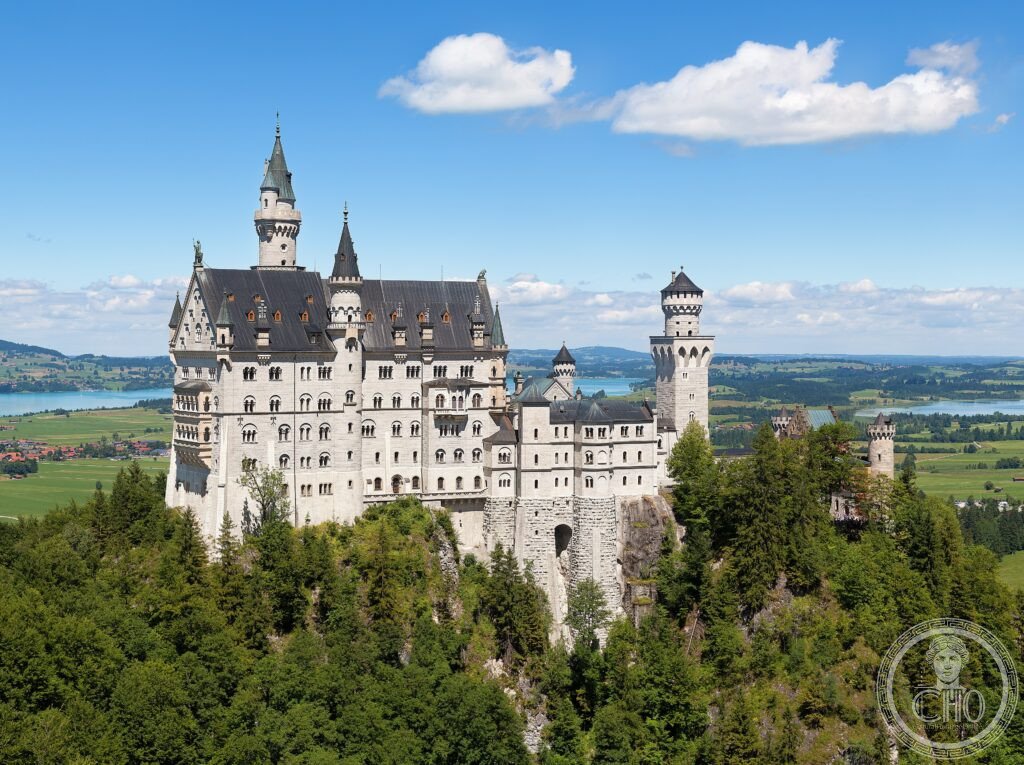
A king who could not bear to be looked at built a castle that is now among the most looked-at buildings on earth. Ludwig II of Bavaria meant Neuschwanstein as a retreat from the court and a stage set for Wagner’s operas; he died before it was finished, and within weeks the state was selling tickets to see it.
At a glance
Neuschwanstein stands on a spur of rock above the Pöllat gorge in the Bavarian Alps, on the site of two ruined medieval castles. Ludwig II commissioned it in 1868 and building began the following year; it was conceived not by an architect in the first instance but by Christian Jank, a theatrical scene painter, with the architects Eduard Riedel, Georg von Dollmann and Julius Hofmann turning the drawings into masonry. The result is Romanesque Revival in style and operatic in intent: a medieval castle as the nineteenth century imagined one, built with the engineering of its own day. In July 2025 UNESCO inscribed it, together with Linderhof, Herrenchiemsee and the royal house on the Schachen, as the Palaces of King Ludwig II of Bavaria.
Key facts
- Unfinished: of the two hundred and more rooms planned, only about fifteen were ever completed. The rest are bare masonry, and the building stopped where it stood when the money and the king ran out.
- Wagner everywhere: the decoration follows the operas rather than Bavarian history — Tannhäuser, Lohengrin, Parsifal. The Singers’ Hall was modelled on the hall at the Wartburg and, in Ludwig’s lifetime, never hosted a performance.
- The Throne Room without a throne: the Byzantine-styled hall was finished except for the throne itself, which was never made.
- The king’s death: Ludwig was declared unfit to rule and deposed in June 1886. On 13 June he was found dead in the shallows of Lake Starnberg, along with the psychiatrist who had certified him. The cause has never been established, and the case remains open to argument rather than settled.
- Opened at once: the castle was shown to paying visitors within weeks of his death, to recover what its construction had swallowed. It has been open ever since.
- Heritage: UNESCO World Heritage Site since 2025, as part of The Palaces of King Ludwig II of Bavaria. Owned by the Free State of Bavaria and run by the Bavarian Palace Department.
- GPS: 47.5576° N, 10.7498° E
History
Ludwig came to the throne in 1864 at eighteen and never took to it. He disliked ceremony and the Munich court, kept nocturnal hours, and put his energy and his money into building and into Richard Wagner, whose debts and demands he underwrote for years. After Bavaria lost its independence in the wars of German unification, the king’s remaining sovereignty was largely ceremonial, and the castles became the kingdom he could still rule. Neuschwanstein was the first and largest of them.
Construction ran from 1869 for the best part of two decades, financed from the king’s personal fortune and civil list rather than the state treasury, and it consumed both. By the 1880s Ludwig was borrowing heavily and his ministers had had enough. In June 1886 a commission declared him insane without examining him, deposed him, and removed him to Berg on Lake Starnberg; he was dead within days. The castle he had built to be alone in opened to the public almost immediately, and the visitors have not stopped since — including Walt Disney, whose Sleeping Beauty Castle took its silhouette from here, which is why a building of the 1880s now reads to much of the world as the shape of a fairy tale.
What you see
From below, the castle is white limestone against grey rock, with the Alps behind it and the gorge dropping away beneath. The classic view is from the Marienbrücke, the footbridge Ludwig had thrown across the Pöllat ravine, which frames the building end-on above the waterfall.
Inside, the tour runs through the finished rooms: the Throne Room, gold-ground and apse-ended like a Byzantine church; the king’s bedroom, carved in oak over years by more than a dozen woodworkers; the artificial grotto built into the living quarters; and the Singers’ Hall under the roof. The contrast with the unfinished floors is the most instructive thing in the building — and so is the technology behind the medievalism, which included a steel frame in places, central heating, running water on every floor and a telephone line.
Practical information
- Tickets: the interior can be seen only on a guided tour with a timed slot, bought in advance through the Bavarian Palace Department’s ticket service. Slots sell out well ahead in summer; arriving without one usually means not getting in.
- Getting up: the castle sits above the village of Hohenschwangau; the climb takes half an hour or so on foot, with shuttle buses and horse-drawn carriages running in season. The Marienbrücke closes in bad weather and for maintenance.
- Photography: not permitted inside. The tours are brisk and on a fixed route.
Getting there
The nearest station is Füssen, with buses to Hohenschwangau in about ten minutes; Füssen is reached by train from Munich in a little over two hours. By road the castle is signposted from the B17. GPS: 47.5576, 10.7498.
Nearby
- Hohenschwangau Castle — in the village below; the neo-Gothic castle where Ludwig grew up, and from whose windows he watched Neuschwanstein being built.
- Linderhof Palace — 50 km east; the only one of Ludwig’s palaces he lived to see completed, and part of the same World Heritage inscription.
- Wieskirche — 25 km north; the Rococo pilgrimage church in the meadows, a UNESCO World Heritage Site in its own right since 1983.
Sources
- Bayerische Schlösserverwaltung (Bavarian Palace Department) — official site of Schloss Neuschwanstein and of the World Heritage nomination
- UNESCO World Heritage Centre, The Palaces of King Ludwig II of Bavaria: Neuschwanstein, Linderhof, Schachen and Herrenchiemsee, inscribed 2025 (reference 1726)
- Encyclopaedia Britannica, Neuschwanstein Castle and Ludwig II of Bavaria
Find it on the map
See this place and what’s around it →📷 Become a Cultural Heritage Online photographer
Share your photos of places: they stay published under your name as the author. The more they're seen, the more you get noticed — and soon a contest will reward the most appreciated photos.
Log in or sign up free to add a photoIs this page about you?
This page is read by travellers and heritage enthusiasts who find it on Google. Tell us how you are connected to this place and we will take it from there.