

The world’s first national park sits atop an active supervolcano, holding more geysers, hot springs and fumaroles than anywhere else on Earth. Beyond the geothermal spectacle, Yellowstone protects one of the last intact large-mammal ecosystems in the northern hemisphere, from wild bison herds to reintroduced wolf packs roaming the Lamar Valley.
At a glance
Yellowstone National Park was established on 1 March 1872 by President Ulysses Grant, making it the world’s first national park and the model for national parks created afterwards, both in the United States and internationally. It was inscribed as a UNESCO World Heritage Site in 1978, the first natural site added to the inaugural World Heritage List.
The park sits directly above the Yellowstone Hotspot, a column of superheated mantle rock rising from deep within the Earth. The Yellowstone Caldera, measuring roughly 72 by 55 kilometres, formed 640,000 years ago during the most recent of three major eruptions, the earlier two having occurred 2.1 million and 1.3 million years ago. The caldera floor still rises and falls by several centimetres a year as the magma body beneath it shifts.
Key facts
- Established: 1 March 1872, by President Ulysses Grant
- World Heritage status: inscribed 1978
- Area: 8,983 km²
- Hydrothermal features: around 10,000, including some 500 geysers, roughly 60% of the world’s total
- Grand Prismatic Spring: about 91 metres in diameter, the largest hot spring in the United States and the third largest in the world
- Bison herd: around 5,000 animals, the largest bison population in any single protected area in the world
History
The Shoshone people, known as the Tukudika or “Sheep Eaters”, lived in the Yellowstone area year-round before European settlement, hunting bighorn sheep in the high mountains through the summer months.The park’s geological history stretches back far further: the Yellowstone Caldera has been shaped by three major eruptions, the most recent 640,000 years ago, when the collapse of a vast magma chamber sent ash across roughly two thirds of the North American continent.
The nineteenth century brought catastrophe to the park’s wildlife. Bison, once numbering around 30 million across North America, were reduced to about a thousand individuals between 1865 and 1890 through systematic hunting; the Yellowstone herd is descended from the survivors. Wolves, eliminated from the ecosystem, were reintroduced in January 1995, when fourteen animals from Jasper National Park in Canada were released into the Lamar Valley, a moment regarded as one of the most significant wildlife reintroductions in American conservation history. The Yellowstone Wolf Project has tracked individual wolves by number ever since, in what is described as the longest continuous wolf study in the world.
What you see
The Upper Geyser Basin holds one of the densest concentrations of geysers anywhere, including Old Faithful, whose eruptions occur roughly every 35 to 120 minutes and can reach up to 56 metres, and the Grand Geyser, which erupts less frequently but taller, at 49 to 61 metres. The Castle Geyser, with a sinter cone estimated at 10,000 to 15,000 years old, is thought to be the oldest geyser formation in the park. In the Norris Geyser Basin, the hottest and most thermally active part of the caldera, the Steamboat Geyser is the tallest active geyser on Earth, with major eruptions reaching more than 90 metres, though its eruptions occur unpredictably, sometimes years apart.
Grand Prismatic Spring is the park’s best-known hydrothermal feature, its surface waters reaching around 70°C and its deep central pool, too hot for microbial life, close to 89°C. The rings of colour spreading outward, through yellow, orange and red, are produced by heat-loving bacteria and archaea living in progressively cooler water; one such organism, Thermus aquaticus, isolated from the park’s Mushroom Pool in 1969, is the source of the Taq polymerase enzyme used in the polymerase chain reaction, a foundational tool of modern molecular biology.
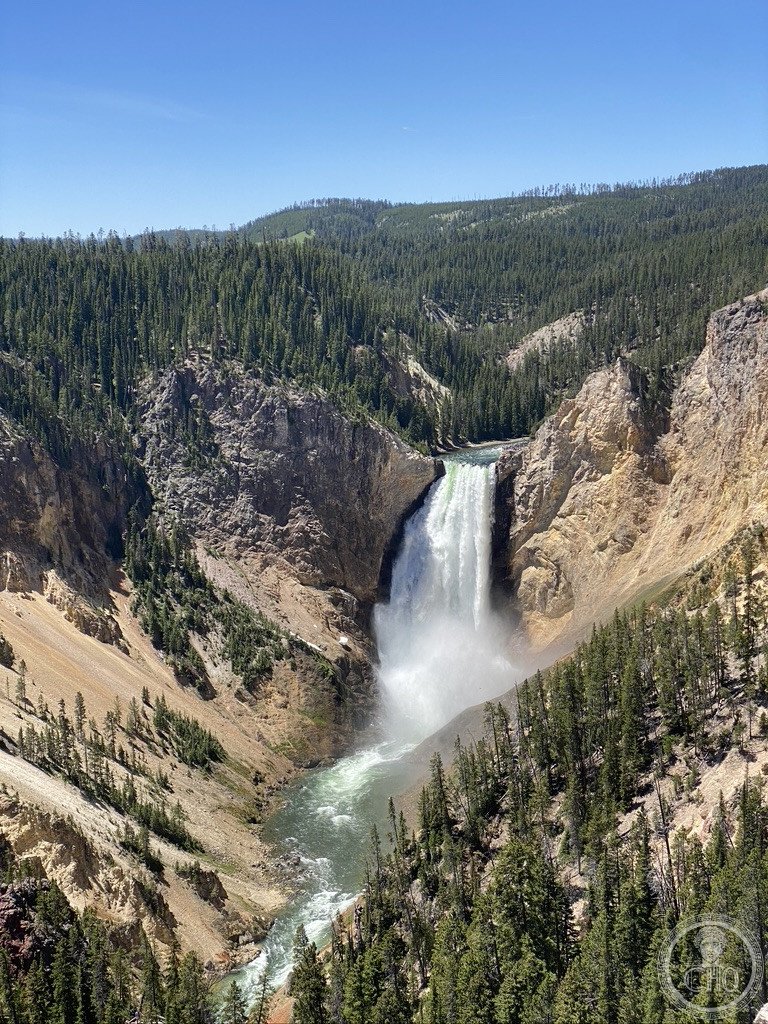
The Grand Canyon of the Yellowstone carries a waterfall through walls of yellow and orange rhyolite rock. In the Lamar Valley, dawn and dusk between June and October often bring sightings of bison, elk, pronghorn, coyote and wolf within the same stretch of grassland.
Practical information
- Monitoring: the USGS Yellowstone Volcano Observatory tracks ground deformation, seismicity and hydrothermal activity continuously; scientific consensus holds that no full caldera eruption is expected for thousands of years.
- Visiting: check the National Park Service’s official channels for current entrance requirements, road access and seasonal closures before travelling.
- Wildlife viewing: the Lamar Valley is considered the most reliable area for multi-species sightings, particularly at dawn and dusk.
Getting there
Yellowstone straddles the borders of Wyoming, Montana and Idaho within the Rocky Mountains. Access is via the park’s network of entrance roads from surrounding gateway communities; travellers should consult the National Park Service for current route and seasonal access information.
Nearby
- Upper Geyser Basin — home to Old Faithful, the Grand Geyser and the Castle Geyser, within a small area holding around 150 geysers.
- Norris Geyser Basin — the hottest and most thermally active part of the caldera, site of the Steamboat Geyser.
- Grand Canyon of the Yellowstone — a rhyolite gorge with a major waterfall.
- Lamar Valley — open grassland known for concentrated large-mammal sightings.
Sources
- USGS Yellowstone Volcano Observatory
- Yellowstone Wolf Project
- UNESCO World Heritage List
Find it on the map
See this place and what’s around it →📷 Become a Cultural Heritage Online photographer
Share your photos of places: they stay published under your name as the author. The more they're seen, the more you get noticed — and soon a contest will reward the most appreciated photos.
Log in or sign up free to add a photo