
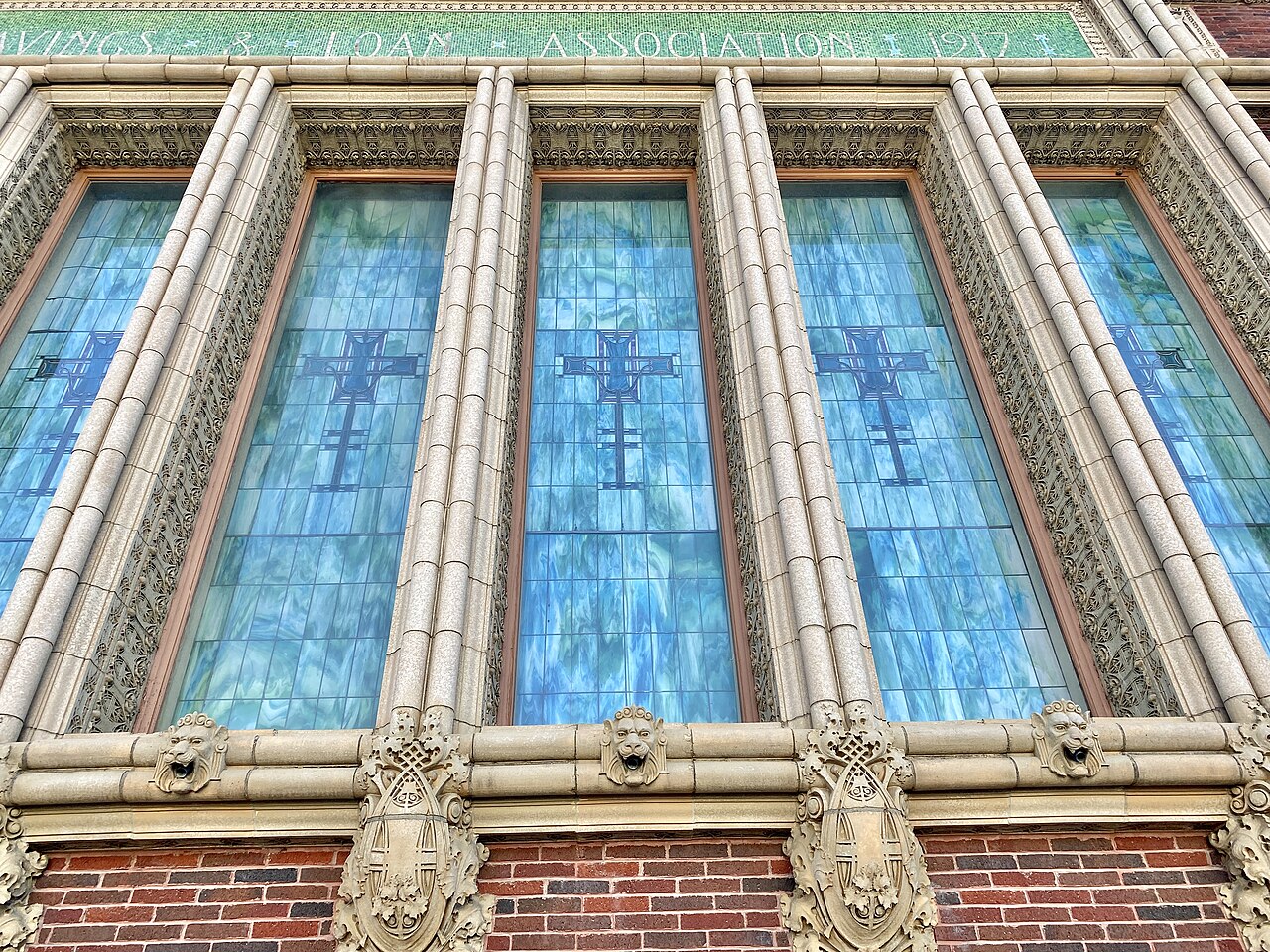
A small-town bank designed by a master: brick, terracotta and gold, with the word THRIFT spelled out in mosaic.
At a glance
On a corner of the courthouse square in Sidney, Ohio, stands one of the last works of Louis Sullivan, finished in 1917. It is one of his small-town “jewel box” banks: a compact brick block opened by a single great arch, set with terracotta ornament and a gold-and-blue mosaic frieze. Where a city bank shouted with columns, Sullivan made a small bank glow.
Key facts
- Location: Court and Ohio Streets, Sidney, Ohio
- Architect: Louis Sullivan
- Built: 1917
- Type: one of Sullivan’s late “jewel box” banks
- Style: Sullivanesque (American Art Nouveau ornament)
History
By the 1910s the big commissions had left Sullivan, and he poured his genius into a series of small Midwestern banks for clients who wanted dignity and trust. Sidney’s was among them, built for a local savings and loan.
He treated it as a careful composition of brick, terracotta and mosaic rather than borrowed classicism. Restored and still in banking use, it is counted among the finest of the jewel-box series.
What you see
The building is a tight brick cube broken by one tall arched window framed in ornament, with a band of blue-and-gold mosaic carrying the word THRIFT. Terracotta foliage curls at the corners and the cornice. Small as it is, every surface is considered, the late Sullivan in miniature.
Practical information
- Open: a working bank; interior in business hours
- Cost: free to view
- Best for: the arched window, mosaic and terracotta
- Time needed: 10–15 minutes
Getting there
The bank faces the courthouse square in downtown Sidney, in western Ohio, off Interstate 75 between Dayton and Lima.
Nearby
- Shelby County Courthouse — the Victorian courthouse on the square
- Downtown Sidney — the historic square around the bank
Sources
- Encyclopædia Britannica / Wikipedia — People’s Federal Savings and Loan Association
- National Park Service — National Historic Landmark record
- Wikimedia Commons — image source and licence
Find it on the map
See this place and what’s around it →Record researched and written by Luigi De Marchi for Cultural Heritage Online, 2026.
📷 Become a Cultural Heritage Online photographer
Share your photos of places: they stay published under your name as the author. The more they're seen, the more you get noticed — and soon a contest will reward the most appreciated photos.
Log in or sign up free to add a photoIs this page about you?
This page is read by travellers and heritage enthusiasts who find it on Google. Tell us how you are connected to this place and we will take it from there.