
Twenty thousand azulejos of Portuguese history in a station hall – the most beautiful railway vestibule in the world, on a convent’s ghost.
At a glance
- Type
- Railway station
- Period
- 1904-1916
- Style
- Beaux-Arts with azulejo program
- Location
- Praca Almeida Garrett, Porto, Portugal
- Coordinates
- 41.1456, -8.6105
- Architect
- Jose Marques da Silva; tiles Jorge Colaco
Overview
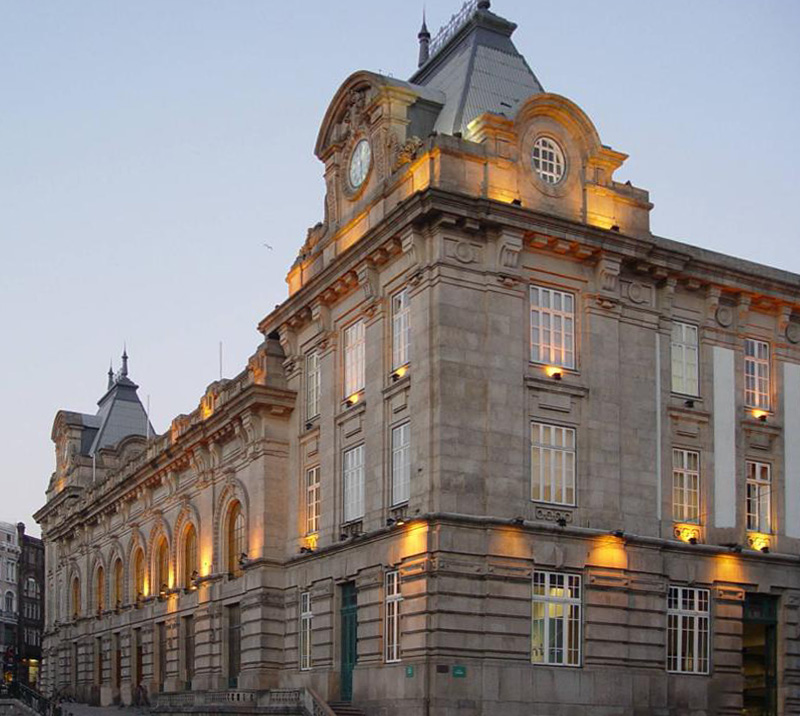
Sao Bento station replaced a Benedictine convent at Porto’s heart with a Parisian Beaux-Arts front by Marques da Silva – but its glory waits inside: Jorge Colaco’s 20,000 azulejo tiles (1905-1916) sheathing the vestibule with Portugal’s history in blue and white, from Joao I’s entry into Porto to the Conquest of Ceuta, crowned by a polychrome frieze of the railway’s own coming.
History
King Carlos I laid the first stone in 1900 on the secularized convent of Sao Bento de Ave Maria; the station opened fully in 1916 as the urban terminus of the Douro lines that carried port wine’s valley to the sea. Routinely listed among the world’s most beautiful stations, it remains a working hub whose commuters cross daily beneath the nation’s painted chronicle.
Architecture and Design
The mansarded stone front defers to the vestibule’s total tile environment – history panels below, an ethnographic frieze of river and harvest above, the ceiling’s painted beams completing Colaco’s decade of work. Azulejo, Portugal’s defining art, here achieves its civic masterpiece.
Cultural significance
Sao Bento concentrates Portuguese identity – tile, rail, history-telling – within Porto’s UNESCO-listed center, the station as national gallery. Its vestibule is the city’s most photographed interior.
Visiting today
The hall is open with rail traffic from early to late; mornings give clearest views. Douro valley trains depart upstairs – the line itself a heritage journey.
Getting there
Sao Bento metro station adjoins; the Se cathedral and Ribeira descend within minutes.
Sources and resources
Find it on the map
See this place and what’s around it →Record researched and written by Luigi De Marchi for Cultural Heritage Online, 2026.
📷 Become a Cultural Heritage Online photographer
Share your photos of places: they stay published under your name as the author. The more they're seen, the more you get noticed — and soon a contest will reward the most appreciated photos.
Log in or sign up free to add a photoIs this page about you?
This page is read by travellers and heritage enthusiasts who find it on Google. Tell us how you are connected to this place and we will take it from there.