
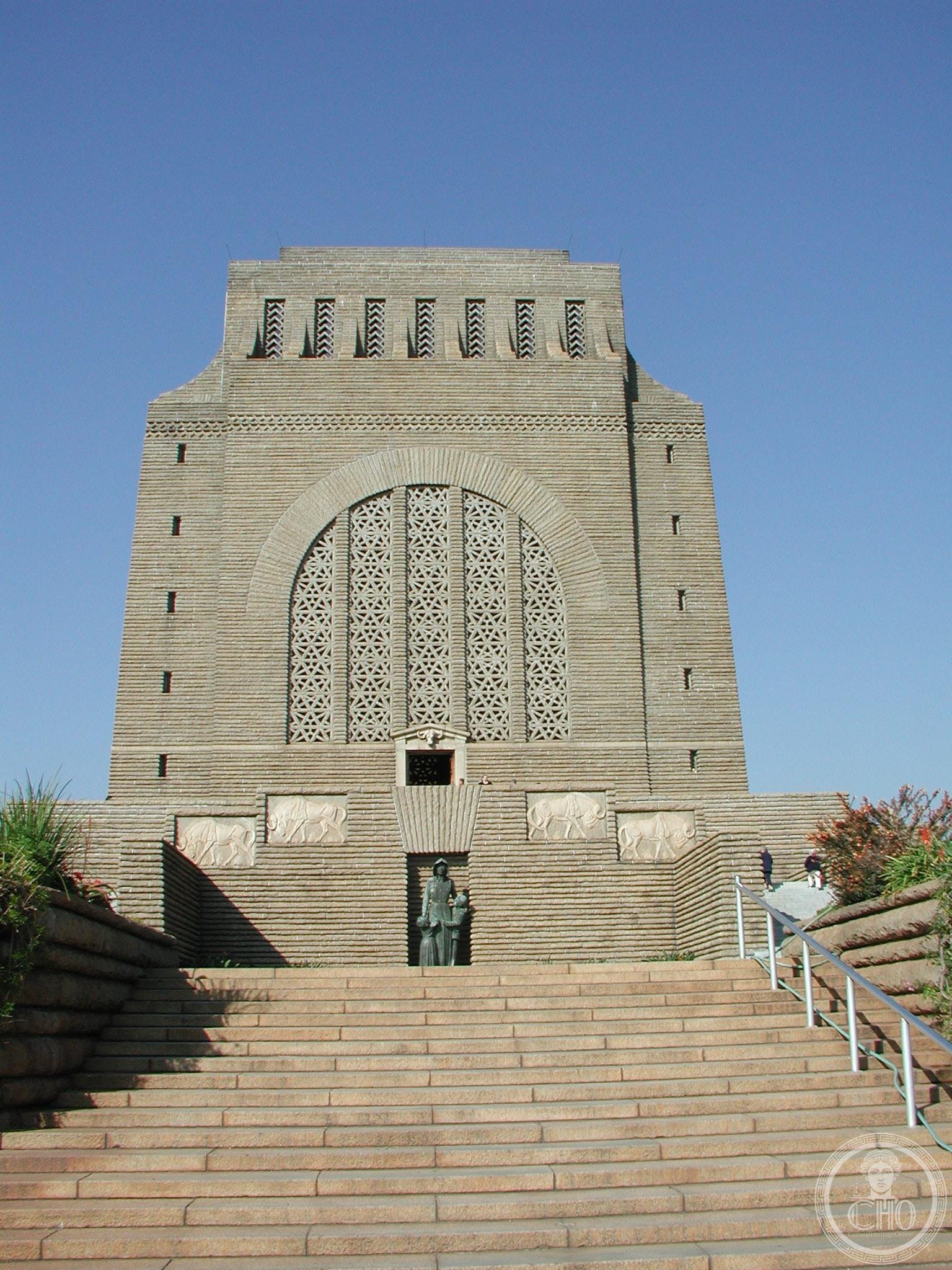
Rising from a hilltop south of Pretoria, the Voortrekker Monument is one of the most ambitious acts of commemorative architecture on the African continent. Completed in 1949, the massive 40-metre granite cube was designed by Gerhard Moerdijk to honour the Voortrekkers — Boer settlers who left the British Cape Colony during the Great Trek of 1835 to 1854 and pushed deep into the interior of southern Africa. The building synthesises monumental classicism with Art Deco geometric severity and Afrikaner nationalist symbolism on every surface. Its interior contains 27 marble bas-relief panels narrating the full story of the Trek, and a central cenotaph aligned so that a shaft of sunlight falls on it through a roof oculus at precisely noon on 16 December — the anniversary of the Battle of Blood River. The monument’s surrounding wall is carved with 64 ox wagons in laager formation. Declared a South African Heritage Site, it draws heritage tourists and historians as well as Afrikaner descendants, and appears on South Africa’s UNESCO World Heritage tentative list.
At a glance
- Type
- Commemorative monument and museum
- Period
- 1937–1949
- Style
- Monumental Classicism / Art Deco
- Location
- Voortrekker Monument Road, Pretoria, Gauteng, South Africa
- Coordinates
- 25.7808° S, 28.1759° E
- Architect(s)
- Gerhard Moerdijk
Overview
The Voortrekker Monument stands on Monument Hill, visible across the southern Pretoria skyline. Moerdijk’s design is a square granite block 40 metres on each side and 41 metres tall, clad in rough-hewn grey granite quarried near Pretoria. The severity of the exterior form contrasts dramatically with the richly decorated interior hall. The structure is surrounded by a monumental staircase, a forecourt with a statue of a Voortrekker woman and children by Anton van Wouw, and a perimeter wall carved with ox wagons. The monument functions simultaneously as cenotaph, museum, and national shrine.
History
The idea for a permanent monument to the Great Trek emerged at the 1938 Centenary celebrations, when a re-enactment trek across South Africa sparked an intense wave of Afrikaner nationalist feeling. Architect Gerhard Moerdijk was commissioned; the foundation stone was laid in 1938 and construction proceeded through the war years. The monument was inaugurated on 16 December 1949, the Day of the Vow, before an estimated crowd of 250,000. During the apartheid era it became the symbolic centre of Afrikaner identity. Post-1994, South Africa recontextualised it as a broader heritage site representing one chapter of a complex national history. Visitor numbers remained high through the transition and have grown further as international historical tourism expanded.
Architecture & Design
Moerdijk’s exterior is deliberately massive and plain — the granite walls are unbroken by windows, the cube form emphasising permanence and inevitability. The only external ornament is the frieze of ox-wagon laagers carved around the perimeter wall. Inside, the Hall of Heroes is lined with 27 white Italian marble bas-relief panels by sculptor Hennie Potgieter, each three metres high, illustrating episodes from the Trek. Above them, a balcony ring carries symbolic friezes. The centrepiece is a cenotaph inscribed “Ons vir jou, Suid-Afrika” (We for thee, South Africa). The oculus in the domed roof is precisely positioned so that sunlight illuminates the cenotaph at 12:00 on 16 December each year.
Cultural significance
The Voortrekker Monument is among the most contested heritage sites in South Africa, carrying layers of meaning that shift with political context. To Afrikaner families it is a sacred memorial to their ancestors’ sacrifices. To historians it is an exceptional example of nationalist architecture and a primary document of twentieth-century Afrikaner identity formation. To post-apartheid South Africa it presents the challenge faced by many nations: how to preserve and interpret monuments built by and for a dominant group in ways that serve a diverse democratic society. Its management has progressively embraced this complexity through multilingual interpretation and community outreach programmes.
Visiting today
The monument is open daily and is managed as a heritage museum with paid admission. Guided tours of the interior are available; the cenotaph sunlight alignment on 16 December draws large crowds and is a ticketed special event. The hill-top site has sweeping views over Pretoria. A visitor centre, cafe, and gift shop are on site. The surrounding nature reserve offers walking trails among the granite outcrops.
Getting there
The monument is located on Monument Road, approximately 6 km south of Pretoria city centre. By car: take the M7 south from central Pretoria; signposted from the N1 and N14. No direct public transport to the site; Uber and local taxis are the practical option from Pretoria Station or the Gautrain Pretoria stop. Organised half-day tours from Johannesburg (50 km north) are available through local operators.
Sources & resources
Find it on the map
See this place and what’s around it →Record researched and written by Luigi De Marchi for Cultural Heritage Online, 2026.
📷 Become a Cultural Heritage Online photographer
Share your photos of places: they stay published under your name as the author. The more they're seen, the more you get noticed — and soon a contest will reward the most appreciated photos.
Log in or sign up free to add a photoIs this page about you?
This page is read by travellers and heritage enthusiasts who find it on Google. Tell us how you are connected to this place and we will take it from there.