
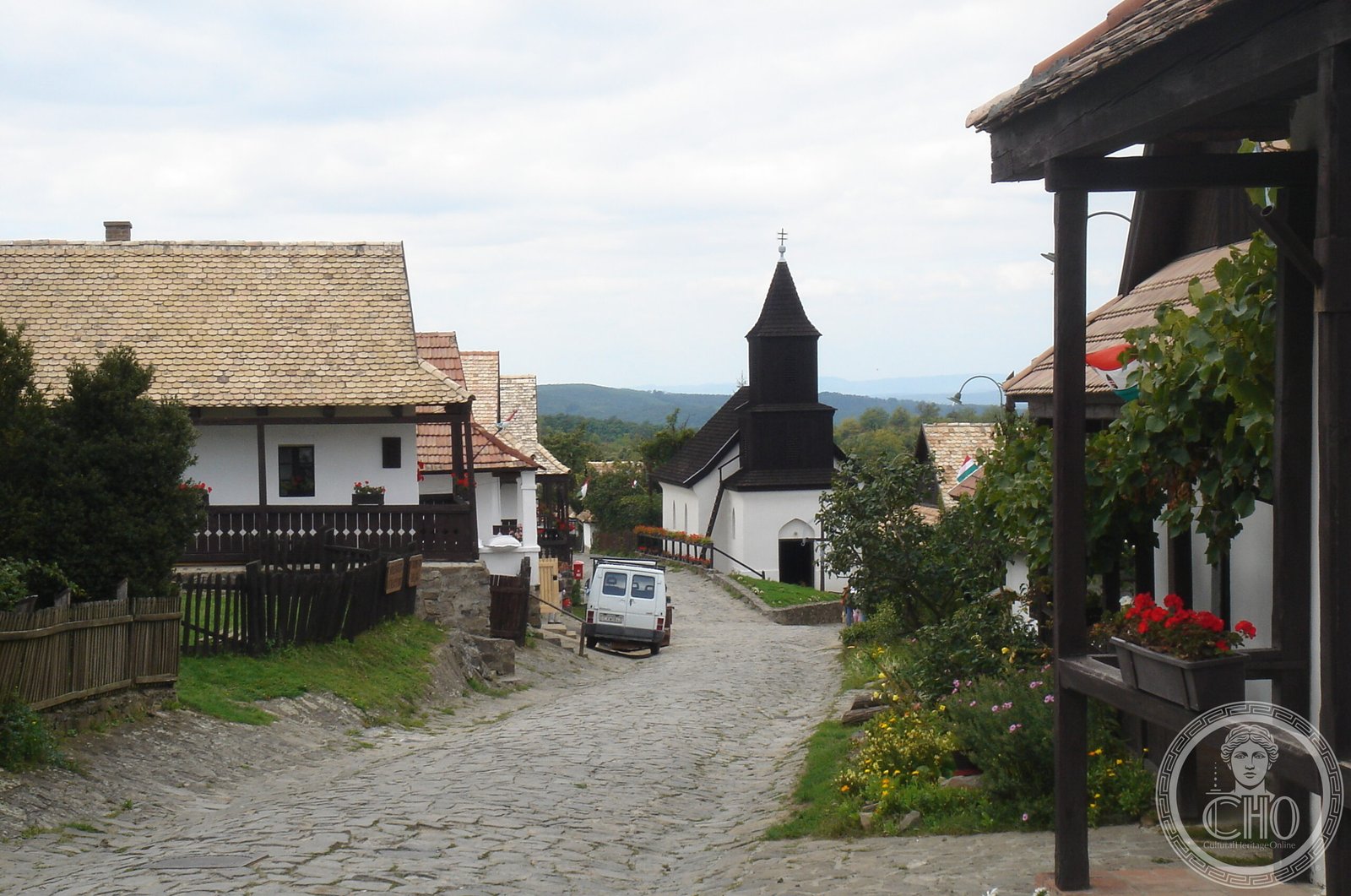
In the Cserhat hills of northern Hungary, a village of 400 people has preserved an entire vernacular world intact — whitewashed timber houses, carved wooden porches, embroidered costumes, and a folk calendar still measured by Easter water-sprinkling and hand-painted eggs. Holloko is the only UNESCO World Heritage Site inscribed specifically for Hungarian rural vernacular heritage.
At a glance
Holloko (Hungarian: raven stone) sits 100 km north of Budapest in Nogard County. Its 65 surviving old-village houses represent the Paloc ethnic building tradition: adobe or timber-frame structures with steep shingle roofs and wood-carved porches painted in geometric patterns of blue, red, and white. UNESCO inscribed the village in 1987 as the oldest and best-preserved example of a traditional Paloc settlement. Uniquely, it is not a museum — it remains actively inhabited.
Key facts
- UNESCO inscription: 1987, Cultural Heritage List (criteria III, V)
- Location: Nogard County, Northern Hungary; GPS 48.0024 N, 19.5866 E
- Population: approximately 400 permanent residents
- Building stock: 65 traditional houses in the protected old village
- Ethnic community: Paloc people, a distinct Hungarian ethnographic subgroup
- Castle: Holloko Castle, 13th-century ruins above the village
- Distance from Budapest: approximately 100 km north
History
The village grew up around Holloko Castle, a 13th-century fortification whose ruins still crown the hilltop. The current village fabric dates primarily from the late 17th and early 18th centuries. A fire in 1909 destroyed the village, but residents reconstructed it precisely according to the traditional layout and building type. The Paloc are a Hungarian ethnic subgroup with a distinctive dialect, embroidery tradition, and ritual calendar. Holloko became a protected monument in 1960 and a UNESCO WHS in 1987.
What you see
Walking the single cobbled street of the old village is an immersion in the Paloc vernacular world. Every house follows the same pattern: whitewashed adobe or timber-frame body, steeply pitched shingle roof, and wood-carved porch painted in blue, red, and white geometric patterns. Above the village, a ten-minute walk leads to the ruins of Holloko Castle with panoramic views over the Cserhat hills. The 18th-century Baroque church anchors the lower end of the village street.
Practical information
- Open: Village street always accessible; castle ruins seasonal hours
- Admission: Village free; ethnographic museum and castle small fee
- Best time: Easter (April–May) for water-sprinkling festival; summer for full village life
- Stay: Several guesthouses and rural B&Bs in the village
- Language: Hungarian; basic English at museum and guesthouses
Getting there
From Budapest: bus from Nepliget station (approx. 2 hours); by car via Road 22 through Balassagyarmat (approx. 1.5 hours). No railway at Holloko; nearest rail hub is Pasztó (20 km) with local bus connection. Driving recommended; free parking at the old village entrance.
Nearby
The Cserhat hills contain other traditional Paloc villages including Rimoc and Nograadmegyer. Szecsenyi (15 km) has a Franciscan church with Gothic frescoes. The Nogard region offers medieval castle ruins at Nogard Castle (20 km) and Somosko (40 km, Slovak border) for multi-day circuits.
Sources
- UNESCO WHL: Holloko Old Village No. 366 (1987)
- Wikipedia: Holloko
- Visit Hungary: visithungary.com
Find it on the map
See this place and what’s around it →
📷 Become a Cultural Heritage Online photographer
Share your photos of places: they stay published under your name as the author. The more they're seen, the more you get noticed — and soon a contest will reward the most appreciated photos.
Log in or sign up free to add a photo