
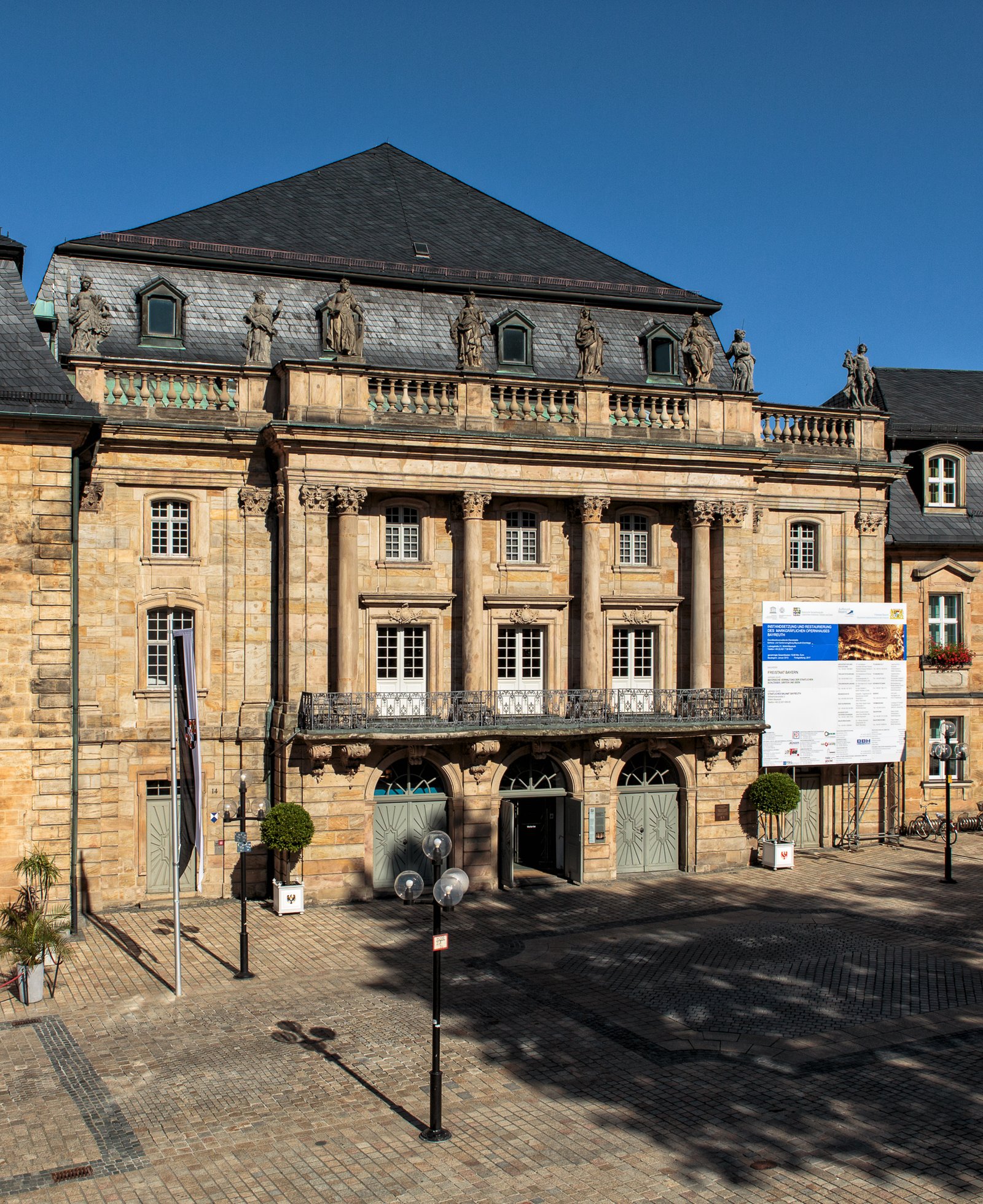
The best-preserved Baroque court theatre interior in the world — a gilded horseshoe of painted wood, original 18th-century stage machinery, and the accidental birthplace of Wagner’s Bayreuth dream.
At a glance
Built in 1748 for Margravine Wilhelmine of Brandenburg-Bayreuth — sister of Frederick the Great and one of the Enlightenment’s most accomplished women — the Margravial Opera House is the supreme surviving example of a European court opera house. Its interior of carved and gilded wood, painted to simulate marble and stucco, has survived virtually unaltered for 275 years. UNESCO inscribed it in 2012 as an outstanding example of Baroque theatrical architecture.
Key facts
- UNESCO inscription: 2012 (sole component)
- Built: 1745–1748 CE
- Architect (interior): Giuseppe Galli Bibiena, Italian High Baroque master
- Auditorium capacity: 500 seats in horseshoe plan
- Stage width: 27 metres — one of the widest in 18th-century Europe
- Stage machinery: Largely original 18th-century equipment, still functional
- Restoration: 2011–2018 (7 years, €28 million) after structural emergency
- Location: Opernstraße 14, Bayreuth, Bavaria, Germany
- Access: Bayerische Schlösserverwaltung (Bavarian Palace Administration)
History
Margravine Wilhelmine (1709–1758) was the intellectual equal of her brother Frederick the Great of Prussia — a composer, author, and passionate patron of the arts who transformed the small Franconian court of Bayreuth into a centre of Enlightenment culture. She commissioned the opera house as the centrepiece of her court life, entrusting the exterior to court architect Joseph Saint-Pierre and the interior to Giuseppe Galli Bibiena, a member of the most celebrated dynasty of Baroque theatrical designers in Europe.
The opera house opened in 1748 for the wedding of Wilhelmine’s daughter. After Wilhelmine’s death in 1758 the court declined and the theatre fell into disuse — which proved to be its salvation. Without patrons to modernise it, the interior was never remodelled or demolished as happened to nearly every comparable court opera house in Europe.
The building’s most consequential visitor arrived in 1871. Richard Wagner came to Bayreuth specifically because he had heard of this extraordinary opera house and hoped to use it for his cycle of music dramas. He found it too small and too Baroque — its aesthetic irreconcilable with his vision of total artwork stripped of aristocratic ornament. Instead he built his own purpose-built Festspielhaus on the Grüner Hügel hill above the town (completed 1876), which has hosted the annual Bayreuth Festival continuously since then (except for wartime interruptions). The Margravial Opera House meanwhile was preserved untouched as a separate monument.
By the early 21st century the interior was in critical structural danger — gilded surfaces delaminating, ceiling fresco at risk. A seven-year, €28 million restoration closed the building in 2011 and returned it to public use in 2018, with the stage machinery conserved and the auditorium restored to its 18th-century condition.
What you see
The exterior is a relatively plain Baroque town building — nothing prepares you for the interior. The auditorium is a horseshoe of three tiers of boxes whose carved wooden surfaces are painted and gilded to simulate marble pilasters, stucco reliefs, and draped fabrics. The technique — called faux marbre — allowed Wilhelmine’s court to achieve Baroque opulence at a fraction of the cost of stone. Under strong light the illusion is nearly complete; up close the brushwork is virtuosic.
The ceiling fresco above the open horseshoe depicts an allegory of the arts. The proscenium arch frames a stage 27 metres wide — equal to the full depth of the auditorium — with an opening that creates a seamless visual continuity between performance and audience space, characteristic of the Bibiena family’s Baroque perspective staging.
Behind the proscenium, the original 18th-century stage machinery — counterweight fly systems, wing chariots, trapdoors, a thunder machine — has been conserved in working order. A separate exhibition in the adjacent building explains Baroque stagecraft and the history of the Bibiena family.
Wagner connection
The relationship between Bayreuth’s two great opera venues is an irony of cultural history. Wagner’s Festspielhaus (1876) on the hill is the more famous — the annual Ring Cycle pilgrimages, the waiting lists of years for tickets, the green hill that has drawn conductors and singers as to a secular Mecca. Yet it exists precisely because Wagner rejected the Margravial Opera House as unsuitable. The 18th-century court theatre that Wagner found too small and too ornate is now UNESCO-inscribed; his purpose-built festival theatre on the hill is not.
Visitors can combine both in a single day: the Margravial Opera House in the morning, the Festspielhaus tour in the afternoon. The contrast — Baroque aristocratic splendour versus austere Wagnerian functionalism — is one of the great architectural arguments in European cultural history.
Practical information
- Address: Opernstraße 14, 95444 Bayreuth, Bavaria, Germany
- Opening hours: Tuesday–Sunday 09:00–18:00 (April–October); 10:00–16:00 (November–March); closed Mondays
- Admission: Adults €8; concessions €7; under 18 free; combined ticket with New Palace (Neues Schloss) available
- Guided tours: Available in German and English; audio guide included with admission
- Photography: Permitted without flash in most areas
- Restoration note: Reopened 2018 after 7-year closure; fully accessible
- Official website: Bayerische Schlösserverwaltung (schloesser.bayern.de)
Getting there
Bayreuth is served by regional rail from Nuremberg (approx. 1 hour). From Bayreuth Hauptbahnhof, the opera house is a 10-minute walk through the town centre. By car from Nuremberg: A9 motorway north, exit Bayreuth-Süd, approximately 45 minutes. The opera house has no dedicated parking but is close to the central Luitpoldplatz car park.
During the Bayreuth Festival (July–August) the town is extremely busy and accommodation must be booked many months in advance. The opera house itself remains open during the festival and is worth combining with a festival visit.
Nearby
- Bayreuth Festspielhaus (1.5 km) — Wagner’s festival theatre on the green hill, guided tours year-round outside festival season
- Neues Schloss Bayreuth (0.3 km) — Wilhelmine’s rococo palace, combined ticket available with the opera house
- Hermitage (Eremitage) Bayreuth (4 km) — Wilhelmine’s garden retreat with grotto, orangery, and sun temple, UNESCO tentative list
- Richard Wagner Museum (1 km) — Haus Wahnfried, Wagner’s villa, now a museum documenting his life and the festival’s history
- Fichtelgebirge mountains (30 km east) — forested upland ideal for hiking and cycling
Sources
- UNESCO World Heritage List: Margravial Opera House Bayreuth (WHC-12/36.COM/8B)
- Wikipedia: Margravial Opera House
- Bayerische Schlösserverwaltung: Official opera house page
- Bibiena family theatre design: Grove Dictionary of Art (Oxford University Press)
Find it on the map
See this place and what’s around it →📷 Become a Cultural Heritage Online photographer
Share your photos of places: they stay published under your name as the author. The more they're seen, the more you get noticed — and soon a contest will reward the most appreciated photos.
Log in or sign up free to add a photo