
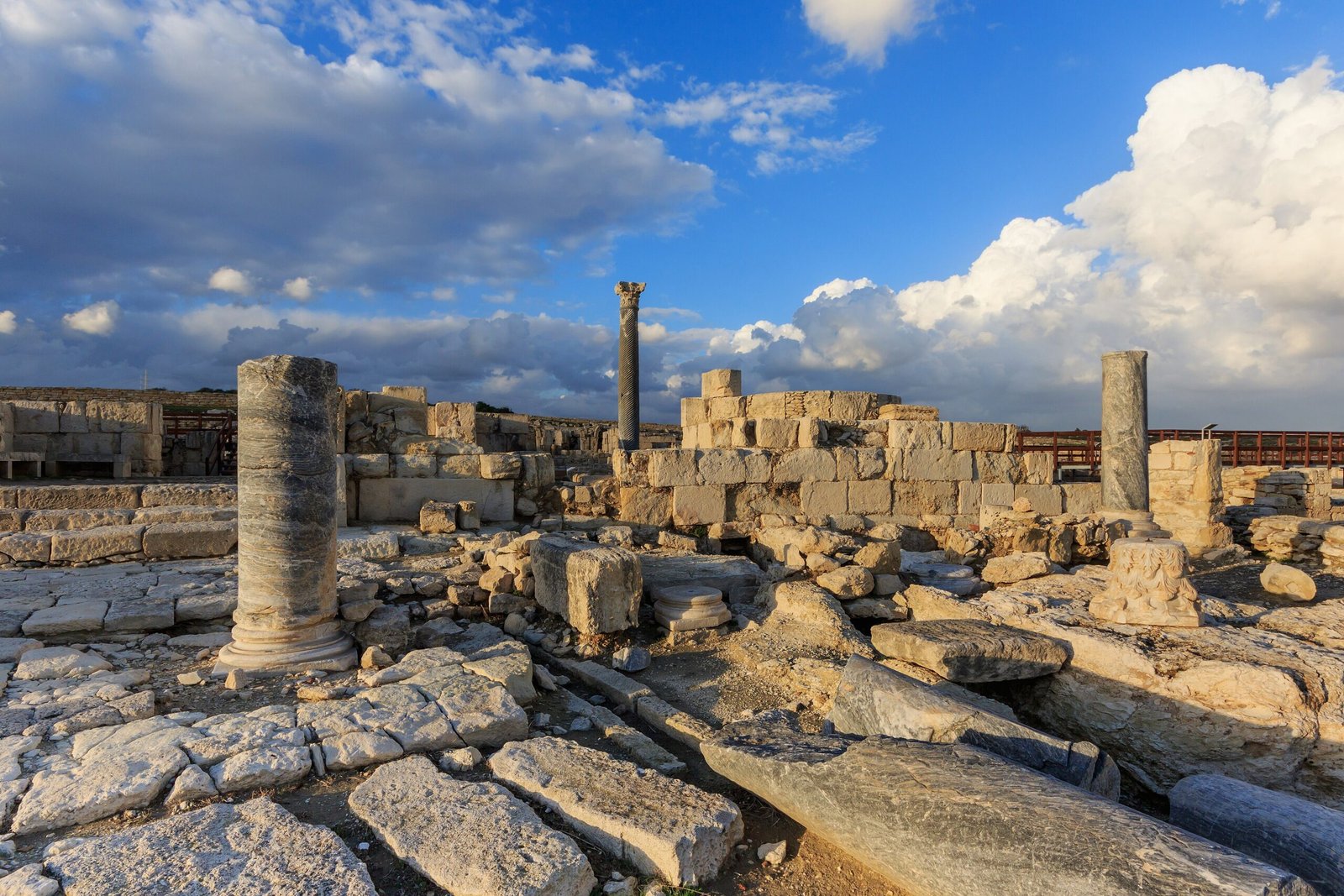
A dramatic Greco-Roman city perched on a high limestone promontory above the southern coast of Cyprus, whose extraordinary mosaics, clifftop theatre, and Roman baths survived long enough to be excavated — along with the skeletons of a family killed in their sleep by the catastrophic earthquake of 365 CE, among the most moving finds in Mediterranean archaeology.
At a glance
Kourion (in Latin, Curium) occupies one of the most spectacular archaeological settings in the entire Mediterranean: a sheer limestone headland some 70 metres above the sea, with views west along the rocky coast toward the Akrotiri peninsula. The site was occupied from at least the Chalcolithic period (c. 2400 BCE), colonised by Greek settlers from the Argolid around 1200 BCE (after the collapse of the Mycenaean world), and transformed into a prosperous Hellenistic and Roman city that reached its height in the 1st–4th centuries CE. In 365 CE, the catastrophic Crete earthquake — the largest seismic event in the ancient eastern Mediterranean — destroyed Kourion so completely that the city was never fully rebuilt. The Department of Antiquities of Cyprus has been excavating the site since the 1930s (with major campaigns by the University of Pennsylvania from 1934, and by the Cyprus American Archaeological Research Institute from 1974), gradually uncovering a city whose destruction-by-earthquake has preserved it in a state of frozen completeness rare in the ancient world.
Key facts
- Period: c. 2400 BCE (Chalcolithic) to 7th century CE (Byzantine abandonment)
- Greek colonisation: c. 1200 BCE; settlers from Argos according to ancient tradition (Herodotus)
- Roman period: Most surviving monuments date to 1st–4th century CE
- Destroying earthquake: 21 July 365 CE — the Crete (Hellenic Arc) earthquake, magnitude est. 8.0+
- Key monuments: Theatre, House of Eustolios, House of Achilles, House of Gladiators, Agora, Nymphaeum, Sanctuary of Apollo Hylates (nearby)
- Famous find: Earthquake family — skeletons of a man, woman, and infant child, found huddled together in their collapsed house
- Location: Episkopi village area, Limassol District; about 14 km west of Limassol city
- Status: Managed by Department of Antiquities, Republic of Cyprus; partially under British Sovereign Base Area jurisdiction
History and significance
The earliest traces of human occupation at Kourion date to the Chalcolithic period, around 2400 BCE. The site continued through the Bronze Age, when it was part of the Late Bronze Age network of Cypriot cities trading with the Mycenaean world. After the Bronze Age collapse around 1200 BCE, Greek-speaking settlers from the Argolid (the region of Argos in mainland Greece) arrived at the site — a founding tradition recorded by Herodotus and confirmed by the archaeological evidence of a distinctively Mycenaean material culture appearing at Kourion in this period. From the 8th century BCE, Kourion was a city-kingdom, one of the ten city-kingdoms of Cyprus, and a significant participant in the complex politics of the island — sometimes aligning with Persia, sometimes with the Greek world. In 498 BCE, the Kourion king Stasanor famously defected from the Greek side to the Persians during a battle, contributing to a Greek defeat.
The Hellenistic and Roman periods were the city’s greatest era. The theatre — originally constructed in the 2nd century BCE and substantially rebuilt in the 2nd century CE — could seat approximately 3,500 spectators. The wealthy houses of the Roman city were adorned with exceptional floor mosaics: the House of Eustolios (a late Roman/early Christian building with Christian inscription mosaics and bathing complex), the House of Achilles (with a large mosaic depicting the revelation of Achilles to Odysseus at the court of Lycomedes), and the House of the Gladiators (with unique mosaic scenes of gladiatorial combat). The forum and agora area, the nymphaeum (monumental fountain), and the early Christian basilica complex are also visible.
On 21 July 365 CE, a massive earthquake — now estimated at magnitude 8.0 or above, centred on the Hellenic Arc south of Crete — struck the eastern Mediterranean. The resulting tsunami devastated Alexandria and the coasts of Libya and Sicily. At Kourion, the earthquake destroyed the city so completely and so suddenly that people were killed in their sleep; the site was partially reoccupied in the late 4th and 5th centuries CE but never recovered its former size or prosperity, and was finally abandoned after Arab raids in the 7th century CE.
The earthquake’s human face was revealed by the archaeologist David Soren of the University of Arizona, who excavated a small house in 1984 and found the remains of a young man, a young woman (approximately 19 years old, wearing gold earrings), and a small child (approximately 18 months old) — the woman and child in the man’s arms, all three killed as the walls collapsed around them at approximately 3 in the morning. The find has been dated to the 365 CE earthquake with high confidence. These three individuals are among the most famous earthquake victims in all of ancient Mediterranean archaeology.
What you see today
The main archaeological site of Kourion contains several distinct areas connected by footpaths across the headland. The theatre — reconstructed and still used for summer performances — is the first major monument encountered from the entrance, commanding extraordinary views across the sea. The House of Eustolios, immediately adjacent, preserves some of the finest late Roman mosaics in Cyprus in situ under protective roofing: geometric patterns, inscriptions, and figural scenes including a personification of Ktisis (Foundation/Creation) with a Roman measurement foot. The House of Achilles and House of the Gladiators preserve large mosaic panels. The ruins of the agora, nymphaeum, and early Christian basilica occupy the central plateau. A separate but closely related site approximately 4 km to the west is the Sanctuary of Apollo Hylates — the sacred precinct of Apollo Hylates (Apollo of the Woodland), one of the most important sanctuaries in ancient Cyprus, with its own museum and reconstructed colonnades.
Practical information
- Address: Kourion Archaeological Site, Episkopi, Limassol District (off the B6 coastal road)
- Opening hours: Daily 08:15–17:00 (winter); 08:15–19:30 (summer); check the Department of Antiquities website for current seasonal hours
- Admission: €4.50 adults; reduced rates for students; free for children under 12; combined ticket with Sanctuary of Apollo Hylates available
- On site: Visitor centre, small museum, reconstructed theatre (summer performances), walking paths; exposed headland — bring water and sun protection
- Time needed: 2–3 hours for the main site; additional 1 hour for the Sanctuary of Apollo Hylates
- Best visit: Morning or late afternoon; midday summer heat on the exposed headland is intense
Getting there
Kourion is approximately 14 kilometres west of Limassol city, accessible via the B6 coastal road. By car from Limassol, follow signs for Episkopi and Kourion; the site is clearly signposted from the B6. By public transport, intercity buses between Limassol and Paphos pass close to the site, with a stop near the turn-off for the archaeological site. Taxis from Limassol are a practical option. The site is commonly combined in a single day itinerary with Choirokoitia (about 35 km east) and the Sanctuary of Aphrodite at Kouklia (about 25 km west toward Paphos).
Nearby
- Sanctuary of Apollo Hylates — the main sanctuary of Apollo in ancient Cyprus, 4 km west; reconstructed colonnades, museum
- Kolossi Castle — 15th-century Crusader castle, seat of the Knights Hospitaller and origin of Commandaria wine, about 15 km east
- Choirokoitia — UNESCO Neolithic settlement, about 35 km east along the A1 motorway
- Paphos Archaeological Park — UNESCO WHS with exceptional late Roman mosaics, about 40 km west
- Akrotiri Salt Lake — flamingo-wintering wetland at the tip of the Akrotiri peninsula, about 10 km east
Sources
- Soren, D. and James, J. Kourion: The Search for a Lost Roman City. Anchor Press/Doubleday, 1988
- Department of Antiquities, Republic of Cyprus: Kourion Archaeological Site
- Cyprus American Archaeological Research Institute (CAARI) — excavation archives
- Nicolaou, K. The Historical Topography of Kourion and the Road Stations in Cyprus. Report of the Department of Antiquities of Cyprus, 1966
- Wikipedia: Kourion
Find it on the map
See this place and what’s around it →📷 Become a Cultural Heritage Online photographer
Share your photos of places: they stay published under your name as the author. The more they're seen, the more you get noticed — and soon a contest will reward the most appreciated photos.
Log in or sign up free to add a photo