
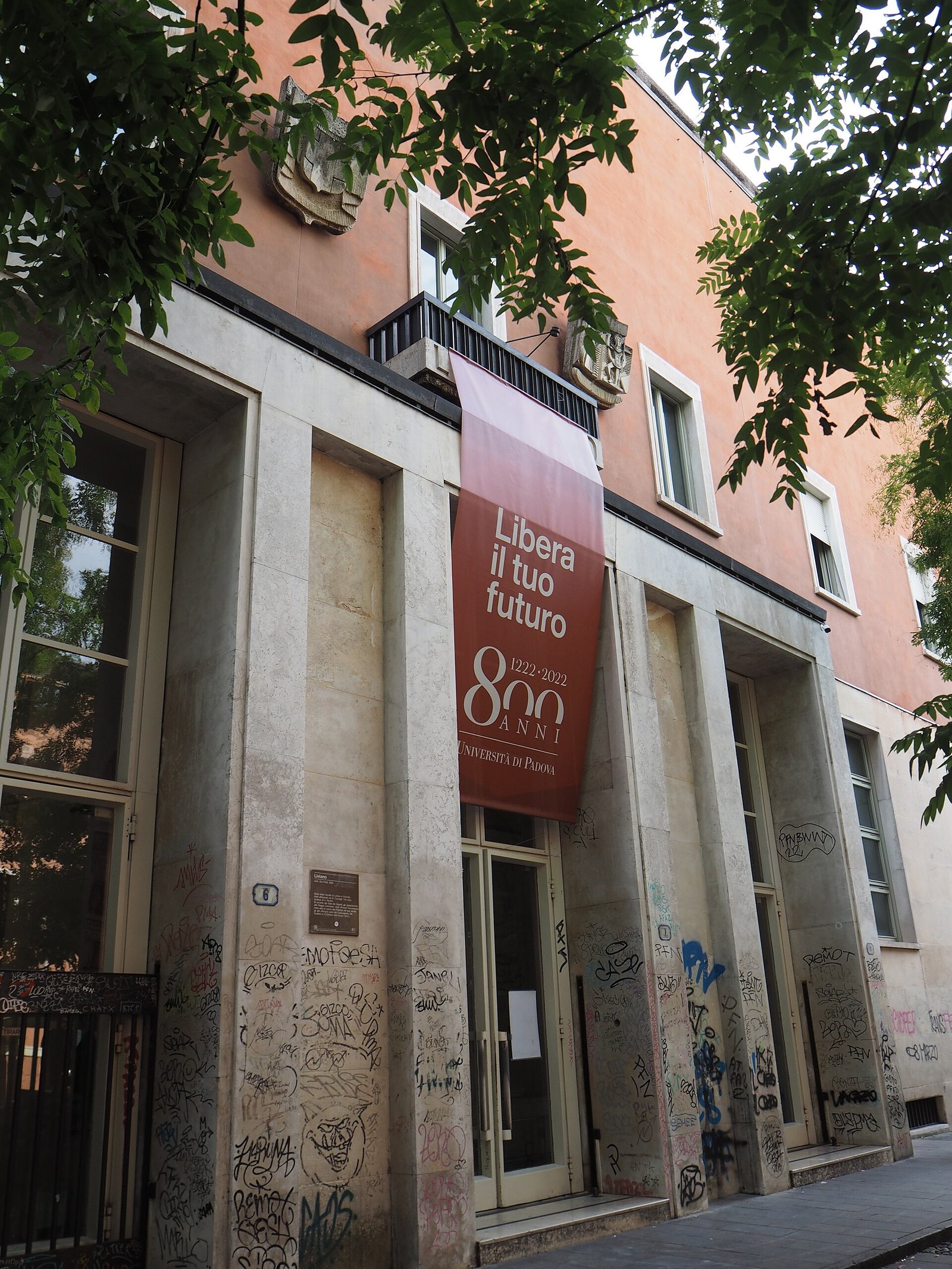
Palazzo Liviano is a 20th-century university building in Padua, designed by architect Giovanni Ponti and completed between 1937 and 1939. Located in the historic centro storico, the palazzo was built by incorporating the structural remains of the Renaissance Palazzo del Capitanio into its modern design. Named in honour of the Roman historian Titus Livius, it represents a deliberate architectural dialogue between Renaissance heritage and contemporary design practice.
Today the building serves as the principal seat of the University of Padua’s School of Human, Social and Cultural Heritage Studies, as well as the Department of Cultural Heritage—Archaeology, Art History, Cinema and Music. It also houses the Museum of Archaeological Sciences and Art. The palazzo is connected to the Sala dei Giganti, an adjacent frescoed Renaissance hall that now hosts concerts and conferences.
About Giovanni Ponti
Giovanni Ponti was an Italian architect, industrial designer and educator whose career spanned six decades. He founded the magazine Domus in 1928 and directed it throughout his life, becoming a major advocate for Italian design renewal. From 1936 to 1961, he taught at the Milan Polytechnic School, training multiple generations of designers. Among his most celebrated works is the Pirelli Tower in Milan, completed in 1960 in collaboration with engineer Pier Luigi Nervi.
Details
- Architect: Giovanni Ponti
- Location: Padua, Veneto, Italy
- Completed: 1939
- Current use: University of Padua facilities and museum
- Incorporates: Remains of the Renaissance Palazzo del Capitanio
- Connected to: Sala dei Giganti (frescoed Renaissance hall)
On the heritage map: Palazzo Liviano — Gio Ponti University Building in Padova (1937–1943)
Frequently asked questions
Who designed Palazzo Liviano?
The building was designed by Giovanni Ponti, an Italian architect and industrial designer whose career spanned six decades and included over a hundred buildings worldwide.
Why is the building called Palazzo Liviano?
The palazzo was named in honour of Titus Livius, the Roman historian, reflecting its scholarly purpose as a university building.
What does Palazzo Liviano house today?
The building serves as the home of the University of Padua’s School of Human, Social and Cultural Heritage Studies, the Department of Cultural Heritage, and the Museum of Archaeological Sciences and Art. It is also connected to the Sala dei Giganti, a Renaissance frescoed hall used for concerts and conferences.
Sources
- S1 — Licitra Ponti, Lisa. Gio Ponti: The Complete Work 1923-1978. MIT Press, 1990. ISBN 978-0-262-12150-7.
- S2 — Irace, Fulvio. Gio Ponti: la collezione del Museo del Design. Electa, 2009. ISBN 978-88-370-6927-8.
Spotted an error? Write to editorial@culturalheritageonline.com and we correct it the same day.


