
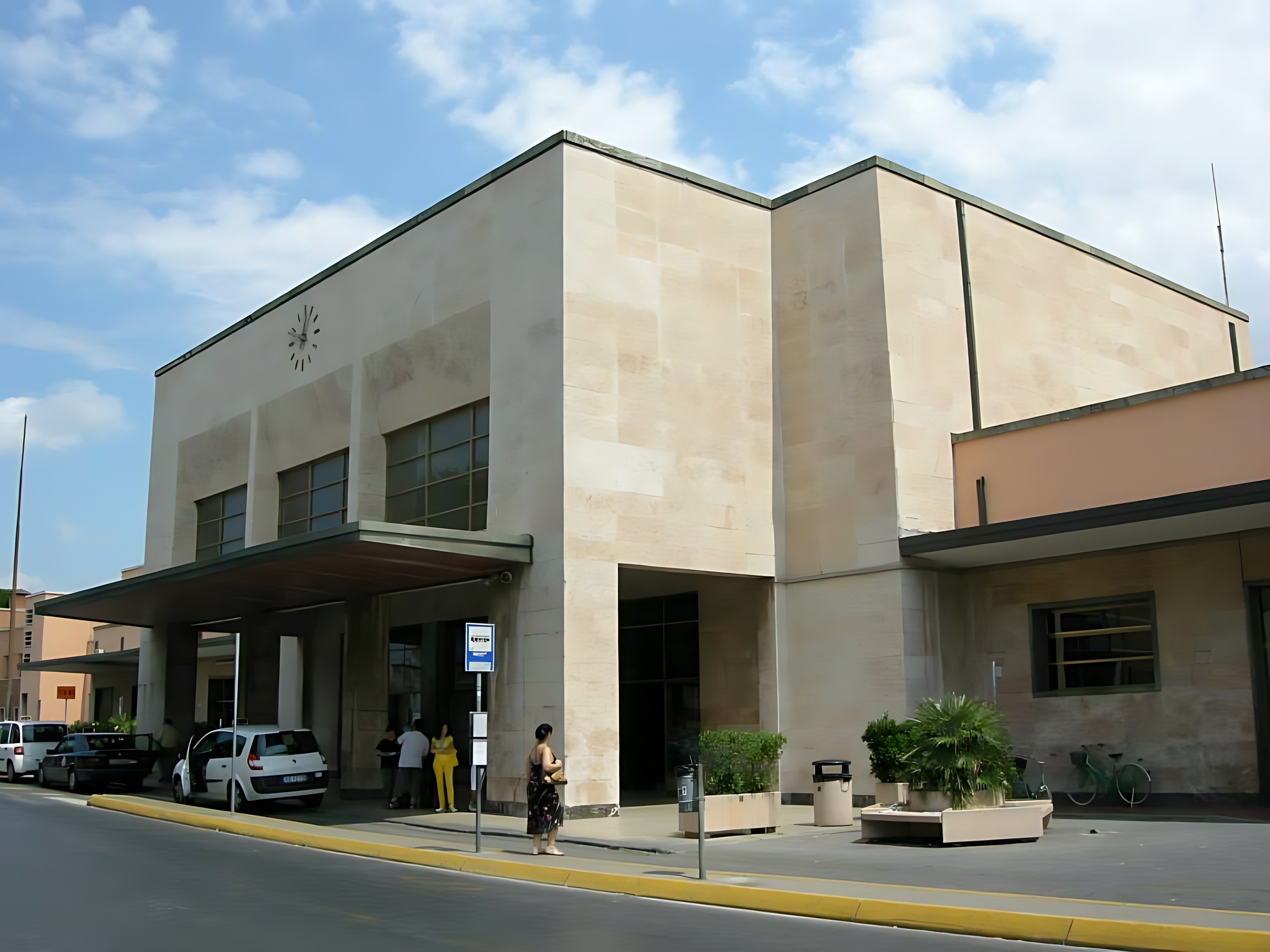
Viareggio Railway Station was designed by architect Roberto Narducci in 1936. The station represents one of approximately forty railway commissions Narducci completed over his career for Italy’s state railway company, Ferrovie dello Stato.
Narducci trained in architectural decoration and civil architecture, obtaining his degree in Civil Architecture in 1923. His practice spanned the Modernist and Novecento movements, periods that shaped his institutional and public commissions. Working under the Ministry of Communications, he designed both new stations and post-war reconstructions throughout Italy, frequently collaborating with colleague Angiolo Mazzoni on significant rail infrastructure projects.
About Roberto Narducci
Roberto Narducci (1887–1979) was a Roman architect and engineer whose career centred on public infrastructure. Beyond his railway stations, he designed approximately ten post offices under state commission. His long professional life—he worked into his nineties—allowed him to document and shape Italy’s transport architecture across decades of modernisation.
Details
- Designer: Roberto Narducci
- Year: 1936
- Location: Viareggio, Lucca, Tuscany
- Building type: Railway station
- Movement: Modernism, Novecento
Explore more: 11 heritage places in Viareggio
Frequently asked questions
Who designed Viareggio Railway Station?
Roberto Narducci, an Italian architect trained in architectural decoration and civil architecture, designed the station in 1936 as part of his extensive work for Italy’s state railway company.
How many railway stations did Narducci design?
Over his lifetime, Narducci designed approximately forty railway stations, including both new buildings and post-war reconstructions, working under the Ministry of Communications.
What architectural movements influenced Narducci’s work?
Narducci’s practice encompassed the Modernist and Novecento movements, architectural tendencies that shaped his approach to public and institutional commissions during the early-to-mid twentieth century.


