
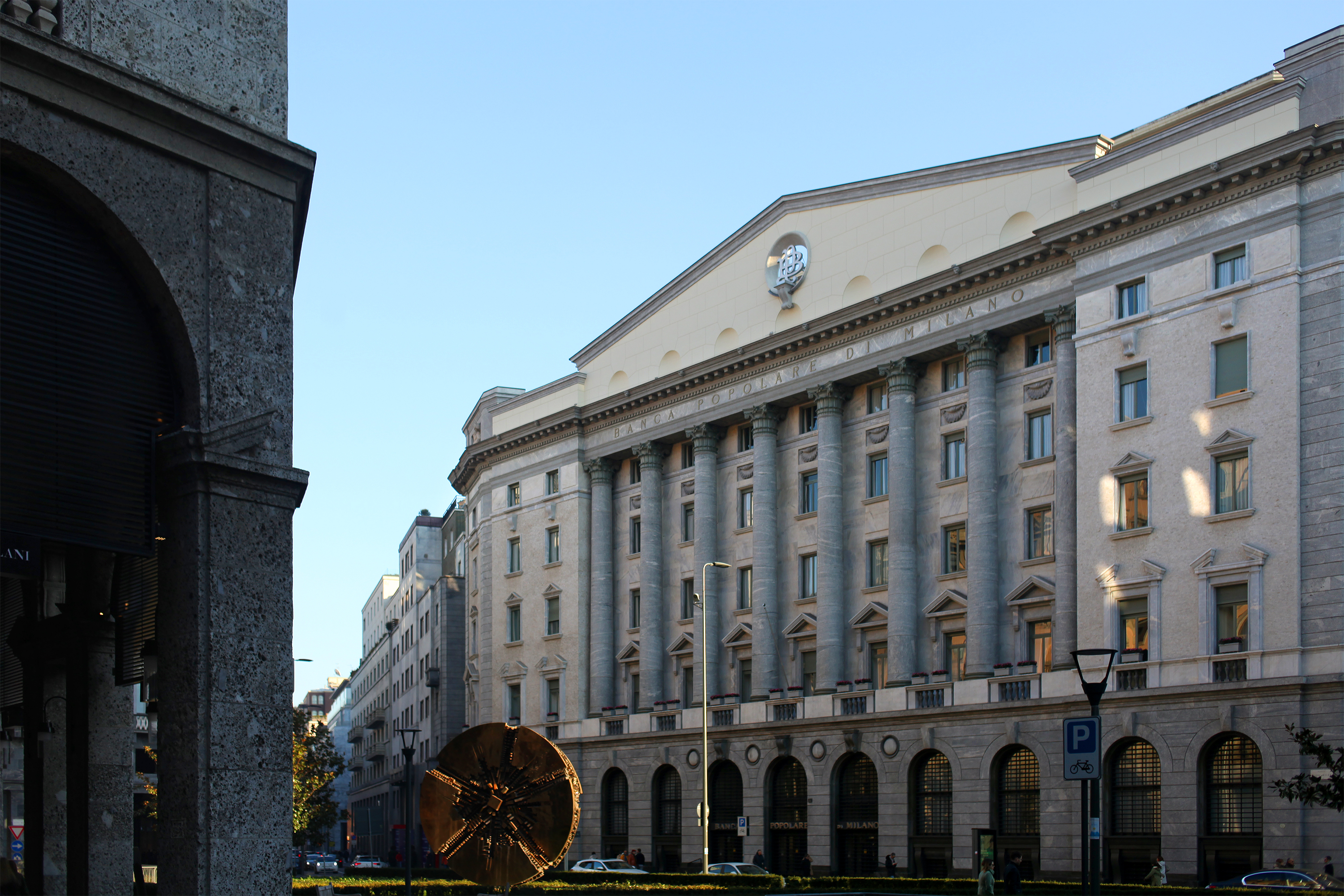
The Palazzo della Banca Popolare di Milano, designed by architect Giovanni Creppi, stands in Piazza Meda, Milan, and was constructed between 1928 and 1930. Commissioned by the Banca Popolare di Milano to serve as a headquarters befitting the bank’s expanding operations, the building exemplifies monumental neoclassical architecture.
The palazzo’s façade is dominated by a central body of eight giant-order columns supporting a simple triangular pediment. The lateral sections display windows framed with decorative cornices that echo the architectural vocabulary of neighbouring buildings in the piazza. The design draws inspiration from the Palazzo Bolchini, which faces it across the square. Following the 1998 merger between Banca Popolare di Milano and Banco Popolare, the palazzo became the registered office of the resulting institution, Banco BPM.
About Giovanni Creppi
Giovanni Creppi was an Italian architect active in early twentieth-century Milan, working within the neoclassical tradition that continued to inform institutional and financial architecture during the interwar period.
Details
- Architect: Giovanni Creppi
- Construction: 1928–1930
- Location: Piazza Meda 2, Milan, Lombardy
- Style: Monumental neoclassicism
- Current use: Headquarters of Banco BPM (post-1998 merger)
Explore more: 193 heritage places in Milano
Frequently asked questions
Who designed the palazzo?
Architect Giovanni Creppi designed the Palazzo della Banca Popolare di Milano, commissioned by the bank to create a new, appropriately monumental headquarters.
What architectural style does it follow?
The palazzo employs a monumental neoclassical style, featuring eight giant-order columns and a triangular pediment on its principal façade, with decorative window cornices on the lateral sections.
What is the building’s current use?
After the 1998 fusion of Banca Popolare di Milano and Banco Popolare, the palazzo became the registered office of Banco BPM.


