
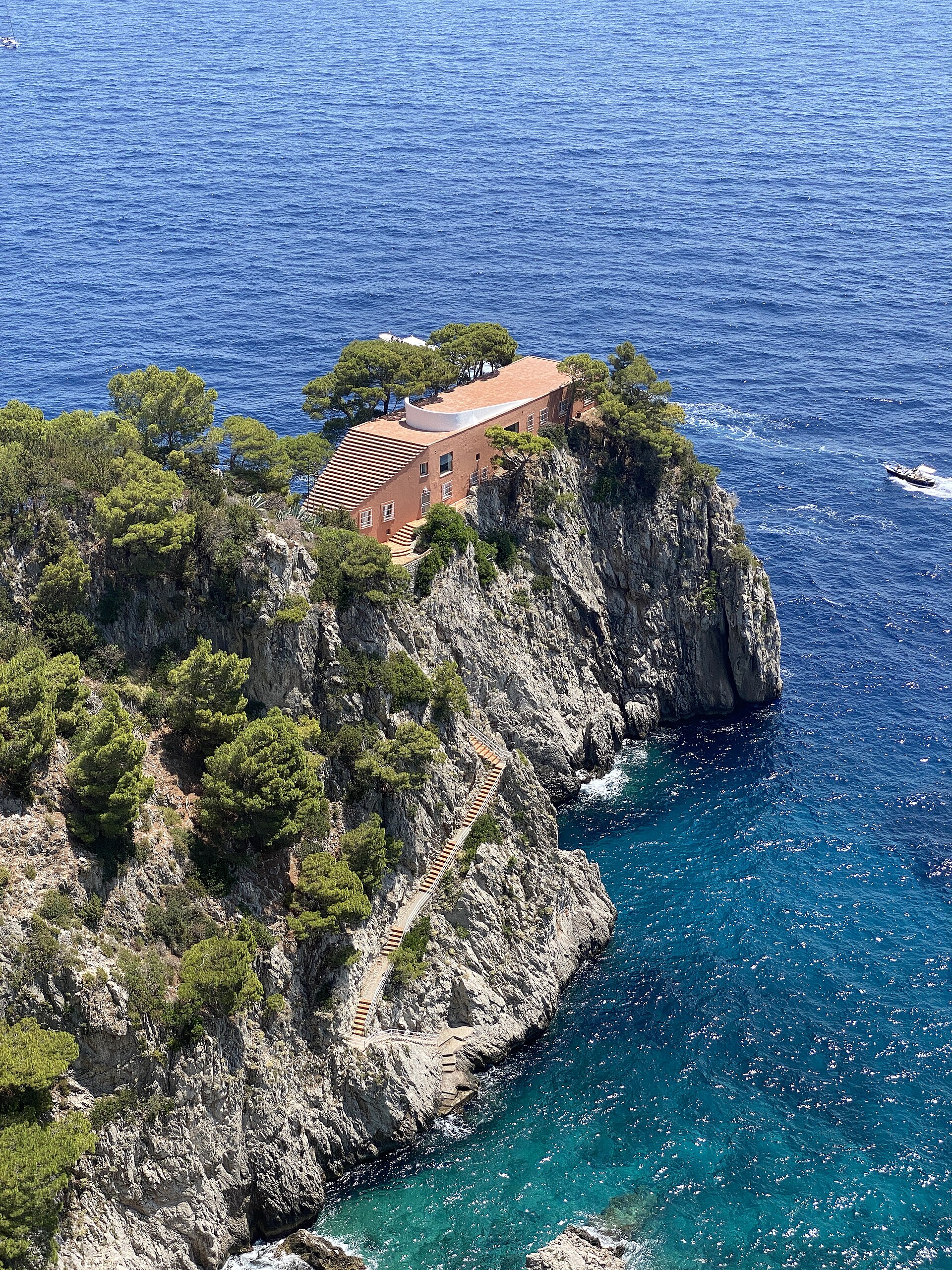
Casa Malaparte, also known as Villa Malaparte, is a house on Punta Massullo on the eastern side of Capri, Italy, conceived by Curzio Malaparte around 1937 and built between 1938 and 1942. The residence stands as one of the finest examples of Italian modern and contemporary architecture.
The house is a red masonry structure distinguished by reverse pyramidal stairs that lead to a rooftop patio. A freestanding curved white wall of increasing height occupies the roof terrace. Perched 32 metres above sea level on a dramatic cliff, the building commands views across the Gulf of Salerno. The property is accessible either on foot from Capri town or by boat and a staircase cut into the cliff face.
About Curzio Malaparte
Malaparte built the home himself with assistance from Adolfo Amitrano, a local stonemason. The house’s interior and exterior, particularly its rooftop patio, gained international visibility through their prominent appearance in Jean-Luc Godard’s 1963 film Contempt.
Details
- Creator: Curzio Malaparte with Adolfo Amitrano
- Years: 1937–42
- Location: Punta Massullo, eastern Capri
- Style: Italian modernism
- Key feature: Red-brick construction with rooftop terrace and curved white wall
- Height above sea: 32 metres
Frequently asked questions
Who designed and built Casa Malaparte?
Curzio Malaparte conceived and built the house himself with the help of Adolfo Amitrano, a local stonemason, between 1937 and 1942.
Where is Casa Malaparte located?
The house sits on Punta Massullo on the eastern side of Capri, perched on a cliff 32 metres above the sea and overlooking the Gulf of Salerno. It is accessible by foot from Capri town or by boat via a cliff staircase.
What is the architectural significance of the building?
Casa Malaparte is considered one of the best examples of Italian modern and contemporary architecture, distinguished by its red-masonry construction, reverse pyramidal stairs, and distinctive rooftop design featuring a curved white wall of increasing height.


