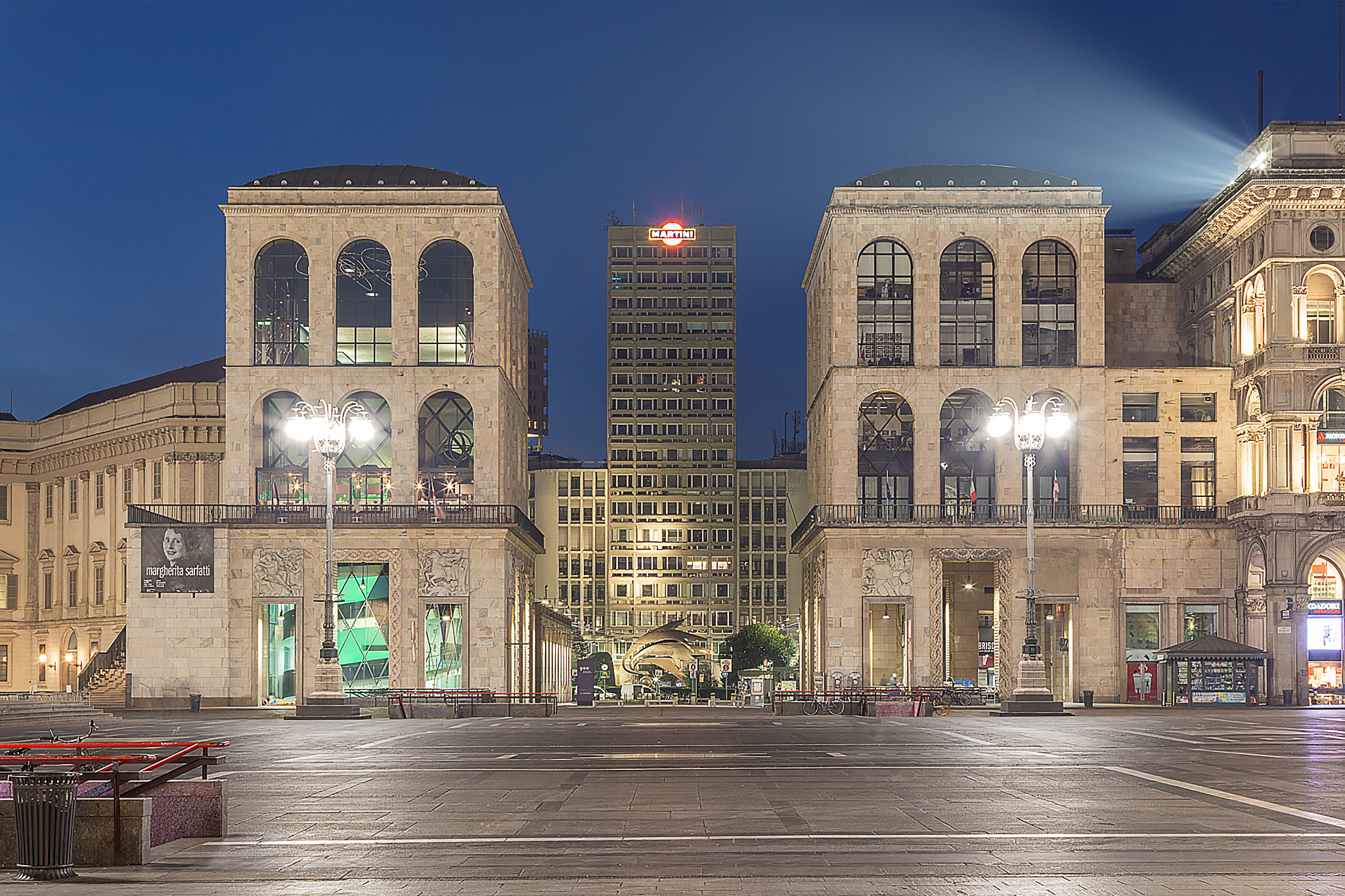
Palazzo dell’Arengario is a Novecento-style palace on Milan’s Piazza del Duomo, designed by architects Piero Portaluppi, Giovanni Muzio, Pier Giulio Magistretti and engineer Enrico Griffini. Construction began in 1936 and concluded in 1956. The building consists of two matching structures and now serves as home to the Museo del Novecento.
The palace’s name derives from the historical term “arengario,” synonymous with “broletto”—the medieval municipal seat of a commune. The project, which won a design competition in 1937, represented the final phase of urban renewal in central Milan initiated by architect Giuseppe Mengoni, who had established the monumental character of the area surrounding the cathedral. The Arengario was constructed following the demolition of the Manica Lunga, the projecting wings of the adjacent Palazzo Reale that once faced Piazza del Duomo.
The palace’s facade features bas-reliefs by sculptor Arturo Martini, integrating sculptural ornament into the building’s modernist composition. The completion of Piazza Diaz marked the architectural conclusion of this transformative urban scheme.
About Piero Portaluppi
Piero Portaluppi (1888–1967) was a prolific Milanese architect responsible for over 100 buildings in the city. He studied at the Politecnico under Enrico Agostino Griffini and graduated in 1910 with the Gold Medal of the College of Engineers and Architects of Milan.
Details
- Architects: Piero Portaluppi, Giovanni Muzio, Pier Giulio Magistretti; Engineer: Enrico Griffini
- Construction: 1936–1956
- Location: Piazza del Duomo, Milan
- Architectural style: Novecento Italiano
- Current use: Museo del Novecento
- Facade decoration: Bas-reliefs by Arturo Martini
Explore more: 193 heritage places in Milano
Frequently asked questions
Who designed Palazzo dell’Arengario?
The palace was designed by four architects: Piero Portaluppi, Giovanni Muzio, Pier Giulio Magistretti, and engineer Enrico Griffini. The project won a design competition in 1937.
What does the name Arengario mean?
Arengario is a historical term synonymous with “broletto,” which referred to the municipal seat of a commune in medieval times. The palazzo’s name references this civic heritage.
What is housed in the building today?
The Palazzo dell’Arengario is home to the Museo del Novecento, a museum dedicated to twentieth-century Italian art.