
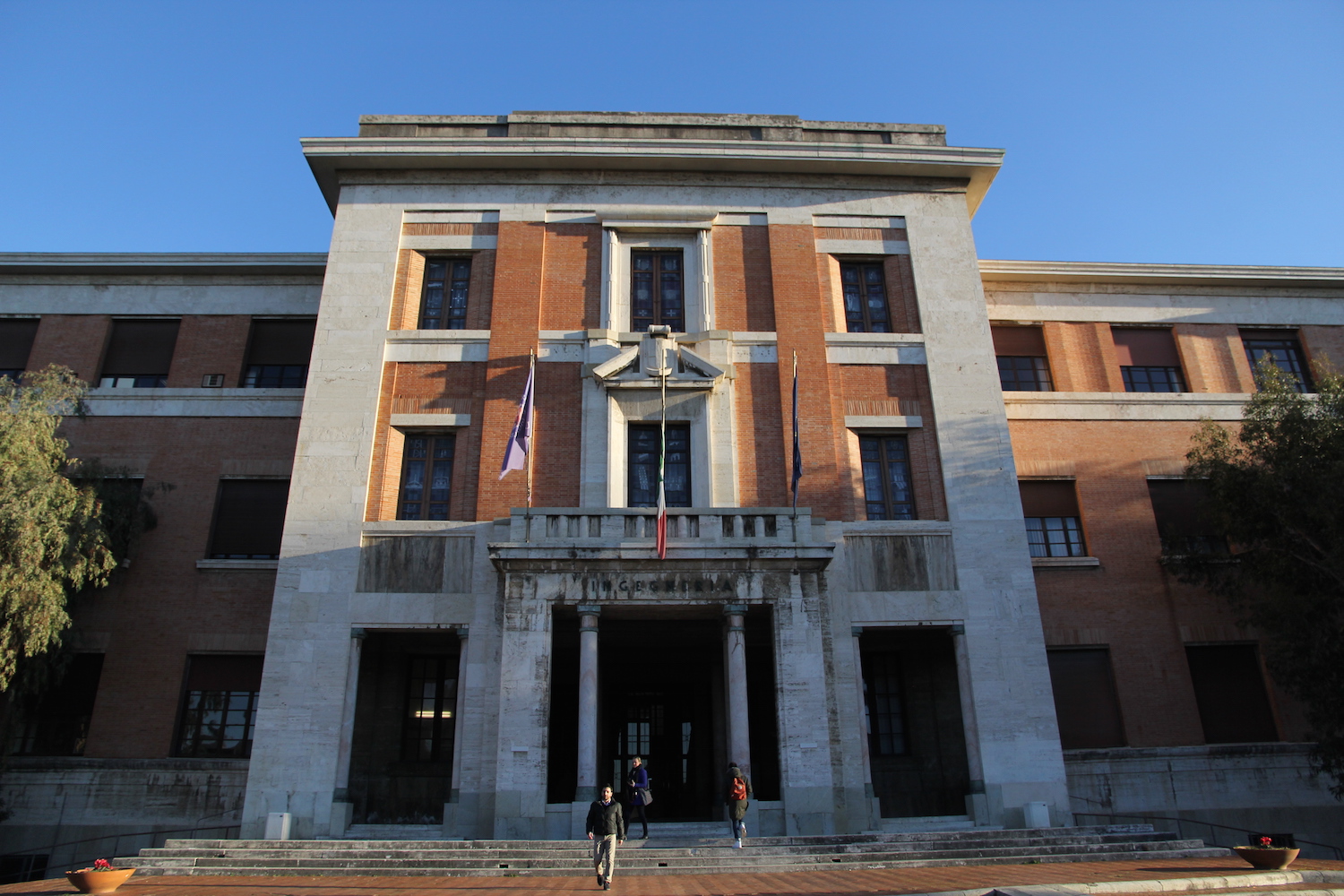
The Royal School of Engineering in Pisa, designed by architects Luigi Pera and Federigo Severini, was completed in 1937 and now houses the Faculty of Engineering at the University of Pisa. Located at via Diotisalvi 2, the building stands on the site of the former Benedictine convent of San Paolo.
The School of Applied Engineering had been established in Pisa by law in 1913, initially occupying scattered premises across the city. By the early 1920s, the need for a unified campus became clear, prompting the municipality to identify a suitable location. The commission for the new building eventually went to Pera and Severini, whose design consolidated the school’s dispersed institutes into a single modern structure.
About Luigi Pera
Luigi Pera (1899–1969) was a Tuscan civil engineer and architect who graduated from the engineering faculty in Pisa in 1925. He later taught technical architecture and urban planning at the same institution, and from 1952 until his death served as director of the Institute of Architecture and Urban Planning in Pisa. Beyond the School of Engineering, Pera designed Pisa’s master plan (1930) and the Casa dello Studente, and contributed substantially to the city’s post-war reconstruction.
Details
- Architects: Luigi Pera and Federigo Severini
- Completed: 1937
- Location: via Diotisalvi 2, Pisa
- Current use: Faculty of Engineering, University of Pisa
- Site history: Built on the grounds of the former Convent of San Paolo
Explore more: 17 heritage places in Pisa
Frequently asked questions
Who designed the Royal School of Engineering?
Luigi Pera and Federigo Severini designed the building. Pera was a Pisan engineer and architect who taught at the Faculty of Engineering and later directed the Institute of Architecture and Urban Planning.
When was it built?
The School of Engineering was completed in 1937, after several years of planning and site preparation following the demolition of the former Benedictine convent that originally occupied the location.
What is it used for today?
The building now serves as the Faculty of Engineering for the University of Pisa and remains in educational use as part of the university campus.


