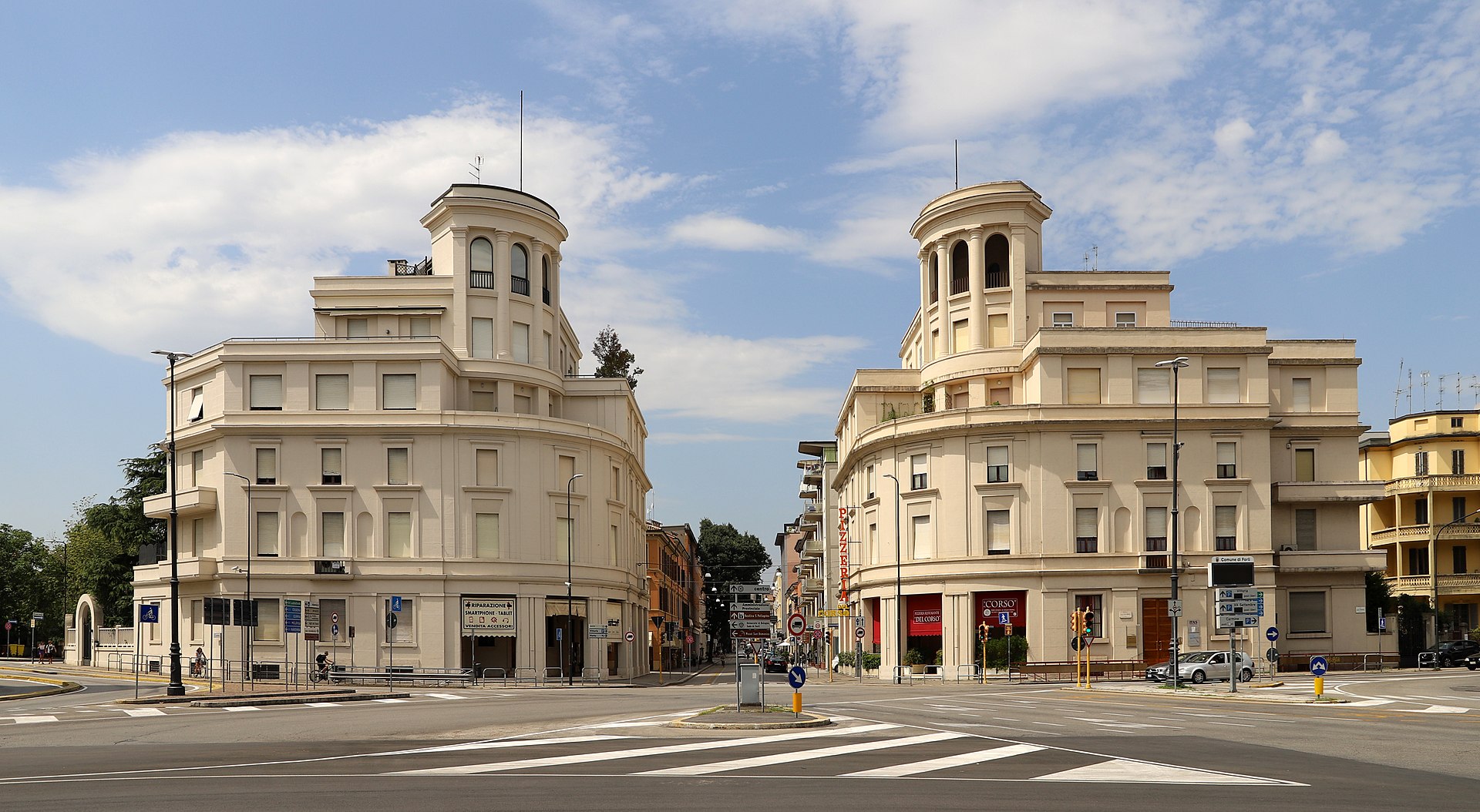
The Palazzine gemelle (Twin Palazzine) in Forlì were designed by architect Cesare Bazzani in 1933. These two symmetrical residential buildings represent the work of one of early twentieth-century Italy’s most prolific and accomplished architects.
Cesare Bazzani (1873–1939) was an Italian architect and engineer whose career spanned from 1911 until his death. Active across multiple cities, Bazzani executed major municipal commissions and significant cultural institutions, including the Galleria Nazionale d’Arte Moderna in Rome and the Biblioteca Nazionale Centrale in Florence. His body of work encompasses religious buildings, civic structures, and residential projects, demonstrating the range typical of major Italian architectural practices of the period.
The paired buildings in Forlì reflect the formal architectural conventions of the 1930s, an era of significant construction activity in Italian cities. The symmetrical composition and paired identity of these palazzine exemplify a common urban design approach of the period.
Details
- Architect: Cesare Bazzani
- Year: 1933
- Location: Forlì, Emilia-Romagna, Italy
- Type: Twin residential buildings
Explore more: 5 heritage places in Forlì
Frequently asked questions
Who was Cesare Bazzani?
Cesare Bazzani (1873–1939) was a prominent Italian architect and engineer active from 1911 until his death. He designed major municipal and cultural works across several Italian cities, including the Galleria Nazionale d’Arte Moderna in Rome and the Biblioteca Nazionale Centrale in Florence.
When were these buildings constructed?
The Palazzine gemelle were designed and built in 1933 in Forlì.
What architectural approach did Bazzani use for this project?
The twin palazzine employ a symmetrical composition, a formal design strategy characteristic of 1930s Italian residential architecture. The paired identity emphasizes balance and institutional order in urban design.