The 24th Mediterranean Archaeological Tourism Exchange (Borsa Mediterranea del Turismo Archeologico) took place from October 27 to 30, 2022, in Paestum, a province of Salerno in Campania. The event, promoted by the Campania Region, the City of Capaccio Paestum, and the Archaeological Park of Paestum and Velia, is endorsed by the Ministry of Culture, the Ministry of Tourism, the Ministry of Foreign Affairs and International Cooperation, the Conference of Regions and Autonomous Provinces, and the National Association of Italian Municipalities. It has been recognized by UNESCO and the UN World Tourism Organization (UNWTO) for several years as a best practice in intercultural dialogue.
The Fair was held across multiple venues: the Tabacchificio Cafasso (a former tobacco factory repurposed as a cultural center since 2021), the Basilica, the Archaeological Park, and the National Archaeological Museum of Paestum. According to founder and director Ugo Picarelli, the Fair’s objectives are to promote archaeological parks and museums, develop archaeological tourism destinations, facilitate commercialization, reduce seasonal tourism concentration, and generate economic opportunities and employment.
Scale and Structure
The previous edition attracted 7,000 visitors, 150 exhibitors representing 15 foreign countries, 110 concurrent conferences and meetings with 550 moderators and speakers across five rooms, 30 European and national tour operator buyers, 140 tourism supply operators, and 150 journalists. The Fair comprises 16 sections, including ArcheoExperience (experimental archaeology workshops), ArcheoIncoming (incoming tourism workshops), ArcheoLavoro (career guidance), ArcheoStartup (cultural innovation ventures), ArcheoVirtual (digital and virtual archaeology applications), exhibition halls covering 4,000 square meters representing 18 Italian regions, and free guided visits to Paestum and Velia archaeological sites.
The Khaled al-Asaad Award
The International Archaeological Discovery Award “Khaled al-Asaad,” now in its eighth edition, honors the Palmyra archaeologist who died defending cultural heritage. The award recognizes the most significant archaeological discovery of the year, selected in collaboration with international media partners including Antike Welt (Germany), Archäologie in Deutschland (Germany), Archéologia (France), Current Archaeology (UK), and Dossiers d’Archéologie (France). Previous recipients include the discovery of hundreds of sarcophagi in the Saqqara necropolis in Egypt (2021), ancient Mesopotamian rock reliefs in Iraqi Kurdistan (2020), the world’s oldest intact shipwreck in the Black Sea (2019), and the Celtic Tomb of Lavau in France (2016).
2022 Finalists
Five discoveries competed for the 2022 award. In Egypt, archaeologist Zahi Hawass’s team uncovered a previously unknown city near Luxor, founded by Pharaoh Amenhotep III (1391–1353 BCE). Called “Tjehen-Aten” or “Aton” (meaning “dazzling”) and known as the “lost golden city,” the site preserves walls nearly complete, household objects, precious rings, scarabs, ceramic vessels, and hieroglyphic inscriptions on clay wine jar stoppers enabling precise dating. In Italy, excavations at Civita Giuliana near Pompeii revealed a slave quarters measuring 16 square meters, containing three wooden beds and a wooden chest with metal and textile items, providing exceptional preservation of ancient domestic life destroyed by the eruption of 79 CE. In Pakistan, the Italian Archaeological Mission in collaboration with Ca’ Foscari University of Venice discovered an early Buddhist temple (II century BCE, possibly III century BCE) in the ancient city of Barikot in the Swat Valley, revealing unique architectural forms suggesting Indo-Greek influence. In England’s Rutland County, a magnificent Roman mosaic measuring 7 by 11 meters was found depicting the encounter between Achilles and Hector from Homer’s Iliad, dating to the late III or early IV century CE. In Turkey, Istanbul University’s team led by Professor Necmi Karul excavated Karahantepe, a rock sanctuary over 11,000 years old located approximately 25 miles southeast of Göbekli Tepe, containing a 23-meter-diameter underground chamber with a monumental human head sculpture and eleven tall phallic-shaped pillars carved from rock, along with 250 monoliths and unique 3D human representations.
Archaeological Sites Open During the Fair
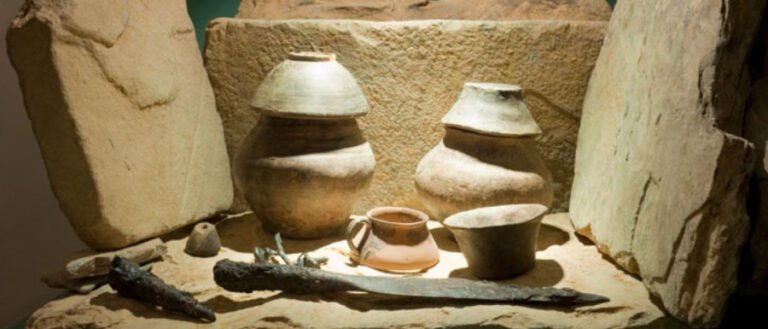
Free admission was offered during the Fair to several archaeological sites in Salerno Province. The National Archaeological Museum of Paestum houses prehistoric artifacts, funerary assemblages, metopes from the Hera Argiva sanctuary, and the famous painted slabs from the Tomb of the Diver (480 BCE), discovered by archaeologist Mario Napoli in the 1960s. The Archaeological Park of Paestum preserves the Greek city of Poseidonia, founded according to Strabo around the end of the VII century BCE by Achaeans from Sibari in Calabria, later conquered by the Lucanians (end of V century BCE) and renamed Paestum when it became a Latin colony in the III century BCE. The park encompasses Doric temples including the Basilica of Hera, the Temple of Neptune (Poseidon), and the Temple of Ceres (Athena), along with Roman structures such as baths, a forum portico, and an amphitheater. The Archaeological Park of Velia preserves the ancient city of Elea, founded around 540 BCE by Phocaean colonists and home to the Eleatic philosophical school (late VI century BCE) of Parmenides and Zeno, notable for the Porta Rosa, an exceptional example of Greek architecture featuring a barrel vault. Additional museums include the National Archaeological Museum of the Middle Sele Valley in Eboli, housed in a restored Thirteenth-century Franciscan convent, displaying funerary assemblages from the ancient city’s Iron Age through the IV century BCE, and the National Archaeological Museum of Pontecagnano, documenting Etruscan settlement from the late X century BCE through the III century BCE Roman colony of Picentia, featuring orientalizing period princely funerary assemblages with symposium wares, bucchero pottery, and jewelry. The Certosa of San Lorenzo at Padula, Italy’s largest monastic complex, begun in 1306 by Count Tommaso Sanseverino, features a 15,000-square-meter cloister arranged in a gridiron shape, its original Sixteenth-century Doric order enriched by Baroque additions, and a legendary kitchen where a thousand-egg omelet purportedly fed soldiers of Charles V in 1535. The Certosa was declared a national monument in 1882 and included on the UNESCO World Heritage List in 1998.
Frequently Asked Questions
What is the Mediterranean Archaeological Tourism Exchange?
The Borsa Mediterranea del Turismo Archeologico is the world’s only meeting point uniting governmental organizations, institutions, local authorities, professional business operators, scholars, travelers, students, and media to advance archaeological tourism, cultural heritage management, and intercultural dialogue. It is recognized by UNESCO and UNWTO as a best practice.
How many visitors and exhibitors attend the Fair?
The previous edition (2021) attracted 7,000 visitors, 150 exhibitors from 15 foreign countries, 30 tour operator buyers, 140 tourism supply operators, and 150 journalists, with 110 concurrent conferences and meetings featuring 550 speakers across five halls.
Who was Khaled al-Asaad?
Khaled al-Asaad was an archaeologist of Palmyra who sacrificed his life defending the archaeological site against destruction, honored through the International Archaeological Discovery Award bearing his name.
Explore more: 6 heritage places in Paestum