
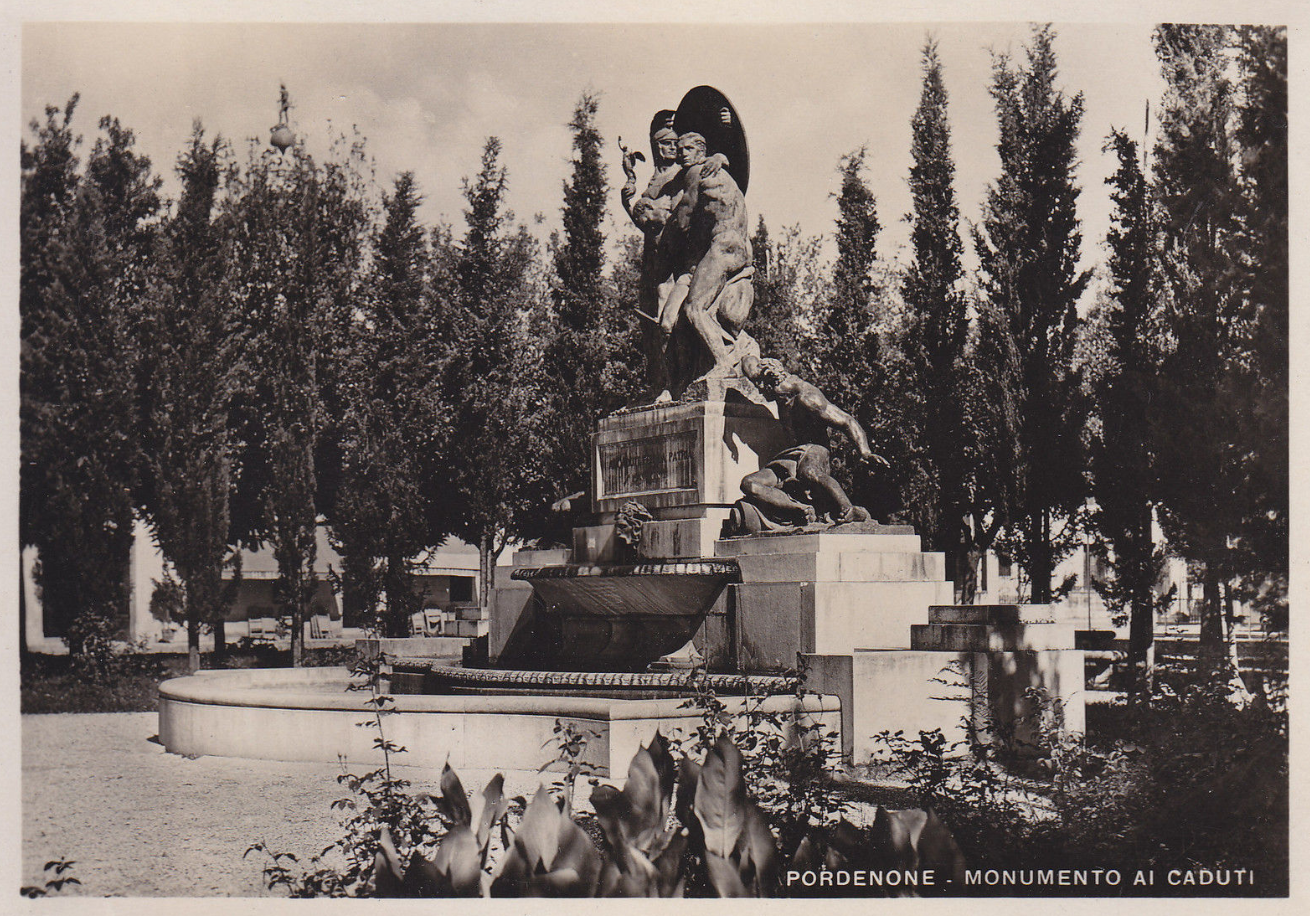
The Monumento ai caduti in Pordenone is a war memorial sculpture created by Aurelio Mistruzzi in 1929. Designed to honour those who fell in conflict, the work exemplifies Mistruzzi’s significant contribution to commemorative public sculpture across the Friuli region during the interwar period.
Mistruzzi, born in Villaorba in 1880, trained at the School of Art in Udine and subsequently at the Academies of Venice and Milan, where he studied under impressionist-influenced sculptors. He later refined his approach through formal training in medal-making at Rome’s school of the art in 1908. Following the First World War, Mistruzzi received numerous commissions for war memorials across Friuli, establishing himself as a primary sculptor of public commemoration during this era. His practice extended to sacred sculpture and private commissions, including funerary works.
About Aurelio Mistruzzi
Aurelio Mistruzzi (1880–1960) was an Italian sculptor and medallist whose career spanned from the early twentieth century through the post-war period. Beyond commemorative works, he contributed monumental sculptural decoration to civic buildings, notably collaborating on the Municipal Palace of Udine in 1914 with architect Raimondo D’Aronco, producing figural groups representing civic and political virtues.
Details
- Creator: Aurelio Mistruzzi
- Year: 1929
- Location: Pordenone, Friuli Venezia Giulia, Italy
- Type: Public war memorial sculpture
- Context: Interwar commemorative monument
Explore more: 22 heritage places in Pordenone
Frequently asked questions
Who designed this memorial?
Aurelio Mistruzzi, an Italian sculptor born in Villaorba in 1880, created the work. He received extensive training at academies in Udine, Venice, Milan, and Rome, and became a prolific designer of war memorials across the Friuli region after the First World War.
When was it installed?
The memorial was completed and installed in Pordenone in 1929.
What was Mistruzzi’s artistic background?
Mistruzzi trained under impressionist-influenced sculptors at major Italian academies and studied medal-making formally in Rome. His style drew on verismo, and he was active in both public commemorative work and private commissions, including funerary and sacred sculpture.
Sources
- S1 — Panzetta, Alfonso. Dizionario degli scultori italiani dell'Ottocento e del primo Novecento. Umberto Allemandi, 2003. ISBN 978-88-422-1158-7.
- S2 — Bossaglia, Rossana. I maestri della scultura italiana del primo Novecento. Electa, 1997. ISBN 978-88-435-6178-0.
Spotted an error? Write to editorial@culturalheritageonline.com and we correct it the same day.


