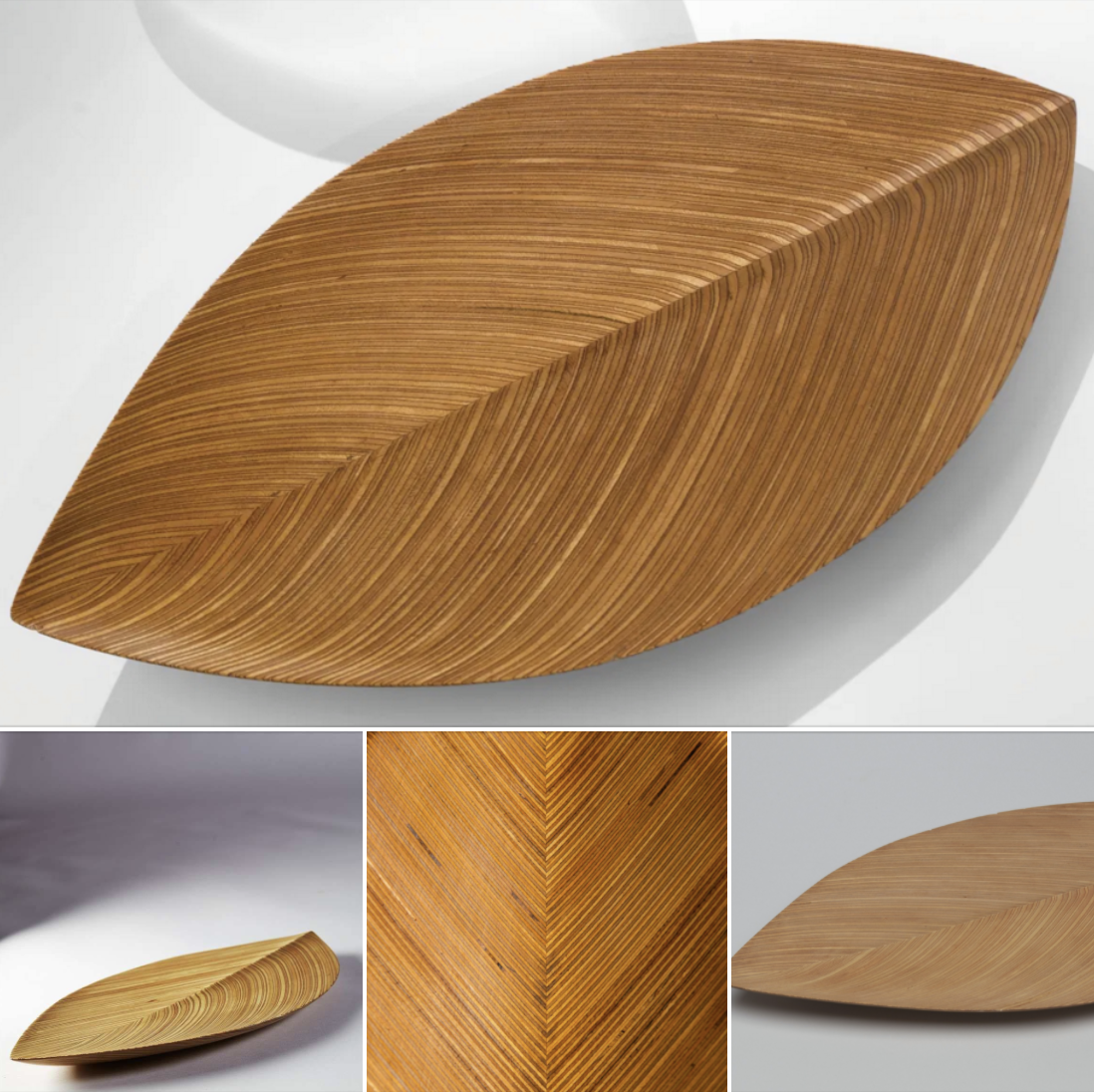
This leaf-shaped tray was designed by Finnish designer Tapio Wirkkala in the 1950s for Soinne et Kni, a Finnish manufacturer. The work exemplifies Wirkkala’s exploration of plywood as an expressive material during this period of his practice.
From the 1950s onward, Wirkkala turned his attention to laminated plywood, employing thin layers of veneer joined together in ways that deliberately exposed the dark adhesive binding them. This technical approach allowed him to create distinctive organic forms and imagery. The resulting designs synthesised Finnish modernist principles with sculptural sensibility, transforming an industrial material into objects of refined visual presence.
The tray is held in the collection of the Museum of Modern Art in New York.
About Tapio Wirkkala
Tapio Wirkkala (1915–1985) was a Finnish designer and sculptor born in Hanko and based in Helsinki. His career spanned industrial design, glasswork, and sculptural practice across several decades, establishing him as a central figure in post-war Nordic design.
Details
- Designer: Tapio Wirkkala
- Date: 1950s
- Manufacturer: Soinne et Kni, Finland
- Material: Laminated plywood with visible glue lines
- Current location: Museum of Modern Art, New York
Frequently asked questions
Who designed this tray?
Tapio Wirkkala, a Finnish designer and sculptor born in Hanko in 1915, designed this plywood tray in the 1950s for the Finnish manufacturer Soinne et Kni.
What makes the plywood technique distinctive?
Wirkkala used thin layers of veneer joined together in a way that deliberately exposed the dark adhesive lines between them, creating distinctive organic forms and visual effects that transformed the industrial material into a refined object.
Where can the tray be seen today?
The tray is held in the collection of the Museum of Modern Art in New York.
Sources
- S1 — De Fusco, Renato. Storia del design. Laterza, 2002. ISBN 978-88-420-6623-1.
- S2 — Sparke, Penny. Italian Design: 1870 to the Present. Thames & Hudson, 1988. ISBN 978-0-500-23531-7.
Spotted an error? Write to editorial@culturalheritageonline.com and we correct it the same day.