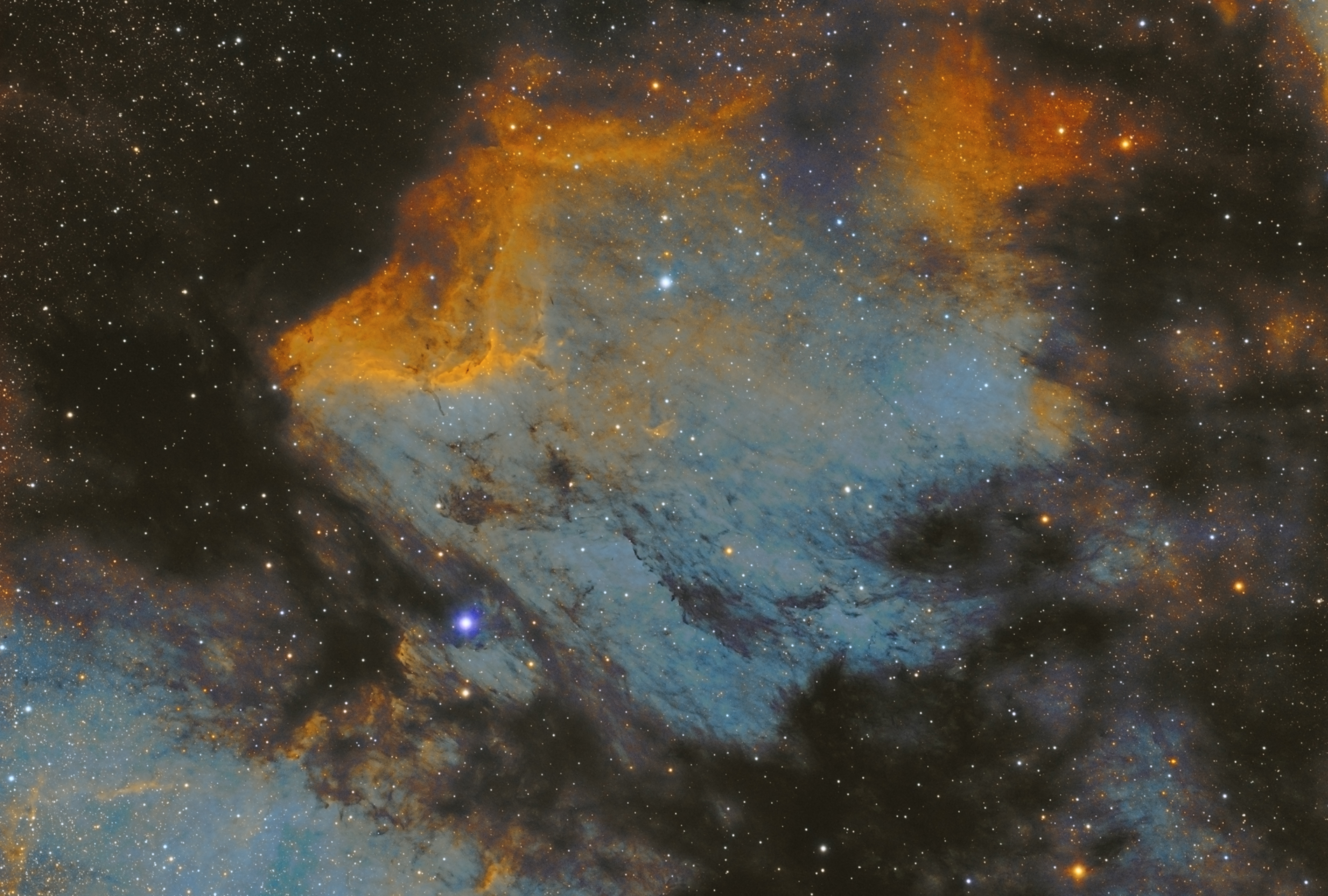
Posted in November 2020, this astrophotographic study documents the Pelican Nebula, designated IC 5070, located in the constellation Cygnus. The image represents 12 hours of light acquisition collected through three narrowband filters.
Narrowband Imaging and Hubble Palette Mapping
The photograph employs narrowband filtration to isolate specific wavelengths of ionized elements. The data was processed using the Hubble palette color scheme, also known as SHO or SIIHaOIII mapping. In this system, ionized sulfur is assigned to the red channel, ionized hydrogen to the green channel, and ionized oxygen to the blue channel. This approach reveals the chemical composition of the nebula through selective wavelength capture and false-color representation.
IC 5070 in Context
The Pelican Nebula is an emission nebula within Cygnus, one of the prominent northern constellations. The extended exposure time across multiple filters allows for detailed structure and composition analysis of this deep-sky object, demonstrating the technical requirements of professional astrophotographic work.
Frequently asked questions
What are narrowband filters in astrophotography?
Narrowband filters isolate specific wavelengths of light emitted by ionized elements such as sulfur, hydrogen, and oxygen, allowing astrophotographers to capture detailed images of emission nebulae even from light-polluted locations.
What is the Hubble palette?
The Hubble palette is a false-color mapping system that assigns narrowband filter data to red, green, and blue channels: ionized sulfur to red, ionized hydrogen to green, and ionized oxygen to blue, producing images that reveal nebular composition visually.
Why does IC 5070 require 12 hours of exposure?
Extended exposure times accumulate sufficient photons from faint nebular emission to produce detailed images with good signal-to-noise ratio, particularly important for narrowband imaging where individual filter transmissions are limited.
Sources
- S1 — Burnham, Robert, Jr. Burnham's Celestial Handbook: An Observer's Guide to the Universe Beyond the Solar System. Dover Publications, 1978. ISBN 978-0-486-23568-4.
- S2 — Kitchin, C. R. Astrophysical Techniques. CRC Press, 2013. ISBN 978-1-4665-1115-6.
Spotted an error? Write to editorial@culturalheritageonline.com and we correct it the same day.