
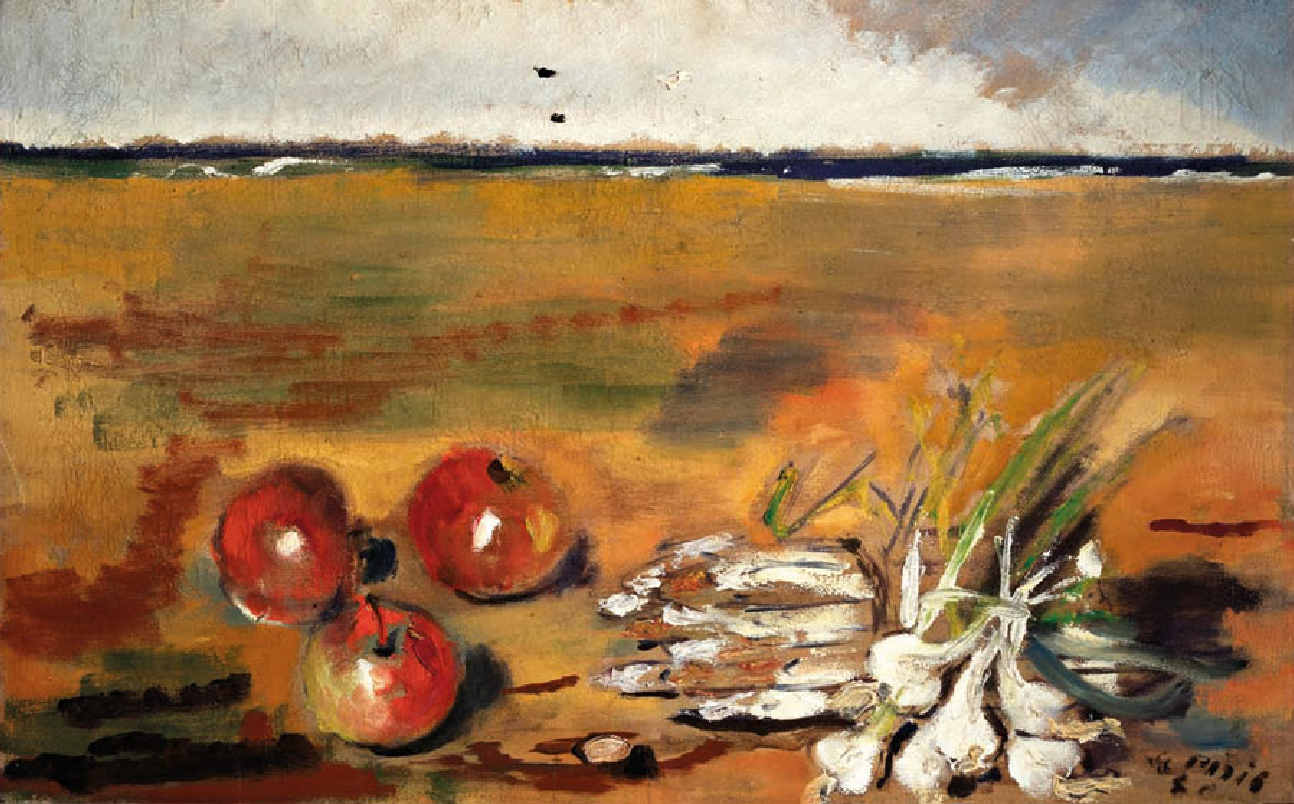
Still Life with Garlic is a 1930 painting by Filippo de Pisis, the Italian painter and poet born in Ferrara in 1896. The work belongs to the artist’s extensive practice of still-life composition, a genre for which he became well known.
De Pisis turned to painting in Rome in 1919, following studies in literature and philosophy. His artistic output spans cityscapes, metaphysically-inspired maritime scenes, and still lifes, particularly those depicting flowers and domestic objects. His compositions characteristically display an airy, immediate quality, with unexpected juxtapositions of scale and spatial arrangement. In still lifes such as this, objects on a surface often seem to extend into deeper pictorial space, creating an effect of intimate immediacy combined with dreamlike spatial logic.
About Filippo de Pisis
De Pisis (1896–1956) was both painter and poet, publishing a collection of writings in 1920. His emotional sensibility, evident in his literary work, translated distinctively to his visual compositions. He spent his career in Rome, Paris, and Venice, developing a body of work marked by a particular blend of sentiment and formal innovation.
Details
- Artist: Filippo de Pisis
- Year: 1930
- Medium: Oil on canvas
- Genre: Still life
On video
Frequently asked questions
Who was Filippo de Pisis?
An Italian painter and poet (1896–1956) born in Ferrara. He studied literature and philosophy at the University of Bologna before moving to Rome in 1919 to begin his painting career.
What subjects did de Pisis paint?
He was best known for cityscapes, metaphysically-inspired maritime scenes, and still lifes, particularly those depicting flowers and domestic objects arranged with an airy, in-the-moment quality.
Where did de Pisis spend his life?
He lived and worked in Rome, Paris, and Venice throughout his career.
Sources
- S1 — Pontiggia, Elena. Il Novecento Italiano. Abscondita, 2003. ISBN 978-88-8416-048-5.
- S2 — Ciucci, Giorgio. Gli architetti e il fascismo: architettura e città 1922-1944. Einaudi, 2002. ISBN 978-88-06-16310-5.
Spotted an error? Write to editorial@culturalheritageonline.com and we correct it the same day.


