
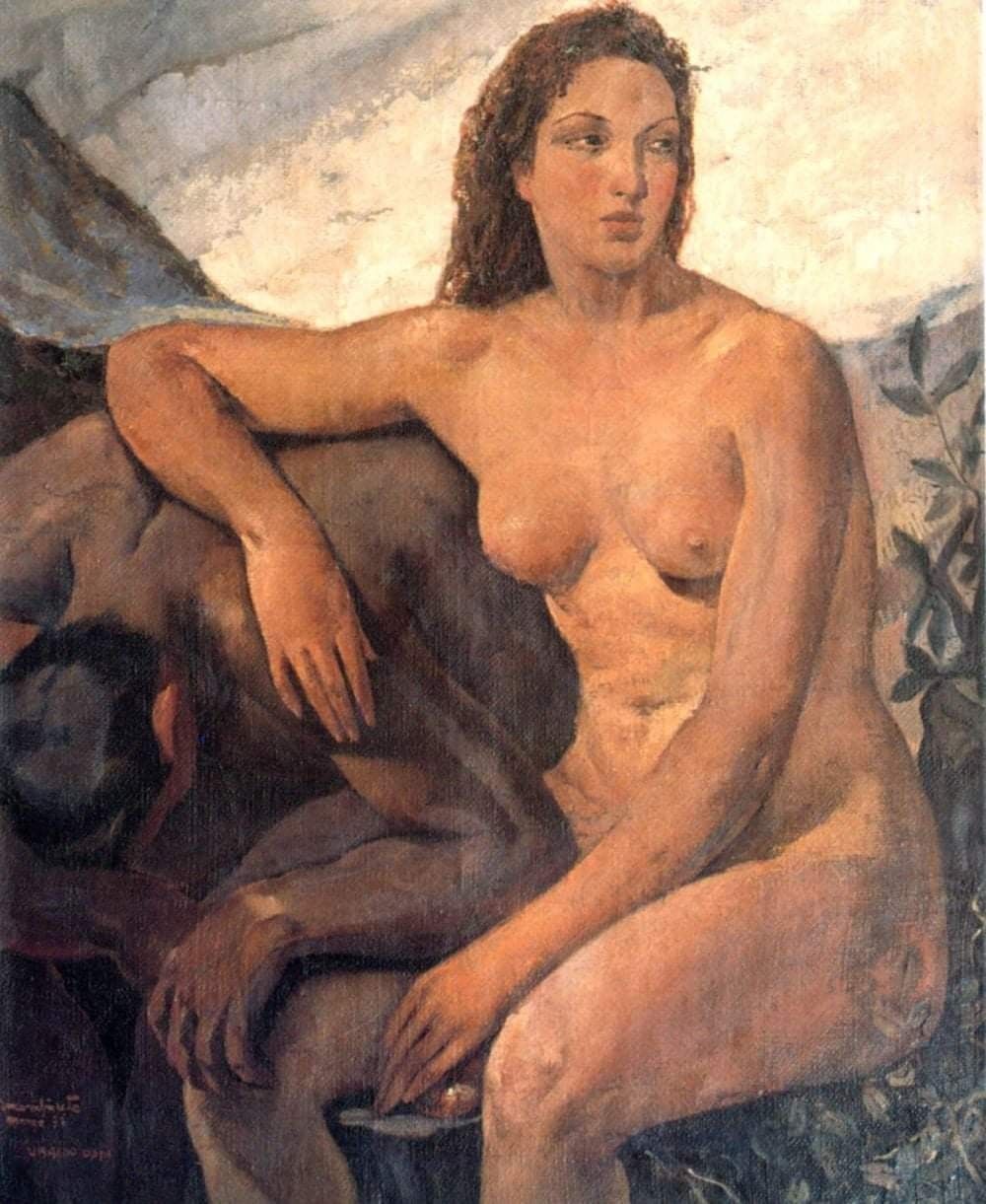
Adamo e Eva is a painting by Ubaldo Oppi from 1930, executed in the neo-quattrocento realist style that characterized the artist’s mature practice within the Novecento Italiano movement.
Oppi was a founding figure of the Novecento Italiano in Milan, a movement that sought to reconcile modern sensibility with the formal clarity and figural discipline of Italian Renaissance art. His approach to the Adam and Eve subject reflects this synthesis: a return to Renaissance compositional principles and volumetric form, inflected through early twentieth-century aesthetic concerns. The work dates from the interwar period, when Oppi’s engagement with quattrocento models intensified.
About Ubaldo Oppi
Born in Bologna in 1889, Oppi studied under Gustav Klimt in Vienna (1907–1909) before establishing himself as a key figure in Italian modernism. He exhibited regularly in major venues including the Venice Biennale from 1924 onward, and was instrumental in developing the Novecento’s distinctive language of formal order and humanistic figuration.
Details
- Artist: Ubaldo Oppi
- Year: 1930
- Movement: Novecento Italiano
- Style: Neo-quattrocento realism
On video
Frequently asked questions
Who was Ubaldo Oppi?
Ubaldo Oppi (1889–1942) was an Italian painter and one of the founders of the Novecento Italiano movement in Milan. He studied under Gustav Klimt in Vienna and became known for his neo-quattrocento realist approach to painting.
What is the Novecento Italiano?
The Novecento Italiano was an Italian artistic movement that sought to synthesize modern art with the formal principles of the Italian Renaissance, emphasizing figural clarity and compositional order.
What subject does this painting address?
Adamo e Eva treats the biblical theme of Adam and Eve, rendered through Oppi’s characteristic fusion of Renaissance form and twentieth-century modernist sensibility.
Sources
- S1 — Pontiggia, Elena. Il Novecento Italiano. Abscondita, 2003. ISBN 978-88-8416-048-5.
- S2 — Ciucci, Giorgio. Gli architetti e il fascismo: architettura e città 1922-1944. Einaudi, 2002. ISBN 978-88-06-16310-5.
Spotted an error? Write to editorial@culturalheritageonline.com and we correct it the same day.


