
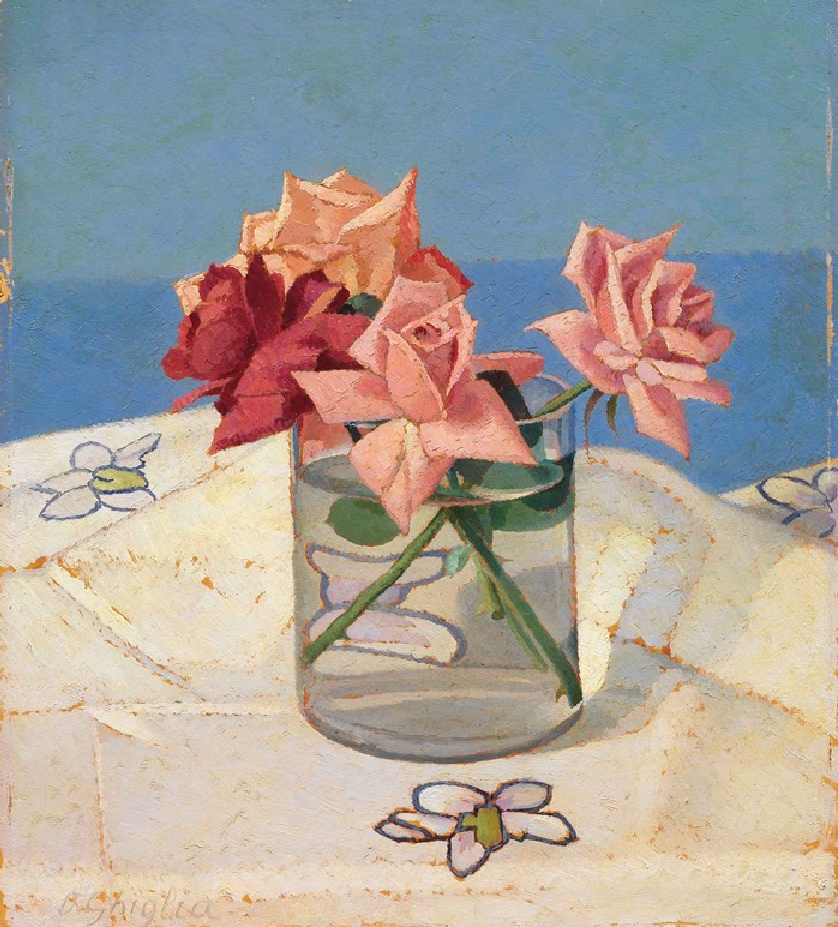
Rose rosa is a still life painting by Oscar Ghiglia, created in 1936. The work represents the artist’s continued exploration of form and colour within the conventions of representational painting.
Ghiglia was born in Livorno in 1876 and received his early training under the landscape painters Ugo Manaresi and Guglielmo Micheli. In Florence, he studied at Giovanni Fattori’s life-drawing school and developed significant connections with his artistic contemporaries, including Amedeo Modigliani. These formative years exposed him to both classical principles and European Secession aesthetics. By the 1930s, when he painted Rose rosa, Ghiglia had established himself as a practitioner of disciplined figurative and still-life work, maintaining allegiance to observable reality and compositional tradition during a period of rapid modernist experimentation across Europe.
About Oscar Ghiglia
Oscar Ghiglia (1876–1945) was an Italian painter whose career spanned from the turn of the twentieth century to the end of the Second World War. His artistic formation in Florence brought him into dialogue with both academic methods and contemporary European movements, notably Central European Secession. He worked across portraiture, figure studies, and still life, anchoring his practice in direct observation and classical structure.
Details
- Creator: Oscar Ghiglia
- Year: 1936
- Genre: Still life
- Artist’s life: 1876–1945
Frequently asked questions
Who was Oscar Ghiglia?
Oscar Ghiglia was an Italian painter born in Livorno in 1876. He trained in Florence under Giovanni Fattori and developed close artistic ties with modernist figures including Amedeo Modigliani, while maintaining a commitment to representational painting throughout his career.
What artistic movements influenced Ghiglia?
Ghiglia was exposed to classical academic training, the work of Florentine painters, and Central European Secession aesthetics through his contact with contemporary artists and intellectual circles in Florence and Paris during the early twentieth century.
When and where did Ghiglia work?
Ghiglia lived and worked from 1876 until his death in 1945, with significant periods in Livorno, Florence, and later in Prato. Rose rosa was painted in 1936, during the latter phase of his artistic career.
Sources
- S1 — Pontiggia, Elena. Il Novecento Italiano. Abscondita, 2003. ISBN 978-88-8416-048-5.
- S2 — Ciucci, Giorgio. Gli architetti e il fascismo: architettura e città 1922-1944. Einaudi, 2002. ISBN 978-88-06-16310-5.
Spotted an error? Write to editorial@culturalheritageonline.com and we correct it the same day.


