
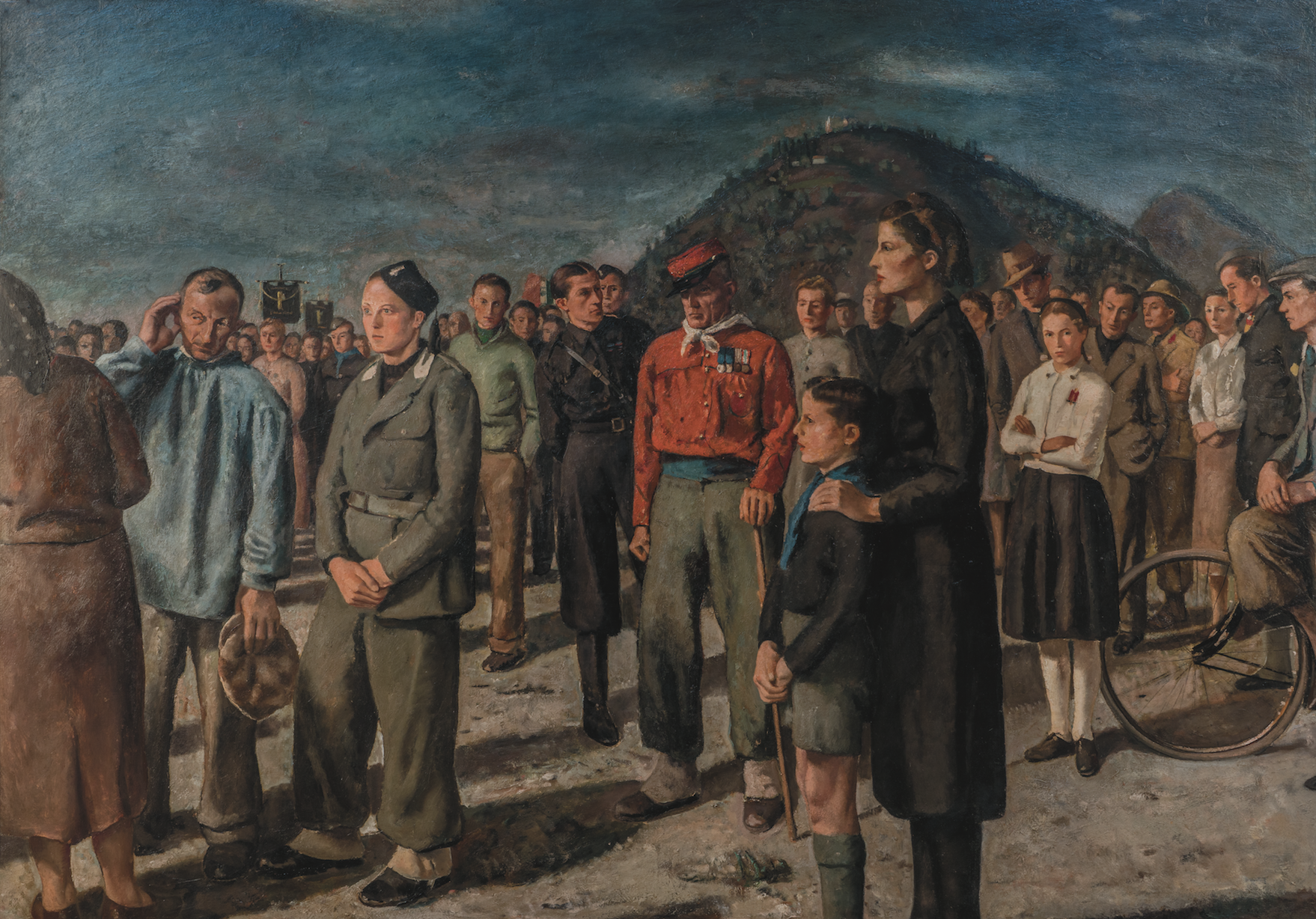
Cesare Maggi’s painting Ascoltando alla radio un discorso del Duce (Listening to the Duce’s Radio Address) dates to 1939 and documents a moment of everyday Italian domestic life during the interwar years. The work captures the cultural phenomenon of radio broadcasting as a mass medium in the home, reflecting the social fabric of its historical moment.
Maggi, a painter born in Rome in 1881, had established himself as a significant figure in Italian art through decades of practice. His career evolved from landscape painting in the Divisionist tradition—a movement he embraced after witnessing Giovanni Segantini’s posthumous exhibition in Milan—to broader subject matter. This domestic interior represents a departure from his earlier focus, engaging instead with contemporary social observation and the mediation of public events through private spaces.
About Cesare Maggi
Maggi trained under Vittorio Matteo Corcos and Gaetano Esposito before establishing himself in Florence and Milan. His work in Divisionism, particularly his mountain landscapes and attention to light’s visual properties, secured his reputation among the second generation of Italian Divisionist painters. He lived from 1881 to 1961.
Details
- Artist: Cesare Maggi
- Year: 1939
- Subject: Domestic scene, radio listening, interwar Italian culture
- Movement: Italian painting of the interwar period
Frequently asked questions
Who was Cesare Maggi?
Cesare Maggi (1881–1961) was an Italian painter born in Rome who became a leading representative of the second generation of Divisionist painters in Italy, known especially for landscape painting.
What does the title refer to?
The title references the practice of Italian households gathering to listen to radio broadcasts of speeches, capturing a moment of mass media engagement in the home during the 1930s.
What movement influenced Maggi’s work?
Maggi was profoundly shaped by Divisionism, adopting its techniques and aesthetic concerns after witnessing Giovanni Segantini’s posthumous exhibition in Milan, which prompted his shift toward landscape painting focused on light and visual perception.
Sources
- S1 — Pontiggia, Elena. Il Novecento Italiano. Abscondita, 2003. ISBN 978-88-8416-048-5.
- S2 — Bossaglia, Rossana. Il Novecento italiano. Electa, 1995. ISBN 978-88-435-6178-0.
Spotted an error? Write to editorial@culturalheritageonline.com and we correct it the same day.


