
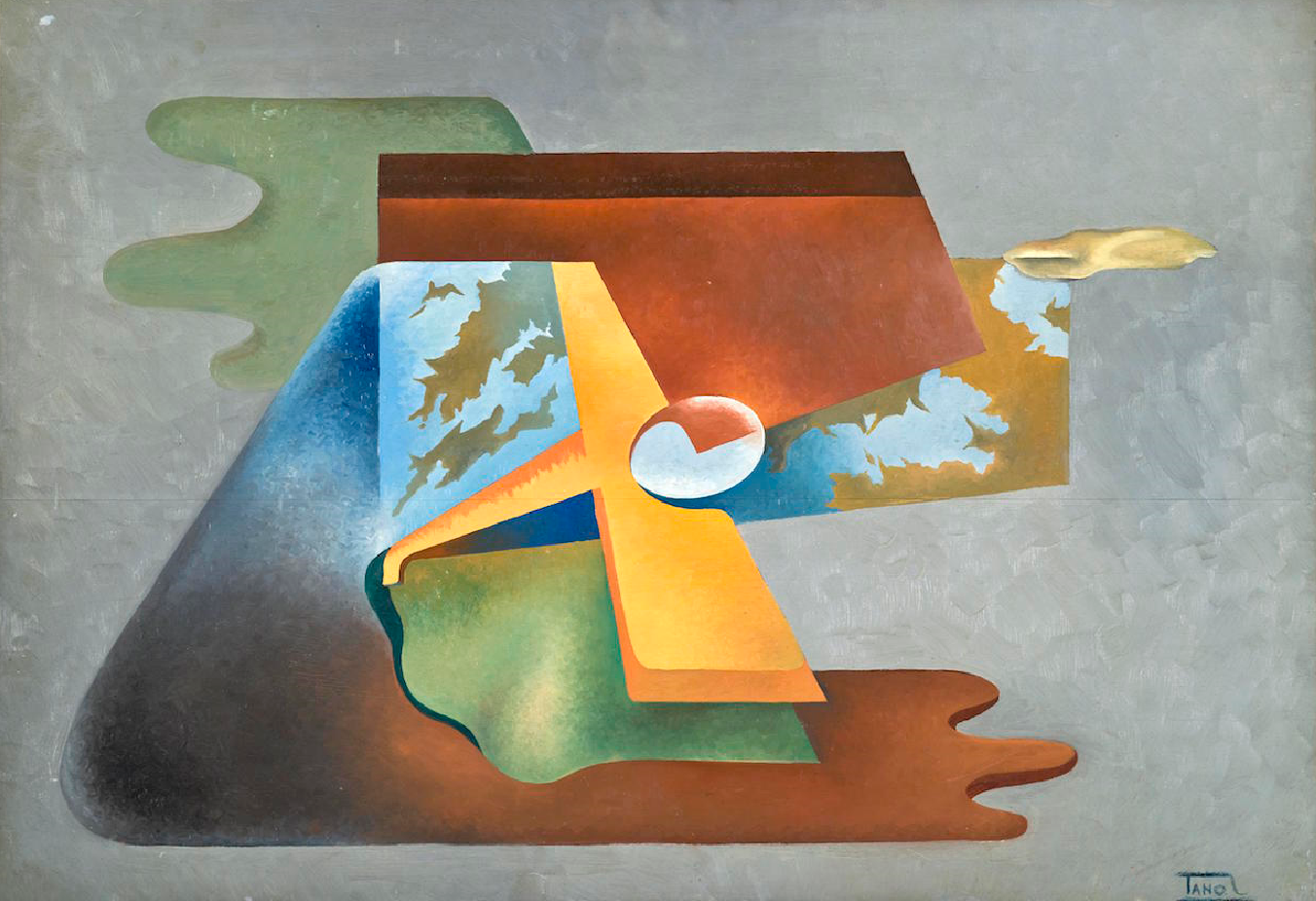
This painting in the aereopittura style was created by Bruno Tano in 1938. Aereopittura—painting from the air—was a Futurist development that sought to capture movement, speed, and dynamism through visual composition.
Bruno Tano (1913–1942) was an Italian painter and artist born in Padova who moved to Macerata in his youth. After graduating from the Regia Scuola di tirocinio in 1931, he relocated to Rome, where he studied at the Museo artistico industriale and collaborated with the journal Il Fuoco. In 1932, he returned to Macerata and became an active correspondent for the magazine Futurismo, joining the Gruppo Futurista Maceratese. Throughout his career, Tano maintained strong connections with Roman artistic circles.
About Bruno Tano
Tano’s work emerged during the height of Italian Futurism’s second phase. He participated in major exhibitions including the 1933 Mostra d’Arte Sacra Futurista in Florence and contributed to the movement’s theoretical and artistic output through his journalism and painting practice until his death in 1942.
Details
- Artist: Bruno Tano (1913–1942)
- Year: 1938
- Style: Aereopittura (Futurist)
- Movement: Italian Futurism
Frequently asked questions
Who was Bruno Tano?
Bruno Tano was an Italian painter born in Padova in 1913 who became active in the Futurist movement. He studied painting and decoration in Macerata, later moved to Rome, and eventually joined the Gruppo Futurista Maceratese in 1932, where he worked as a correspondent for Futurismo magazine until his death in 1942.
What is aereopittura?
Aereopittura was a Futurist painting technique developed to represent the visual experience of flight and movement from above, emphasizing dynamism and modernity through distinctive compositional strategies.
When did Tano work in this style?
Tano was active in Futurist circles from 1932 onwards, participating in major exhibitions and creating works in aereopittura through the 1930s until his death in 1942.
Sources
- S1 — Pontiggia, Elena. Il Novecento Italiano. Abscondita, 2003. ISBN 978-88-8416-048-5.
- S2 — Bossaglia, Rossana. Il Novecento italiano. Electa, 1995. ISBN 978-88-435-6178-0.
Spotted an error? Write to editorial@culturalheritageonline.com and we correct it the same day.


