
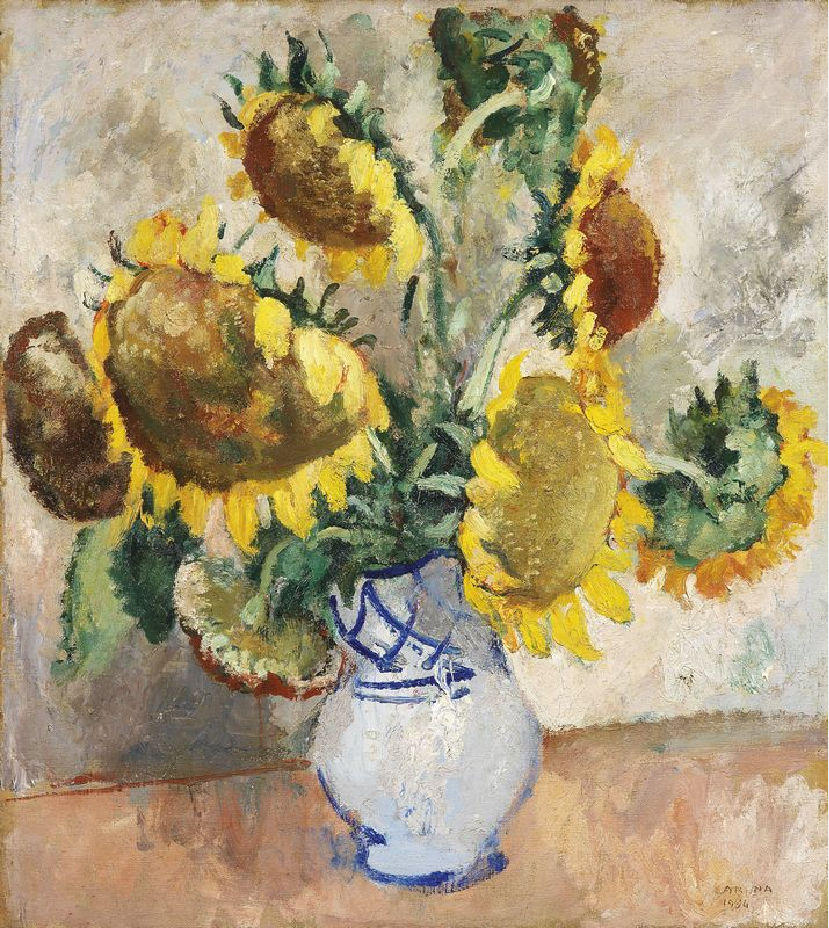
Felice Carena’s Girasoli (Sunflowers), painted in 1934, is an oil painting by the Italian modernist artist.
Carena developed his artistic practice over decades of experimentation, beginning his formal training at Turin’s Accademia Albertina before moving to Rome in 1906. Between 1913 and 1915, his work came under the influence of Cézanne and Matisse, marking a shift toward modernist colour relationships and structural clarity. By 1934, when he painted Girasoli, Carena had established himself as a significant figure in Italian art, having exhibited at the Venice Biennale since 1912 and founded an art school in Rome in 1922. His teaching career, which began at the Florence Academy in 1924, shaped a generation of Italian painters, including Giuseppe Capogrossi.
Girasoli reflects Carena’s mature engagement with the formal principles absorbed from his study of modern European painting—a synthesis of Post-Impressionist structure and twentieth-century sensibility that positioned him within Italy’s broader modernist dialogue during the interwar years.
About Felice Carena
Felice Carena (1879–1966) was born in Cumiana and studied under symbolist influences in Turin before relocating to Rome, where he became a central figure in Italian modernism. His career spanned multiple decades and pedagogical roles, concluding in Venice, where he settled in 1945.
Details
- Artist: Felice Carena
- Year: 1934
- Title: Girasoli (Sunflowers)
- Medium: Oil painting
- Movement: Italian modernism, influenced by Cézanne and Matisse
On video
Felice Carena — video from the Cultural Heritage Online archive
Frequently asked questions
Who was Felice Carena?
Felice Carena (1879–1966) was an Italian painter born in Cumiana who studied at Turin’s Accademia Albertina and became a significant modernist artist. He founded an art school in Rome in 1922 and taught at the Florence Academy from 1924 onwards.
What artistic influences shaped this work?
Between 1913 and 1915, Carena’s style was influenced by Cézanne and Matisse, leading him toward modernist approaches to colour and form that are evident in works like Girasoli.
Where did Carena work during the 1930s?
By 1934, Carena was established in Italy as a painter and educator; he remained active in Rome and Florence before eventually moving to Venice in 1945, where he lived for the remainder of his life.
Sources
- S1 — Pontiggia, Elena. Il Novecento Italiano. Abscondita, 2003. ISBN 978-88-8416-048-5.
- S2 — Bossaglia, Rossana. Il Novecento italiano. Electa, 1995. ISBN 978-88-435-6178-0.
Spotted an error? Write to editorial@culturalheritageonline.com and we correct it the same day.


