
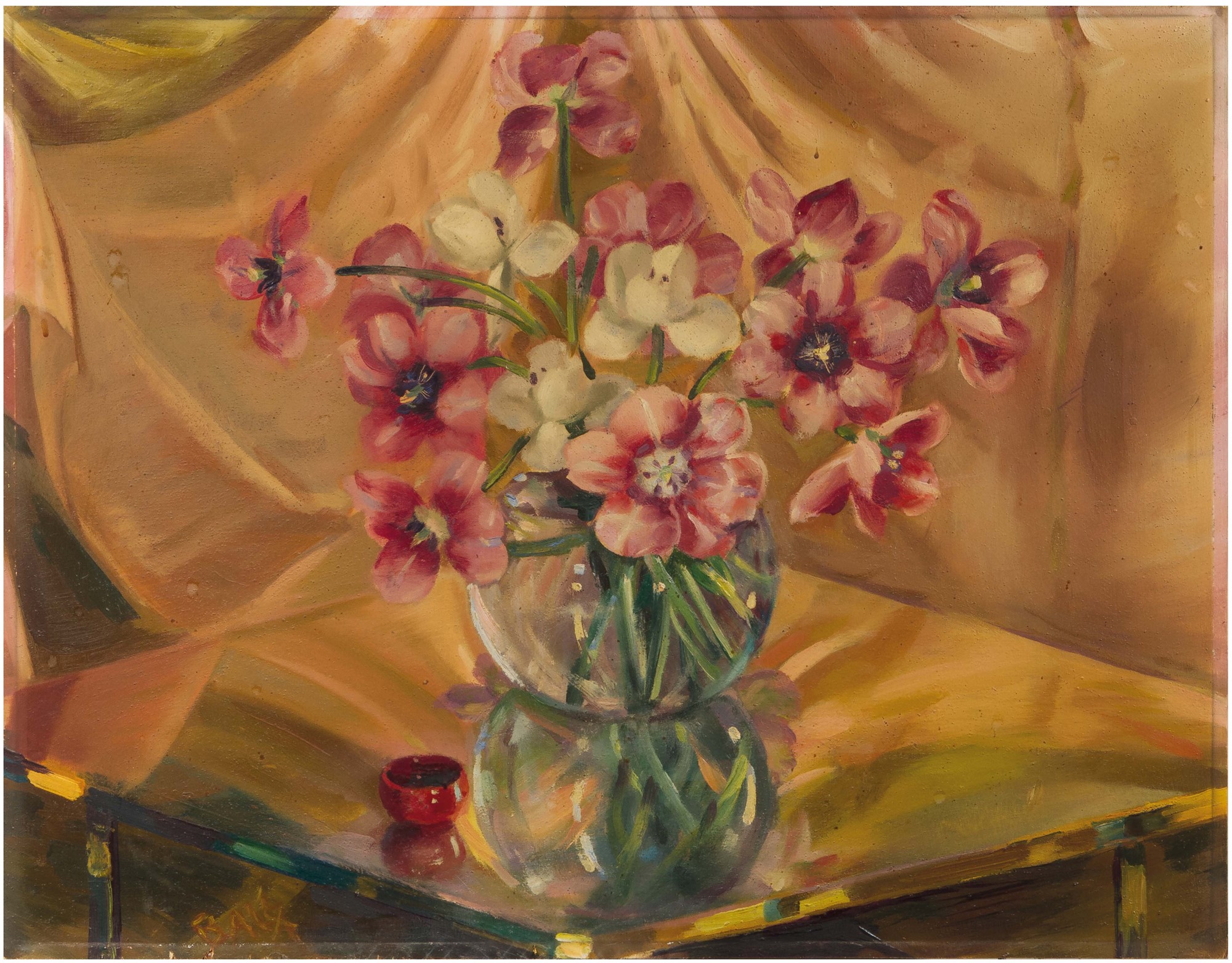
Penombre Riflessi Tulipani is a painting by Giacomo Balla completed in 1940. The work belongs to the artist’s mature engagement with Futurism, a movement in which he held a prominent position as a key proponent.
Balla’s artistic practice centred on the depiction of light, movement and speed. In this composition, the subject of tulips becomes a vehicle for exploring the interplay of shadow and reflection—penombre and riflessi in Italian. Rather than pursuing the machine aesthetics and violence that preoccupied many of his contemporaries in the Futurist circle, Balla maintained a distinctly whimsical approach to representing dynamic visual phenomena. His concern lay with capturing the ephemeral effects of luminosity and optical sensation, translating them into painted form.
About Giacomo Balla
Balla was an Italian painter, art teacher and poet. A leading figure in Futurism, he distinguished himself through his focus on light and optical effects rather than industrial or aggressive imagery, bringing a poetic sensibility to avant-garde practice.
Details
- Artist: Giacomo Balla
- Year: 1940
- Movement: Futurism
- Subject: Tulips, light, reflection
On video
Frequently asked questions
Who was Giacomo Balla?
Giacomo Balla was an Italian painter, art teacher and poet, and a key proponent of Futurism. He was known for depicting light, movement and speed in his paintings, with a tendency towards the witty and whimsical rather than machines or violence.
What makes this painting characteristic of Balla’s work?
The painting exemplifies Balla’s approach to Futurism through its focus on light effects and optical phenomena. Rather than depicting machinery or aggression, he explored the poetic dimensions of luminosity and reflection through a floral subject.
What period does this work date from?
Penombre Riflessi Tulipani was completed in 1940, representing Balla’s later work as an established artist within the Futurist movement.
Sources
- S1 — Pontiggia, Elena. Il Novecento Italiano. Abscondita, 2003. ISBN 978-88-8416-048-5.
- S2 — Bossaglia, Rossana. Il Novecento italiano. Electa, 1995. ISBN 978-88-435-6178-0.
Spotted an error? Write to editorial@culturalheritageonline.com and we correct it the same day.


