
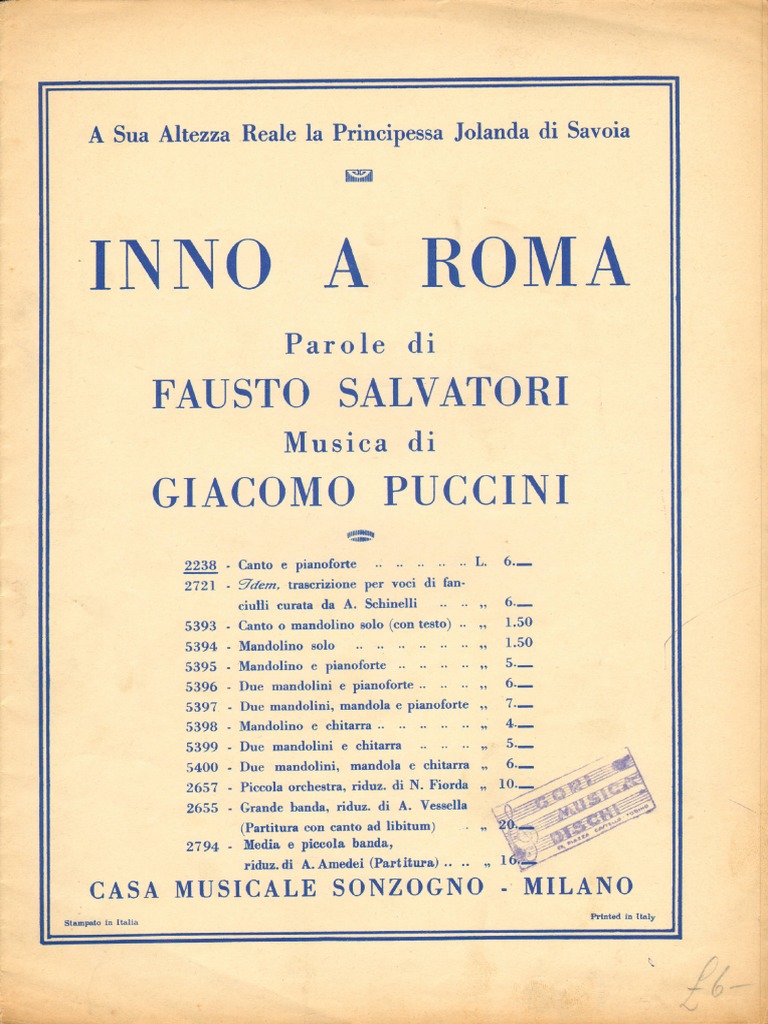
In 1919, composer Giacomo Puccini set words by Fausto Salvatori to music in “Inno a Roma” (Hymn to Rome), a patriotic composition celebrating the city and the nation in the aftermath of World War I.
The Text and Its Context
Salvatori’s text invokes Rome as a divine mother and eternal source of law. The hymn addresses the sun rising over the Capitoline Hill, where sacred laurel perpetually flourishes, and declares that nothing in the world equals Rome’s greatness. Written in 1919, the verses reflect post-war Italian nationalism, with references to victory, the tricolour flag, and Rome’s civilising role among peoples. The text repeats its refrain: “Sun that rises free and joyful over our hill, you tame your horses there; you will not see anything in the world greater than Rome.”
Patriotic Imagery and Symbolism
The hymn employs classical Roman imagery—the Capitoline, laurel crowns, and eternal law—as symbols of national continuity and pride. References to banners flying across the sky and the tricolour singing at building sites and factories anchor the composition in the contemporary moment of reconstruction and national renewal. The invocation of Rome as a mother dispensing eternal and pure law to peoples reflects a vision of Italian cultural and moral authority rooted in ancient Rome.
On video
Frequently asked questions
Who wrote the text and music for “Inno a Roma”?
Fausto Salvatori wrote the text and Giacomo Puccini composed the music in 1919.
What themes does the hymn celebrate?
The hymn celebrates Rome as a divine city, Italian victory, national renewal after World War I, and Rome’s eternal role as a source of law and civilisation for all peoples.
Sources
- S1 — Settis, Salvatore. Italia S.p.A.. L'assalto al patrimonio culturale. Einaudi, 2002. ISBN 978-88-06-16973-2.
- S2 — Casarin, Francesco. Il marketing dei musei e delle istituzioni culturali. Il Mulino, 2019. ISBN 978-88-15-28514-0.
Spotted an error? Write to editorial@culturalheritageonline.com and we correct it the same day.


