
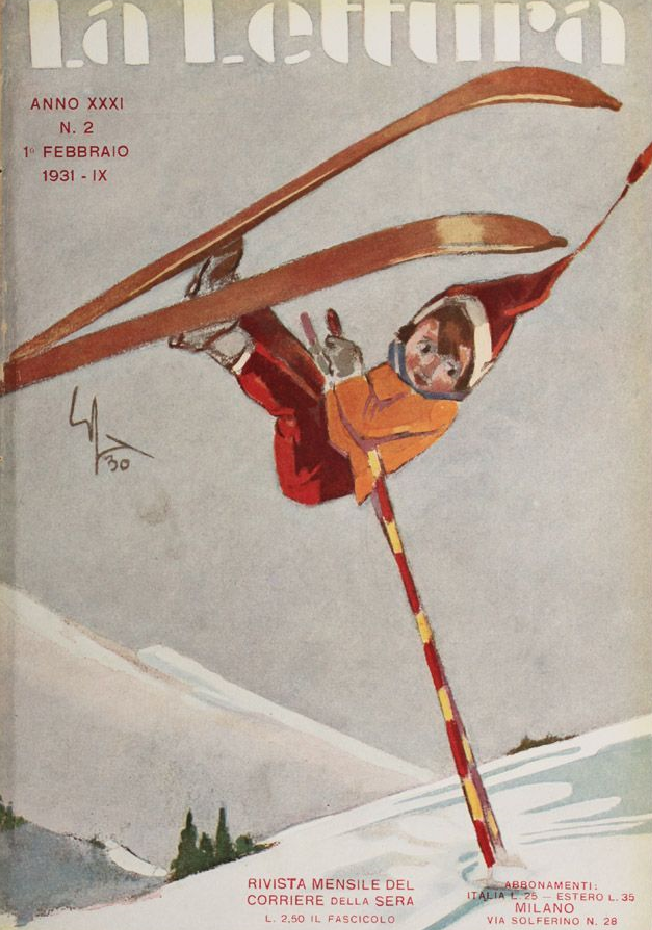
A magazine cover illustrated by Enrico Sacchetti in 1931. Sacchetti was one of Italy’s most celebrated caricaturists and advertising illustrators of the twentieth century.
Sacchetti (1877–1967) built his reputation as a caricaturist working with publisher Umberto Notari, achieving particular success through advertising campaigns for Bitter Campari and Proton tonic syrup. A collaborator with Filippo Tommaso Marinetti on poetry publications, Sacchetti worked across multiple media—painting, illustration, and written work. He won the Bagutta Prize in 1935 for his book Vita d’artista. Born in Rome to a Tuscan family, he spent formative years in Florence and maintained strong ties to Italian artistic circles throughout his career, also working in Buenos Aires during 1908 before returning to Italy.
About Enrico Sacchetti
Sacchetti emerged as a leading figure in early twentieth-century Italian illustration and caricature. His facility with line and character made him sought after for both editorial and commercial work, defining a visual style that reached mass audiences through advertising and periodical publication.
Details
- Creator: Enrico Sacchetti (1877–1967)
- Year: 1931
- Object type: Magazine cover illustration
- Nationality: Italian
Frequently asked questions
Who was Enrico Sacchetti?
Enrico Sacchetti (1877–1967) was an Italian painter, illustrator, and writer considered one of the most famous caricaturists of the twentieth century. He worked in advertising, editorial illustration, and collaborated with major cultural figures including Filippo Tommaso Marinetti.
What made Sacchetti successful as an illustrator?
Sacchetti gained prominence through his caricature work with publisher Umberto Notari and achieved widespread recognition through celebrated advertising campaigns, particularly for Bitter Campari and Proton tonic syrup. He illustrated poetry publications and contributed to Italy’s visual culture across multiple genres.
Did Sacchetti work outside Italy?
Yes. In 1908 Sacchetti moved to Buenos Aires, where he contributed to El Diario, the city’s major daily newspaper, before returning to Italy following his experience there.
Sources
- S1 — Menegazzi, Luigi. Il manifesto italiano: 1882-1925. Electa, 1995. ISBN 978-88-435-5134-7.
- S2 — De Fusco, Renato. Storia del design. Laterza, 2002. ISBN 978-88-420-6623-1.
Spotted an error? Write to editorial@culturalheritageonline.com and we correct it the same day.


