
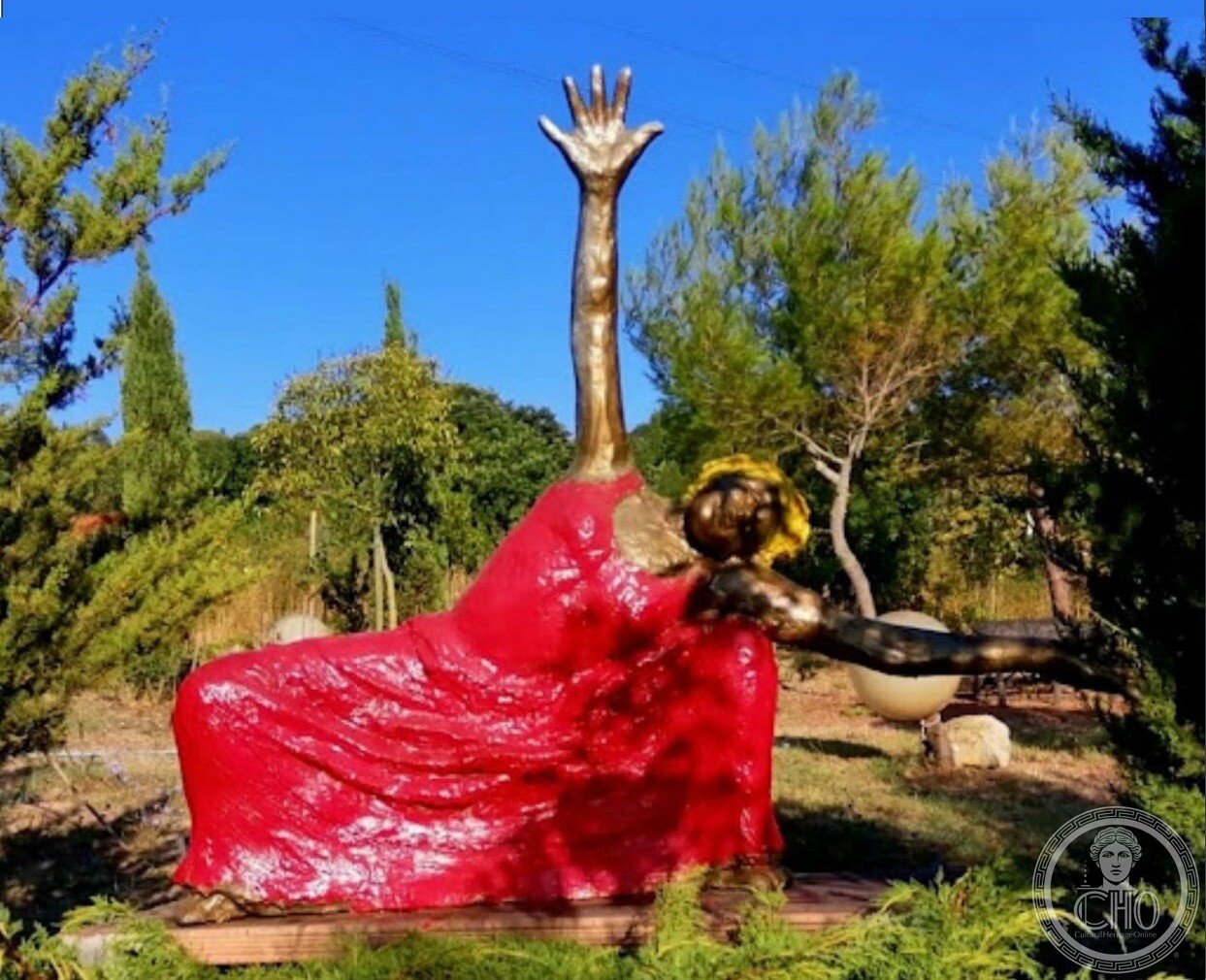
The Parco delle sculture La Giunca is an open-air sculpture park on the provincial road of the Giunca, in the hills of Rosignano Marittimo on the Tuscan coast south of Livorno. It was created in 2010 by the sculptor and set designer Franca Frittelli, together with her husband, the painter and graphic artist Ariberto Badaloni, to bring together in a single place works that until then had been scattered across various locations. Recognised by the Region of Tuscany among its artistic parks, it holds more than forty sculptures — many from Frittelli’s cycle dedicated to dance — along a gently sloping wood that the two founders planted themselves on ground that had been left uncultivated.
At a glance
- Type
- Open-air sculpture park and artists’ garden
- Founded
- 2010, by Franca Frittelli and Ariberto Badaloni
- Works on show
- More than forty sculptures in marble, resin, stone and wood, plus more than thirty large-format reproductions of paintings, drawings and illustrations by Ariberto Badaloni
- Location
- Strada Provinciale 12 della Giunca 49, locality Colli, 57016 Rosignano Marittimo, Livorno, Tuscany
- Coordinates
- 43.4223° N, 10.4646° E
- Recognition
- Among the artistic parks recognised by the Region of Tuscany
Overview
La Giunca belongs to a particular Italian category: the park made by the artist who lives in it. There is no institutional collection here and no curator brought in from outside. The sculptures are Franca Frittelli’s own, the land is hers and Ariberto Badaloni’s, and the arrangement of the works among the trees is the work of the sculptor herself, who trained as a set designer and treats the slope as a stage. The founders describe the result as a large three-dimensional monographic catalogue: a body of work that can be walked through rather than filed.
The park sits roughly halfway along the Strada Provinciale della Giunca, the road that links the hilltop village of Rosignano Marittimo with the SS 206 «Emilia», the state road connecting Cecina to Pisa. It opens for a short season each year and for a few hours at a time, which keeps it closer to a studio visit than to a museum outing.
History
In 2010 Franca Frittelli decided to recover the sculptures she had placed over the years in various locations and to gather them in one place that friends and anyone interested in art could actually see. The ground chosen was uncultivated. Over four years of work the two founders put in close to a thousand plants — holm oaks, oaks, eucalyptus, Mediterranean scrub, olives and fruit trees of every kind — turning the plot into a park that reads as a wood.
The site has since been included among the artistic parks recognised by the Region of Tuscany, and the park operates with the patronage of the Comune di Rosignano Marittimo and the association Associazione per le Arti Visive «La Torre» nella Cultura di Genere e Ambiente, founded by Frittelli and Badaloni.
What you see
More than forty sculptures are placed along the slope. Most belong to the cycle Frittelli has dedicated to dance since the 1990s, and they vary widely in material and in scale: marble, resin, stone and wood, from pieces at hand height to figures several metres across. Because the ground rises and falls and the vegetation closes and opens, each work can be read from several distances and angles — which is the point, since form and surface are what sculpture asks you to walk around.
Alongside the sculptures the park shows more than thirty gigantografie, large-format reproductions of paintings, drawings and illustrations by Ariberto Badaloni, drawn from different periods of his output. The planting is still being extended: the founders describe the park as permanently in progress.
Cultural significance
La Giunca is a private initiative that has become a public resource, and it documents a working artist’s output in the place where that output was made — a rarer thing in Italy than the number of sculpture gardens might suggest. During the open season the two founders also run cultural events on the site, from courses and conferences to concerts and theatre, with a stated focus on gender culture and the environment.
Practical information
- Season
- 1 June to 30 September each year. Visits in April, May and October by prior arrangement by telephone.
- Opening hours
- Saturday and Sunday, 17.30–20.30. Hours are short and seasonal: telephone before travelling.
- Getting around the park
- The park can be reached on foot or by mountain bike and works as a stop on longer walks through the surrounding countryside.
- Contact
- Telephone and WhatsApp 328 5520188 — 328 2090066
Getting there
Rosignano Marittimo lies on the Etruscan Coast of Tuscany, south of Livorno. By car, leave the coastal road at Rosignano and follow the Strada Provinciale della Giunca inland towards the hill village; the park is at number 49, roughly midway along the road. The nearest railway station is Rosignano Solvay, on the Pisa–Rome line.
Sources & resources
- La Giunca Sculpture Park — Visit Tuscany (Region of Tuscany)
- Franca Frittelli — official site
- Parco delle sculture La Giunca — official page
- Information and materials supplied to Cultural Heritage Online by the park’s founders, August 2026
See the place
Find it on the map
See this place and what’s around it →📷 Become a Cultural Heritage Online photographer
Share your photos of places: they stay published under your name as the author. The more they're seen, the more you get noticed — and soon a contest will reward the most appreciated photos.
Log in or sign up free to add a photo