
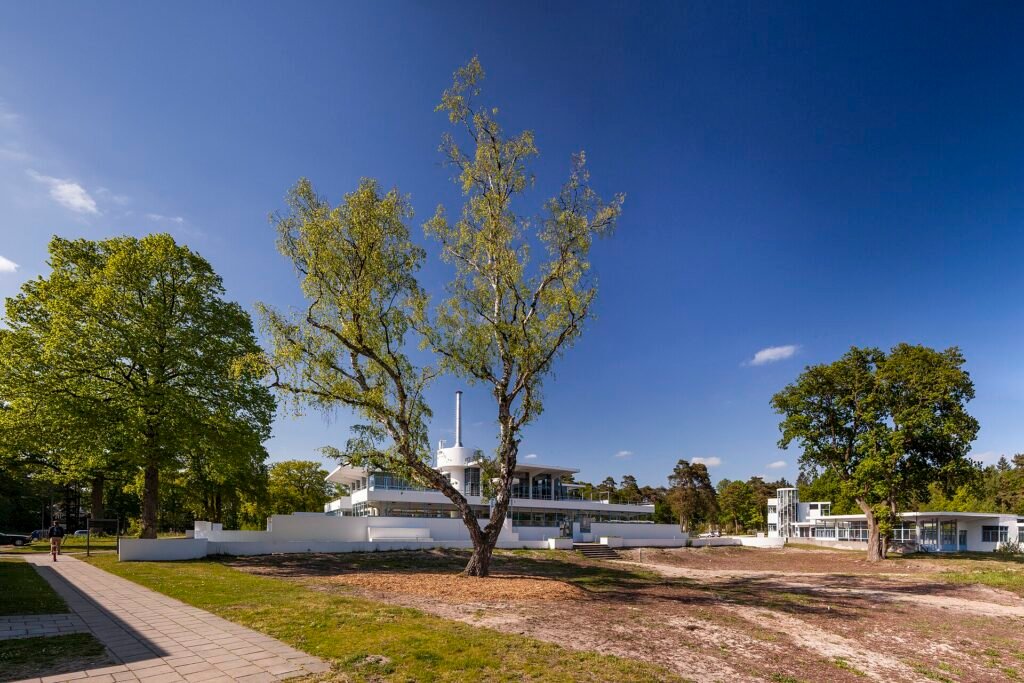
Light, air and glass as medicine: a sanatorium built so transparent it seems to dissolve into the woods.
At a glance
Zonnestraal — the name means sunray — was built between 1926 and 1928 as a tuberculosis sanatorium in the woods near Hilversum. Jan Duiker and Bernard Bijvoet designed it as a frame of slender concrete and vast glass, letting in the light and air that were the only treatment of the day. It is a landmark of the Nieuwe Bouwen, the Dutch modern movement.
Key facts
- Location: Loosdrechtse Bos, near Hilversum
- Architects: Jan Duiker and Bernard Bijvoet
- Built: 1926–1928
- Style: Nieuwe Bouwen (functionalism)
- Origin: a workers’ tuberculosis sanatorium
History
A diamond-workers’ union funded the sanatorium from money saved by its members, to treat tuberculosis among the trade. Duiker and Bijvoet, with the engineer Jan Gerko Wiebenga, built it as lightly as possible.
They expected it to last only as long as tuberculosis itself, and used the thinnest concrete frame they could. The disease was beaten by drugs, the buildings decayed, and a long restoration around 2000 brought the transparent pavilions back to life.
What you see
The pavilions are almost all glass, held by a spidery white concrete frame; walls seem to vanish and the pine woods show straight through. Balconies open to the south for the cure of sun and air. It is one of the most weightless buildings of its century, built on the idea that architecture could heal.
Practical information
- Open: grounds accessible; buildings by guided tour
- Cost: grounds free; tours ticketed
- Best for: the glass pavilions in the woodland setting
- Time needed: 45–60 minutes
Getting there
The estate lies in woodland on the edge of Hilversum, reached by bus or car from Hilversum station, itself about half an hour from Amsterdam by train.
Nearby
- Hilversum Town Hall — Dudok’s brick masterpiece in the town
- Het Gooi — the woods and heaths around Hilversum
Sources
- Encyclopædia Britannica / Wikipedia — Zonnestraal
- Rijksmonument / Zonnestraal foundation — building history
- Wikimedia Commons — image source and licence
Find it on the map
See this place and what’s around it →📷 Become a Cultural Heritage Online photographer
Share your photos of places: they stay published under your name as the author. The more they're seen, the more you get noticed — and soon a contest will reward the most appreciated photos.
Log in or sign up free to add a photoIs this page about you?
This page is read by travellers and heritage enthusiasts who find it on Google. Tell us how you are connected to this place and we will take it from there.