
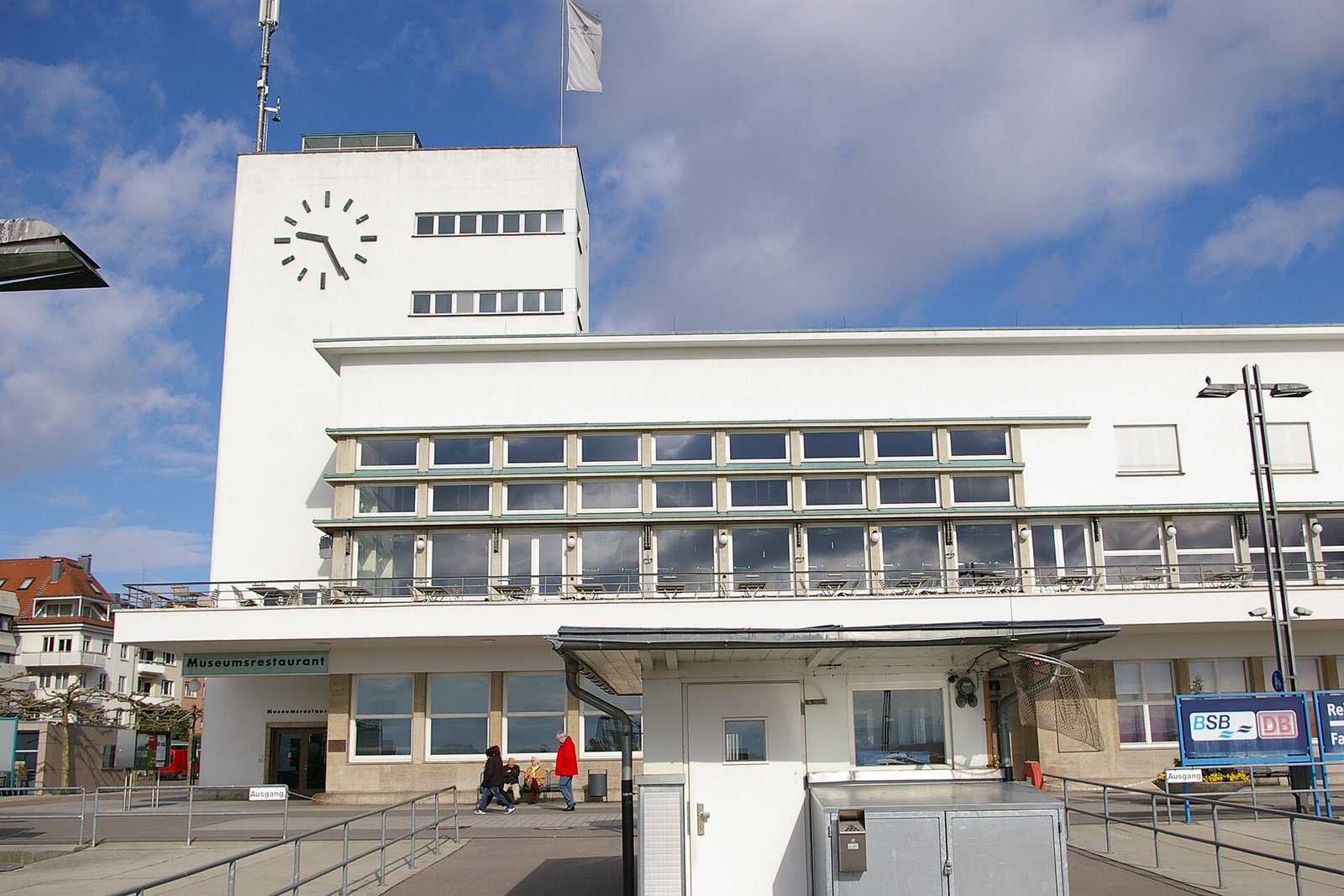
The world’s largest collection on airship history occupies a white modernist harbour station of 1933 on the shore of Lake Constance. The hangars that once held the Zeppelins are gone: none survives at Friedrichshafen.
At a glance
- Type
- Museum of airship history and technology, and regional art collection
- Building
- Former Hafenbahnhof (harbour railway station) by Karl Hagenmayer, 1931–1933
- Style
- Neue Sachlichkeit (New Objectivity), classical modernism
- Protection
- Listed monument since 1987
- Museum opened
- 2 July 1996, after conversion works of 1993–96
- Location
- Seestraße 22, 88045 Friedrichshafen, on Lake Constance
Overview
Friedrichshafen built the rigid airship, and the airship built Friedrichshafen. The museum that tells that story does not stand in a hangar, as visitors often expect, but in the town’s former harbour railway station: a white, flat-roofed building of 1933 where lake steamers and trains once met.
Inside, the centrepiece is a full-scale walk-through reconstruction of a 33-metre section of LZ 129 Hindenburg, entered as passengers entered it. The collection covers the technology and the social history of airship travel, and the building also holds the municipal art collection, a legacy of the Bodensee-Museum that preceded it.
History
The institution is older than its building. A Bodensee-Museum opened in Friedrichshafen on 8 June 1912, at the height of the Zeppelin years, and was destroyed in 1944 with much of the town.
The building it now occupies went up between 1931 and 1933 to the design of Karl Hagenmayer, as the Hafenbahnhof where the railway reached the lake harbour. Its white cubic volumes, long window bands and projecting first-floor balcony belong to the New Objectivity of those years, built on a steel skeleton with hollow-stone infill. It was placed under monument protection in 1987.
The airship works themselves did not survive the war. A first great hall was completed in 1915, when the site was renamed Luftschiffhafen Löwental, and was dismantled in 1928 because of its condition and its limits. Its successor, begun in 1930 for LZ 127 Graf Zeppelin and LZ 129 Hindenburg, was demolished in early 1943 and carried away on a purpose-built industrial railway into the Zeppelin works. Eleven Allied air raids struck Friedrichshafen; after the raid of the night of 27–28 April 1944 the Luftschiffbau Zeppelin design office moved to Weissenau, near Ravensburg, and Berlin chose not to rebuild the plants here.
The station was converted into a museum between 1993 and 1996, with exhibition design by HG Merz, and opened on 2 July 1996. In the same years the airship returned to the town in a new form: Zeppelin Luftschifftechnik was founded in 1993, a new hangar was built on the north side of the airport in 1996–97, and the Zeppelin NT made its first flight on 18 September 1997.
What you see
The reconstructed section of the Hindenburg is the reason most visitors come. It is built at full scale and can be walked through, with the passenger lounge, cabins and the famous windows that opened onto the air. Around it the museum sets out engines, structural rings of duralumin girder, fabric samples and the archives of the Luftschiffbau.
The building itself is worth a slow look from the lake promenade, where the long horizontal bands of windows and the white geometry read exactly as they were meant to in 1933. The upper floor holds the art collection, with works from the Middle Ages to the twentieth century, in rooms that still betray their origin as a station.
Cultural significance
This is the principal collection anywhere on the rigid airship, the technology that for three decades made Friedrichshafen a name known across the world, and it is housed in a listed monument of German interwar modernism. Two heritages, aviation and architecture, sit in the same building.
It is also an honest place about loss. The great sheds that defined the town’s skyline are documented here and nowhere else, because none of them is left to visit.
Practical information
- Address: Seestraße 22, 88045 Friedrichshafen, Germany
- Setting: on the harbour promenade, beside the lake steamer pier
- Do not confuse it with the working airship hangar of Zeppelin Luftschifftechnik on Allmannsweilerstraße, north of the airport: that is a factory built in 1996–97, not a museum and not open as one
- Official site: zeppelin-museum.de for current opening hours and tickets
Getting there
The museum stands on the Friedrichshafen lakefront, a short walk from the Stadtbahnhof and directly at the harbour where the Lake Constance ferries dock. Friedrichshafen is reached by rail from Ulm and Lindau, by ferry from Romanshorn in Switzerland, and by air through Friedrichshafen airport a few kilometres to the north.
Sources
- Zeppelin Museum Friedrichshafen, institutional history — zeppelin-museum.de
- Vielfalt der Moderne, Baden-Württemberg modernism heritage portal, entry on the Friedrichshafen port station (Hagenmayer, 1931–33, listed 1987)
- Landeszentrale für politische Bildung Baden-Württemberg, Bauhaus pages on the Hafenbahnhof Friedrichshafen
- Bodensee-Airport Friedrichshafen, official chronicle (1915 airship hall and Luftschiffhafen Löwental; dismantling 1928; demolition of the successor hall in early 1943) — bodensee-airport.eu
Find it on the map
See this place and what’s around it →📷 Become a Cultural Heritage Online photographer
Share your photos of places: they stay published under your name as the author. The more they're seen, the more you get noticed — and soon a contest will reward the most appreciated photos.
Log in or sign up free to add a photo