
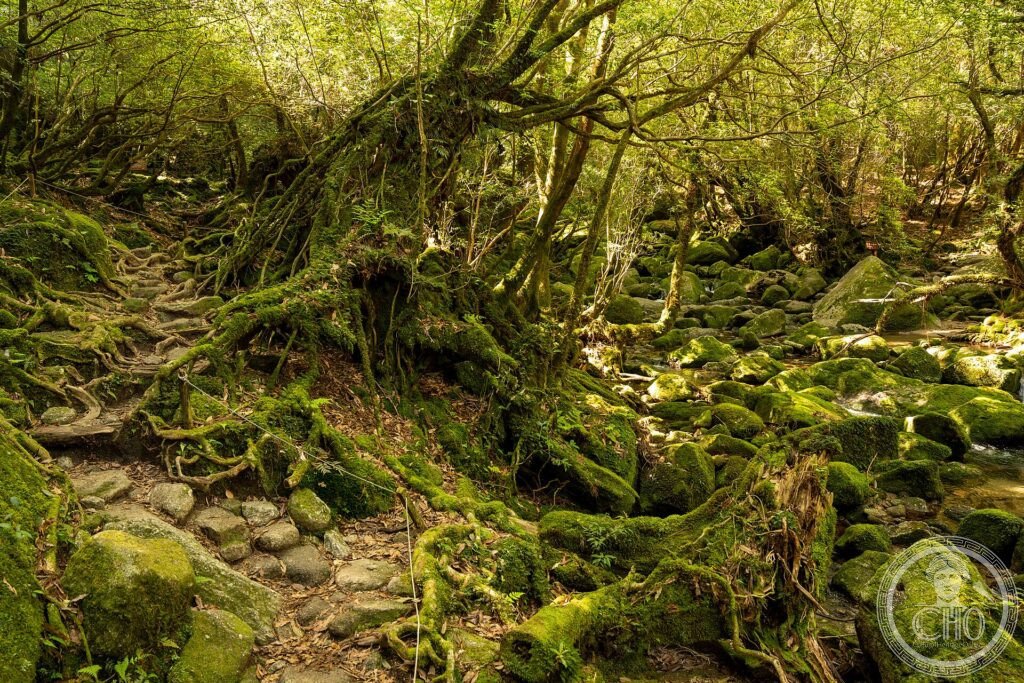
On a mountainous island in the south of Japan, beaten by some of the heaviest rainfall in the country, an enchanted forest grows: Japanese cedars (sugi) thousands of years old, rocks and trunks clothed in moss, streams and mist. Yakushima is a damp and ancient world, which has fed the imagination of films and legends.
At a glance
Yakushima, a mountainous island off the southern tip of Kyushu in Japan, is famed for its ancient forest of Japanese cedars (sugi). Drenched by some of the heaviest rainfall in Japan, the island rises from subtropical coast to near-alpine peaks, and on its misty slopes grow the yakusugi — cedars thousands of years old, the most famous, Jomon Sugi, among the oldest trees in the world — amid a deep-green world of moss-covered rocks and roots. This luxuriant forest was inscribed by UNESCO in 1993.
Key facts
- UNESCO: World Heritage since 1993 (Yakushima)
- Ancient cedars: yakusugi, some thousands of years old
- Jomon Sugi: a giant cedar among the oldest trees on Earth
- Moss forest: deep-green, rain-soaked woodland
- Vertical range: from subtropical coast to high peaks
- Heavy rainfall: among the wettest places in Japan
History
Yakushima’s extraordinary rainfall — the island is said to have “35 days of rain a month” — and its range of altitudes nurture a forest of exceptional richness. Its cedars were logged for centuries, prized for their resinous, slow-grown timber, but the oldest and largest, deep in the mountains, were spared; some, like Jomon Sugi, may be thousands of years old.
The island’s mossy, primeval forests captured the imagination of artists and are often linked with the dreamlike woodland of Japanese animation. Recognising the global value of this ancient forest and its ecosystems, from coast to summit, UNESCO inscribed Yakushima in 1993, among the first natural sites listed in Japan.
What you see
Forest trails — such as the route to Jomon Sugi and the much-loved Shiratani Unsuikyo ravine — lead through dripping, moss-covered woodland of ancient cedars, twisted roots and clear streams, climbing toward the high moorland of the island’s peaks. The coast adds beaches where sea turtles nest and hot springs.
The hushed, green, rain-soaked forest, with its thousand-year-old trees, is the magic of Yakushima.
Practical information
- Island: reached by ferry or air from Kagoshima
- Best time: spring to autumn; rain is likely any time
- Time needed: two or more days
- Note: the Jomon Sugi hike is long; bring rain gear
Getting there
Yakushima lies off the southern tip of Kyushu, in Kagoshima Prefecture, Japan, reached by ferry and by air from Kagoshima. GPS: 30.35° N, 130.50° E.
Nearby
- Kagoshima — the mainland city and gateway
- Shiratani Unsuikyo — the famous mossy ravine
- Tanegashima — the neighbouring island
Sources
- UNESCO World Heritage Centre — “Yakushima” (ref. 662)
- Japan Ministry of the Environment — official body
- Encyclopaedia Britannica — Yaku Island
Find it on the map
See this place and what’s around it →
📷 Become a Cultural Heritage Online photographer
Share your photos of places: they stay published under your name as the author. The more they're seen, the more you get noticed — and soon a contest will reward the most appreciated photos.
Log in or sign up free to add a photo