
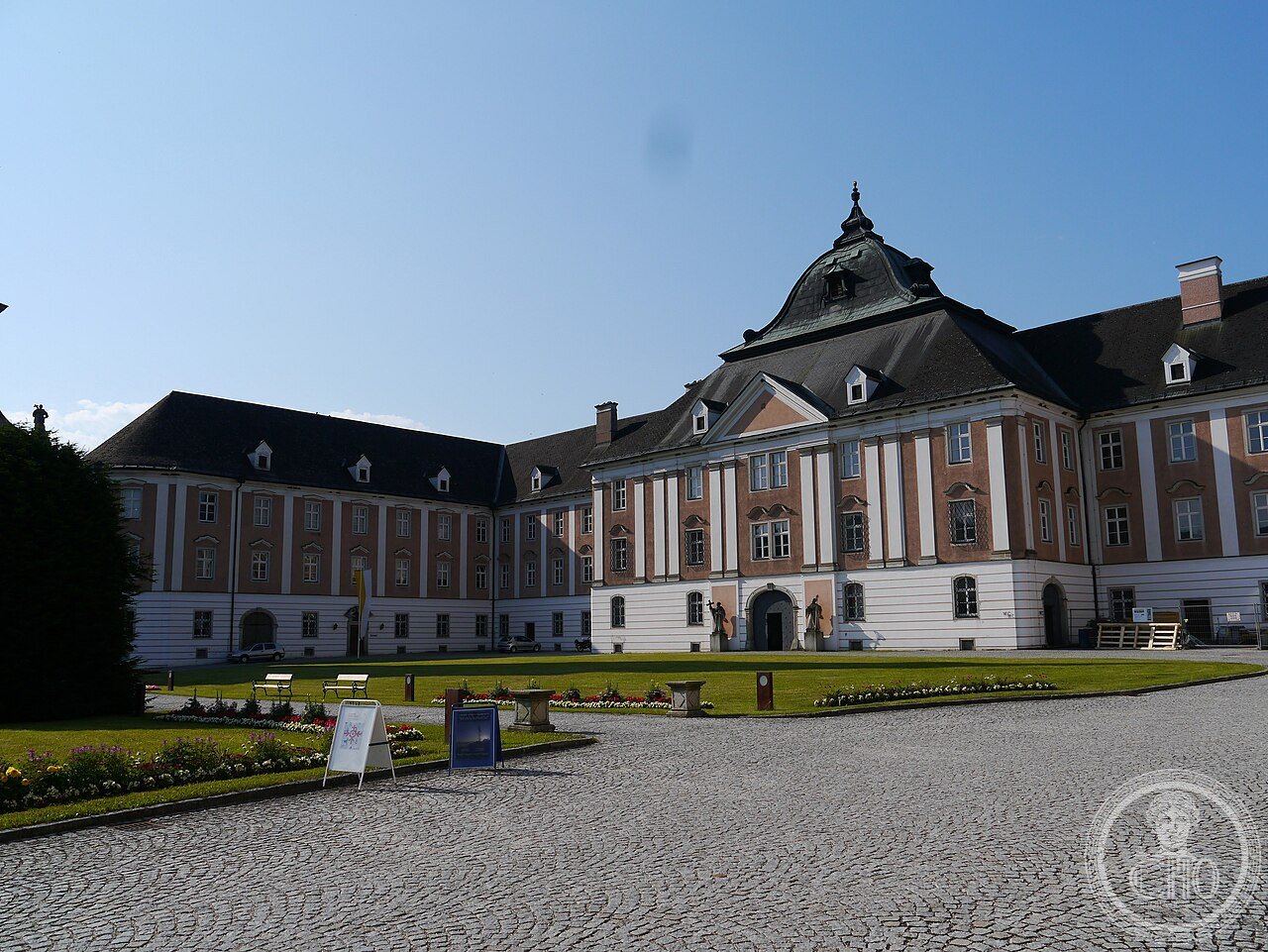
On 6 March 1733 a fire destroyed almost all the buildings of the Cistercian abbey founded in 1146 by Ulrich and Kolo of Wilhering in their own family castle. Abbot Johann Baptist Hinterhölzl had the church urgently repaired, then entirely rebuilt in Rococo style by the master builder Johann Haslinger of Linz: completed in 1748, it remains today one of the most significant Rococo buildings in the whole German-speaking area.
About Wilhering Abbey
Wilhering Abbey, a Cistercian monastery roughly 8 km from Linz in Upper Austria, was founded in 1146 by Ulrich and Kolo of Wilhering, who donated their family’s old castle for the purpose; on 30 September 1146, Ulrich replaced the initial community of canons with Cistercian monks brought from Rein Abbey in Styria. The abbey buildings were almost entirely destroyed by fire on 6 March 1733, and Abbot Johann Baptist Hinterhölzl (1734-1750) initially made emergency repairs to the church using the surviving remnants of the walls. The church was then completely rebuilt in Rococo style by Johann Haslinger, a relatively little-known master mason from Linz, possibly working from designs connected to Abbot Hinterhölzl himself; the essential decoration and furnishing work was completed by 1748. The result is now recognised as one of the most significant Rococo buildings anywhere in the German-speaking world. In the 19th century, Abbot Alois Dorfer, who led the community for more than forty years (1851-1892), placed particular emphasis on preserving the abbey’s Cistercian heritage and encouraged administrative structures echoing the medieval filiation system linking each Cistercian house to a mother abbey; Wilhering subsequently joined the Austrian Province for Cistercian abbeys upon its establishment in 1854.
Key facts
- Foundation: 1146, by Ulrich and Kolo of Wilhering, on their family castle site; Cistercian monks from Rein Abbey, Styria, installed 30 September 1146
- 1733 fire: destroyed almost the entire abbey complex on 6 March 1733
- Rococo rebuilding: church rebuilt by master mason Johann Haslinger of Linz; decoration and furnishing complete by 1748
- Significance: one of the most important Rococo buildings in the German-speaking world
- Abbot Alois Dorfer (1851-1892): emphasised Cistercian heritage and filiation-system administrative structures
- 1854: Wilhering joined the newly established Austrian Province for Cistercian abbeys
History
Ulrich and Kolo of Wilhering’s decision to donate their own family castle to found the abbey, and to specifically bring in Cistercian monks from Rein Abbey in Styria to replace an initial community of secular canons, reflects the broader 12th-century pattern of noble families across the Austrian lands actively favouring the reformist Cistercian order over older, less strictly regulated monastic and canonical arrangements — a preference that helped drive the order’s rapid territorial expansion across Central Europe during this period. The 1733 fire’s near-total destruction of the medieval complex, followed by complete Rococo reconstruction rather than a more conservative restoration, situates Wilhering’s rebuilding within the broader 18th-century pattern of Central European monasteries treating catastrophic fire damage as an opportunity for wholesale stylistic modernisation, producing buildings whose visible architectural character today often has more to do with a specific 18th-century rebuilding campaign than with the institution’s actual medieval founding date.
Abbot Alois Dorfer’s 19th-century emphasis on restoring medieval Cistercian filiation structures reflects a broader Catholic institutional response, across the second half of the 19th century, to the disruptions of Napoleonic-era secularisation and subsequent political instability, in which monastic orders across Central Europe worked to formally re-establish traditional administrative and spiritual relationships between mother and daughter houses that earlier upheavals had weakened or severed.
What you see
The Rococo church interior, completed in 1748, is Wilhering’s essential single destination, its status as one of the most significant Rococo interiors in the German-speaking world rewarding a slow, detailed viewing of its decorative ceiling frescoes, stucco work, and furnishings. The surviving medieval castle-site foundation, beneath the later Rococo superstructure, connects the visible building to its original 1146 founding donation. The complex’s continuing active Cistercian community situates the abbey as a living monastery within its historic Rococo shell.
Practical information
- Opening hours: generally open daily during the visitor season, check current hours before visiting; free admission to the church, guided tours available
- Address: Stift Wilhering, 4073 Wilhering, Austria
Getting there
Wilhering is reachable by regional bus from Linz (approximately 20 minutes). By car, Wilhering sits just off the A7 motorway near Linz, Upper Austria. GPS: 48.3236° N, 14.1893° E.
Nearby
- Linz — approximately 20 minutes away; Upper Austria’s capital, on the Danube
- Danube river — the abbey lies close to the river, within the broader Linz-Wilhering riverside landscape
- St. Florian Priory — another major Upper Austrian monastery, within reach
Sources
- Wikipedia — “Wilhering Abbey” (en.wikipedia.org)
- CulturezVous — “Wilhering Abbey, an Austrian Rococo gem” (culturezvous.com)
- SpottingHistory — heritage documentation (spottinghistory.com)
Find it on the map
See this place and what’s around it →📷 Become a Cultural Heritage Online photographer
Share your photos of places: they stay published under your name as the author. The more they're seen, the more you get noticed — and soon a contest will reward the most appreciated photos.
Log in or sign up free to add a photo