
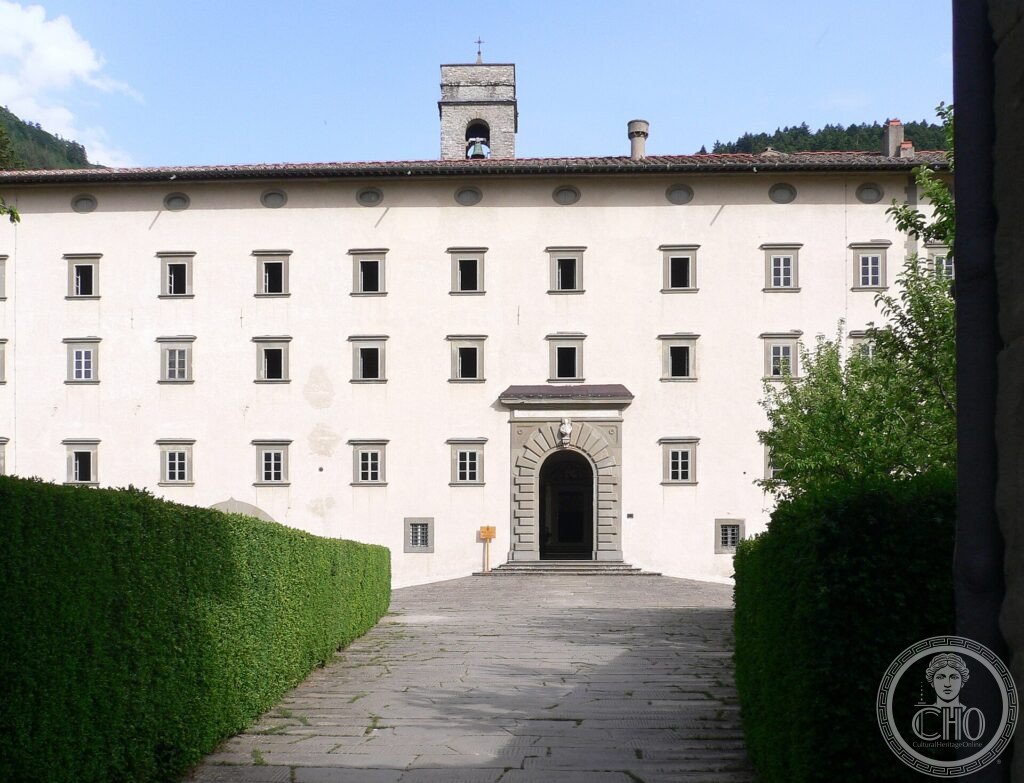
A monastic community founded on principles of evangelical poverty and clerical reform, Vallombrosa Abbey stands as a testament to medieval spiritual renewal and centuries of artistic patronage in the Florentine hills.
At a glance
Vallombrosa Abbey, located in the municipality of Reggello near Florence, was established by San Giovanni Gualberto in 1036 as a centre for monastic reform. The community built the stone church between 1224 and 1230, with major architectural additions in the fifteenth and seventeenth centuries. Pope Pius XII granted the abbey church the status of Minor Basilica in November 1950.
History
San Giovanni Gualberto, born into a prominent Florentine family, founded the Vallombrosani congregation when he retired to a place then called Acquabella with a small group of followers. His monastic reform centred on combating simony and promoting clerical renewal through communal life and a return to evangelical poverty—ideals that positioned the order at the heart of religious disputes between papacy and empire.
The community initially worshipped in a wooden oratory before constructing a stone church in 1058. A larger basilica rose between 1224 and 1230 as the monastery expanded. The fifteenth century brought substantial works: a large cloister, sacristy, tower, and refectory with kitchen. Following fires and reconstructions, the seventeenth and early eighteenth centuries gave the church its present homogeneous and sumptuous character. The monastery achieved abbey status in 1713, with Giovanni Francesco Luci as its first abbot.
Napoleonic suppressions in 1808 and subsequent demanialisation under Savoy rule in 1867 severely depleted the abbey’s artistic holdings. The Vallombrosans returned to reclaim the monastery in 1949.
What you see
The abbey church exemplifies the layering of medieval and early modern aesthetics. Fifteenth-century additions established the large cloister and sacristy, while seventeenth-century renovations unified the interior with ornamental grandeur. The bell tower and refectory reflect periods of intensive construction and practical monastic life.
The church interior preserves significant artworks accumulated across centuries. A notable painting by Lorenzo Lippi survives among the abbey’s artistic patrimony.
Cultural significance
Vallombrosa Abbey embodies a pivotal moment in medieval Church reform. San Giovanni Gualberto’s insistence on poverty and communal discipline resonated across Christendom, making the Vallombrosani order a recognised force in eleventh-century religious renewal. The abbey’s survival through suppression and demanialisation underscores its enduring spiritual importance to the Florentine region.
Key facts
- Address: Loc. Vallombrosa, 115, 50066 Reggello, Florence
- Coordinates: 43.73207685148298, 11.557531356811522
- Founded: 1036
- Church constructed: 1224–1230
- Abbey status granted: 1713
- Minor Basilica designation: November 1950
- Phone: 055 862251
- Website: monaci.org
Practical information
The abbey operates as a working monastery. Visits are generally possible; contact the community directly to confirm access times and any restrictions. The official website and telephone number provide current information on visiting conditions.
Getting there
Vallombrosa Abbey is situated in the locality of Vallombrosa within Reggello municipality, approximately 30 kilometres south-east of Florence city centre. Public transport connections exist via regional buses; a personal vehicle offers greater flexibility for reaching this mountain location. Check local travel resources for current routes and journey times.
See the place
Sources & resources
Find it on the map
See this place and what’s around it →📷 Become a Cultural Heritage Online photographer
Share your photos of places: they stay published under your name as the author. The more they're seen, the more you get noticed — and soon a contest will reward the most appreciated photos.
Log in or sign up free to add a photoIs this page about you?
This page is read by travellers and heritage enthusiasts who find it on Google. Tell us how you are connected to this place and we will take it from there.