

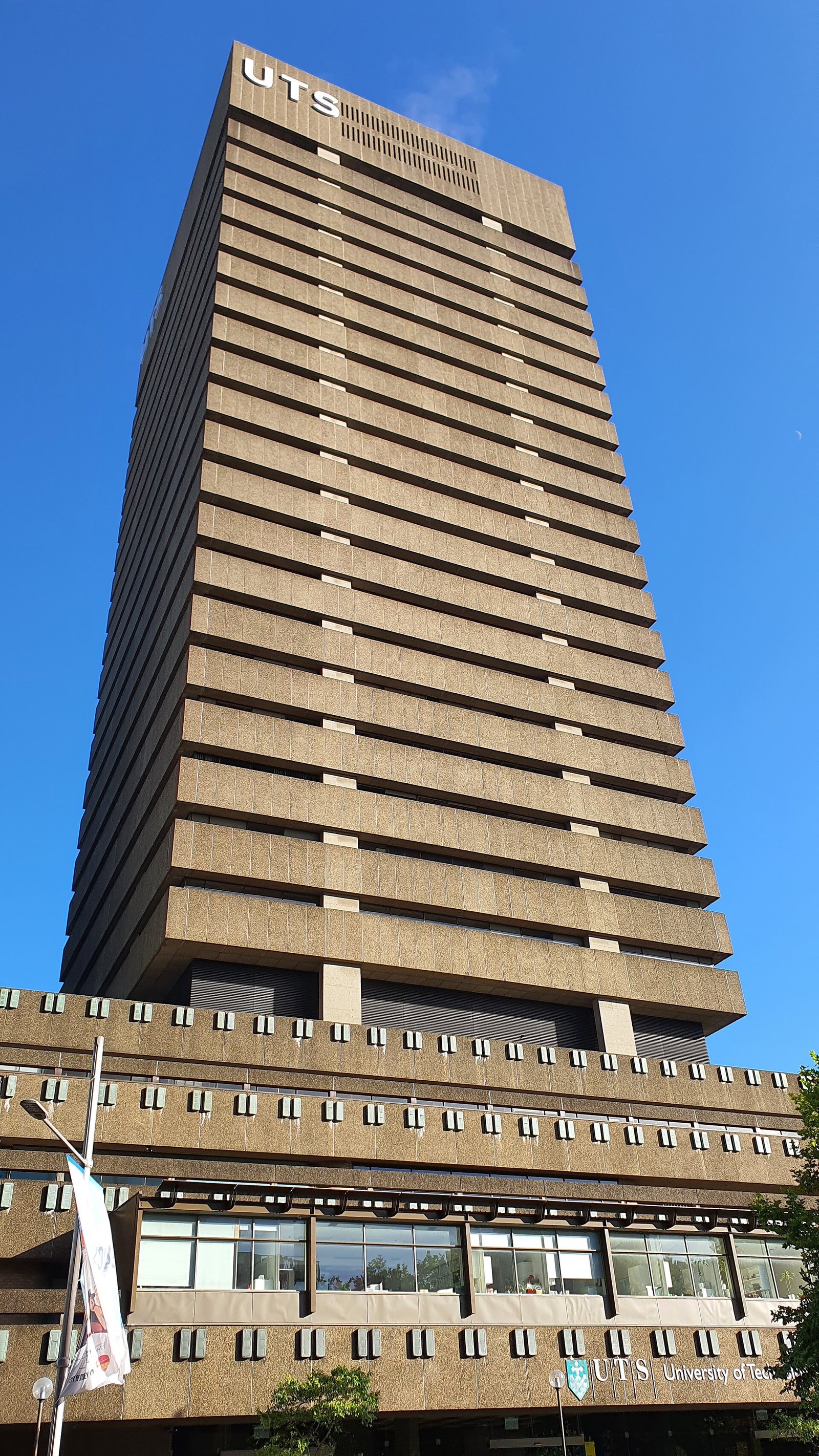
A brutalist landmark marking Sydney’s CBD gateway, this 27-storey administrative hub for the University of Technology rises boldly above Broadway.
At a glance
Completed in 1979, UTS Tower dominates the southern approach to Sydney’s central business district. The building houses many administrative functions of the University of Technology, Sydney across its 27 occupied floors. Its sculptural concrete form exemplifies the brutalist movement at its Australian peak.
History
The tower was designed from a 1968 plan by Michael Dysart of the NSW Government Architect’s Office. Construction culminated in its 1979 completion, when NSW Premier Neville Wran officially opened the building. The structure arrived at a moment when brutalism dominated public architecture across Australia and the world.
What you see
Raw concrete dominates the tower’s exterior—a defining characteristic of brutalist design. Geometric massing and fortress-like proportions give the building imposing presence on Broadway. The 27-storey volume rises as a solid, unadorned monument to institutional purpose and modernist principle.
Cultural significance
UTS Tower represents a pivotal moment in Australian public architecture when the nation’s government embraced bold geometric forms and raw materiality. The building stands as a significant example of 1970s institutional design and remains a defining landmark of Sydney’s urban fabric.
Key facts
- Country: Australia
- City: Sydney, New South Wales
- Completed: 1979
- Architect: Michael Dysart, NSW Government Architect’s Office
- Opened by: NSW Premier Neville Wran
- Floors: 27 occupied
- Coordinates: -33.8837, 151.2007
Practical information & getting there
UTS Tower is located on Broadway at the southern gateway to Sydney’s CBD, making it accessible by public transport and on foot. As an institutional building, access to interior spaces may be restricted. You can appreciate the building’s architectural presence from street level.
Sources & resources
Find it on the map
See this place and what’s around it →📷 Become a Cultural Heritage Online photographer
Share your photos of places: they stay published under your name as the author. The more they're seen, the more you get noticed — and soon a contest will reward the most appreciated photos.
Log in or sign up free to add a photoIs this page about you?
This page is read by travellers and heritage enthusiasts who find it on Google. Tell us how you are connected to this place and we will take it from there.