

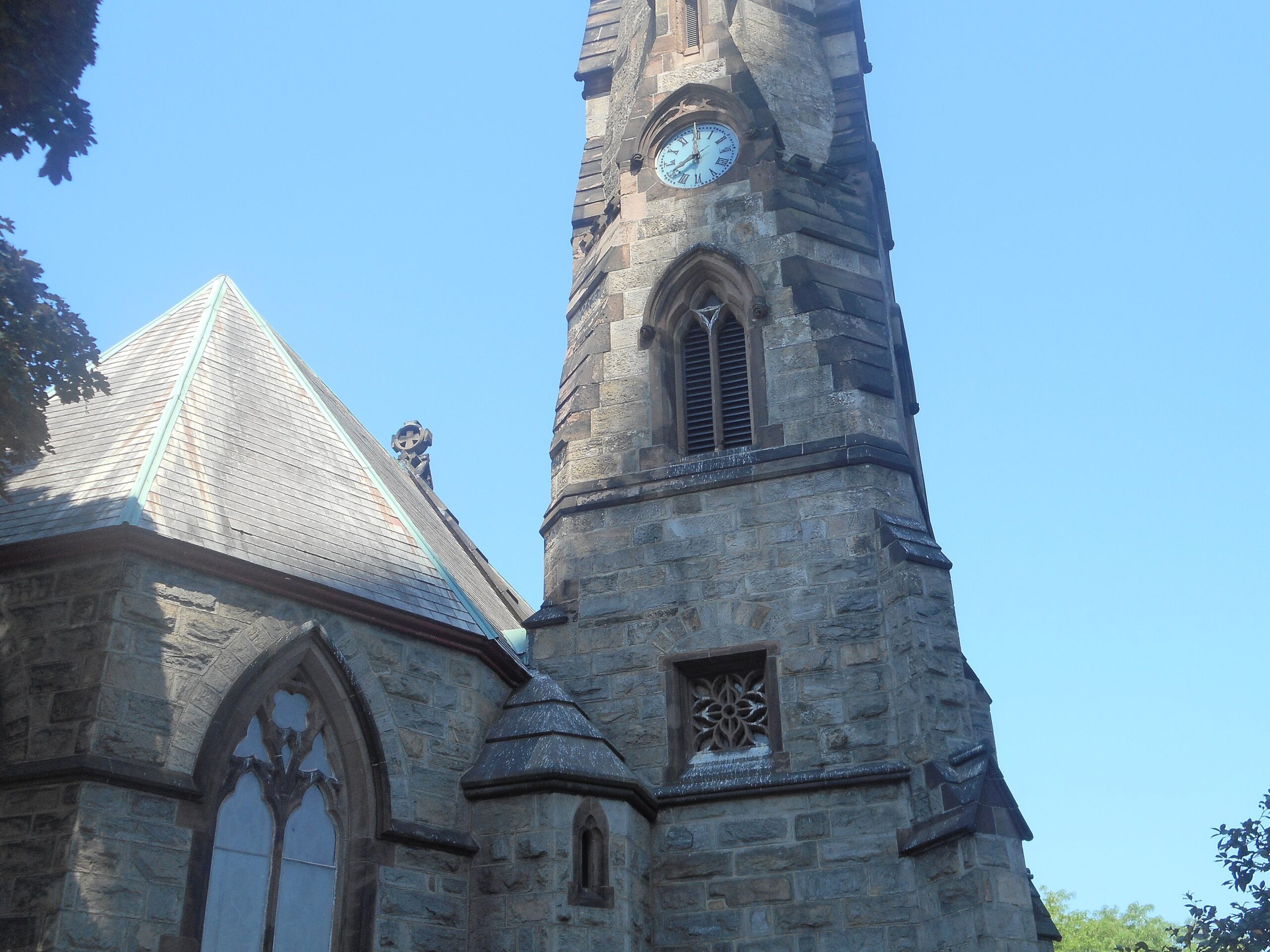
A Gothic Revival church built for a congregation descended from New Rochelle’s founding Huguenots. The present building opened in 1863 and was designed by Richard Upjohn & Son.
At a glance
Trinity-St. Paul’s Episcopal Church stands at the northwest corner of Huguenot Street and Division Street in New Rochelle, New York. The building is the third church erected by this congregation. Its cornerstone was laid on August 13, 1862, and the church opened for worship on September 13, 1863.
History
The congregation represents the majority of New Rochelle’s founding Huguenot French Calvinistic community. In June 1709, this group conformed to the liturgy of the established Church of England. King George III granted Trinity its first charter in 1762. After the American Revolutionary War, the church became a parish of the Protestant Episcopal Church of America.
The present granite and brownstone building replaced a wooden church erected in 1823–1824. The land had been conveyed to the church wardens by Aman Guion in 1743.
What you see
The church was designed by Richard Upjohn & Son, a firm known for Gothic Revival architecture. Work began with the cornerstone laying in 1862. The tower was the last major element finished, completed on November 30, 1864.
A parish house was added on the western side in 1892. Architect Frederick Carles Merry designed it using the same granite and brownstone as the church. Merry also designed the New Rochelle Trust building on Main Street.
Cultural significance
The church was added to the National Register of Historic Places in 2006. Its listing recognizes the building’s connection to the early Huguenot settlers of New Rochelle and the congregation’s long history on this site.
Key facts
- Country: United States
- City: New Rochelle, New York
- Coordinates: 40.90953, -73.78455
- National Register of Historic Places: 2006
Practical information & getting there
The church is located at the northwest corner of Huguenot Street, also known as the Boston Post Road, and Division Street in New Rochelle, Westchester County, New York.
Sources & resources
Find it on the map
See this place and what’s around it →📷 Become a Cultural Heritage Online photographer
Share your photos of places: they stay published under your name as the author. The more they're seen, the more you get noticed — and soon a contest will reward the most appreciated photos.
Log in or sign up free to add a photoIs this page about you?
This page is read by travellers and heritage enthusiasts who find it on Google. Tell us how you are connected to this place and we will take it from there.